

do disposable weed vapes expire is a common search from users who want clear, practical answers. We open with the bottom line: unopened THC cartridges typically hold quality for about 1–2 years, while opened units are best within 6–12 months.
We outline two main failure modes. First, oil chemistry drifting causes terpene loss and lower potency. Second, battery aging reduces output and run time. Both affect taste, vapor, and overall experience.
Our guide focuses on adult readers (21+ in the United States). We will test hands-on signals such as throat hit, vapor production after 5000 puffs, and quick diagnostics that separate empty, clogged, or aged devices.
We also cover authenticity checks (QR and packaging), safe USB‑C charging steps for supported units, and a competitor comparison that estimates Puffs per Dollar and flavor consistency against Geek Bar and Lost Mary.
Key Takeaways
- Unopened units: ~1–2 years of stable quality.
- Opened units: use within ~6–12 months for best effects.
- Main risks: oil oxidation and battery self-discharge.
- We test real signals (vapor, throat hit, flavor after 5000 puffs).
- Check QR codes and packaging to avoid counterfeits that mimic “expired” symptoms.
Nicotine warning and responsible-use safety note
Before any use, confirm product labeling and follow basic safety rules for nicotine-containing devices.
Nicotine warning: Many market products contain nicotine, an addictive chemical. Keep all items away from children and pets. Use only if you are 21+ and legally permitted.
We discuss device aging and storage; this is not medical advice and does not replace manufacturer instructions or local rules. Do not modify sealed units. Overuse and misuse raise risk of harms and unpredictable effects.
- Stop using any device that tastes burnt, overheats, leaks, or acts erratically.
- Adopt conservative pacing: short draws and breaks between puffs to reduce coil stress and harshness late-cycle.
- Treat end-of-life hardware as e-waste because of integrated lithium cells and residual oil.
| Label | Typical meaning | Quick action |
|---|---|---|
| 2% nic salt | Mild-to-moderate nicotine delivery | Follow label; monitor tolerance |
| 5% nic salt | Stronger nicotine delivery | Prefer short draws; avoid heavy sessions |
| No nicotine | Only cannabinoid or flavoured oil | Still follow safety and disposal steps |
We aim to keep users informed so their overall experience is safer and clearer.
What “expiration” means for disposable weed vapes in the present day
In practical terms, “expiration” for modern disposable pens reads as gradual performance loss rather than sudden spoilage. We treat it as a decline in quality that changes the user experience, not as a food‑safety event.

Why an “expired” unit is more like a stale product
Chemistry shifts make the oil taste muted and less potent. Terpenes fade first. Cannabinoids slowly transform, so flavor drops before functional harm appears.
This means the device often still works. The real issues are harsh hits, inconsistent vapor, and wasted money. It rarely becomes toxic like spoiled food.
Two parts that age: oil vs. the integrated battery
We separate the systems. The cannabis oil loses terpene aroma and can thicken. Oxidation lowers potency over time and under poor conditions.
The battery self‑discharges and can lose output even while shelved. Typical symptoms include weak draws, blinking lights, or no vapor at all.
- Practical definition: less consistent vapor, muted flavor, altered effects.
- Storage impact: heat, light, and air speed oil change; long drawer storage drains batteries.
- Common fail signs: harsh taste, weaker hit, or IRREGULAR firing—each needs separate diagnosis.
For more on longevity and testing, see our detailed guide on product shelf life.
Do disposable weed vapes expire and how long do they last?
How long a sealed cartridge stays fresh depends on storage and the oil’s formulation. We answer directly: yes — the useful shelf life is limited by oil chemistry and battery aging even when unopened.
Typical life when unopened
Rule of thumb: an unopened unit usually keeps good quality for about 1–2 years if kept in stable, cool conditions.
Typical life once opened
After first use, finish within 6–12 months for best potency and flavor. Regular airflow and heat speed changes.
Why many carts feel “off” after ~6 months
Early terpene loss and mild oxidation blunt taste and throat feel around six months. After roughly one year, oil can darken and thicken. That shift often reduces perceived potency.
- Darkening: amber → brown is normal; very dark or sludgy suggests past-prime.
- Storage tips: consistent room temperature, minimal light, and upright storage slow decline.
- Next steps: use our diagnostics to tell empty vs expired vs clogged before discarding.
What makes THC oil degrade over time
Small reactions with oxygen and heat drive most long‑term change in THC oil. We summarize the key chemical and environmental drivers so you can store products to keep flavor and potency.
Oxidation and cannabinoid change
Oxygen exposure slowly converts THC into other cannabinoids, often increasing CBN levels. This shift can make effects feel less uplifting and more sedating for some users.
Terpenes fade before cannabinoids
Terpenes are fragile. They evaporate and break down faster than THC. That is why flavor and aroma often flatten while measured potency looks similar.
Heat, light, and repeated heating
Temperatures above roughly 70°F accelerate chemical change. Direct sunlight and hot cars are common failure points.
Every session warms the oil and can pull in small amounts of air. Repeated heating speeds darkening and taste drift over time.
“Keep cool and dark to preserve aroma; limit air exposure to protect potency.”
- Practical: prioritize cool, dark storage for terpene protection.
- Potency focus: reduce heat and oxygen exposure.
- Normal aging: amber→brown can be expected; thick or harsh oil signals past‑prime.
For a deeper look at chemical darkening, see why cannabis oil darkens.
Battery life and device aging that can end a disposable early
Battery aging is a silent limiter: the cell, not the oil, often ends useful life first. We focus on how integrated cells lose charge and how that affects pen performance.
Self-discharge: why an unused unit can die in a drawer
Integrated lithium cells slowly self-discharge even when stored. Months on a shelf can cut available charge and reduce peak output.
Common end-of-life symptoms
- Blinking light or rapid flashing when firing.
- Weak hit despite visible oil.
- Inconsistent firing or no vapor at all.
- Shorter run time per session and fewer reliable puffs.
The usable life of a pen is a race between oil and battery. Sometimes the oil remains but the cell can’t supply heat. Other times the coil or airflow fails first.
Heavy, long draws and back-to-back sessions strain the battery and speed decline. Puffs counts are estimates; coil design and user behavior change real output.
“If a battery flashes rapidly, gets hot, or swells, stop using it and dispose of it safely.”
| Factor | Effect on device | Quick action |
|---|---|---|
| Self-discharge | Lower peak voltage, weak vapor | Check charge indicator; discard if dead |
| Heavy puffing | Faster output drop, heat stress | Use short draws; allow cool-downs |
| Storage (hot/light) | Accelerated aging of cell and oil | Store cool, dark, upright |
Hands-on testing: what “expired” feels like after heavy use
Our stress tests simulate heavy use to show what changes users actually feel as a device ages. We focus on sensory cues and measurable output, not lab claims.
Throat hit progression
Early runs deliver a smooth, clean throat hit. Terpenes and oil balance mask irritation.
With continued use, oxidation and terpene loss make draws feel sharper. The same draw may move from mild to harsh.
Vapor production over time
Output is steady at first. The coil heats oil reliably and airflow stays clear.
When oil thickens or residue builds, vapor volume drops. Reduced wick feed and blocked airflow produce weaker clouds and shorter runs.
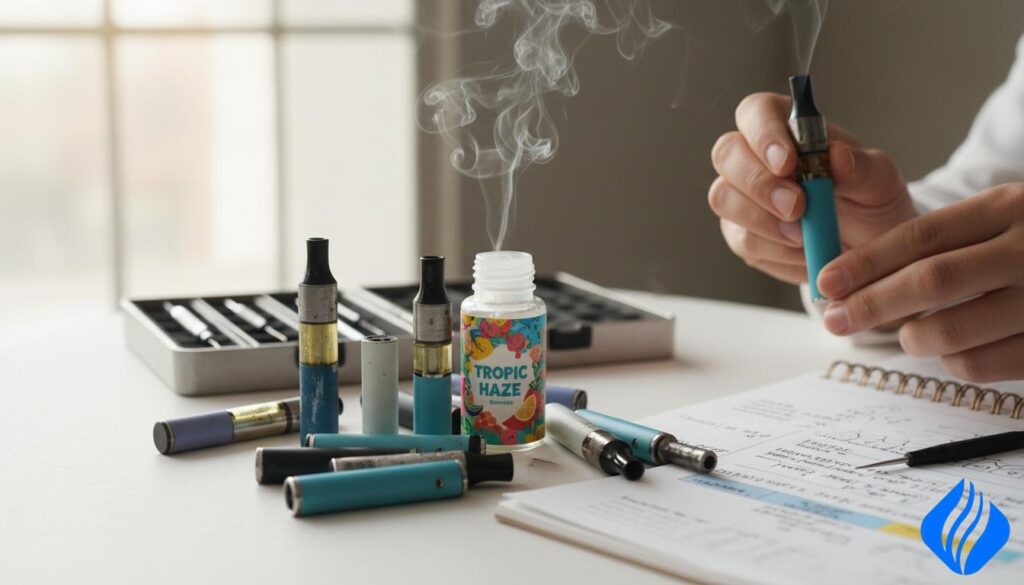
Flavor and consistency after 5000 puffs
We use 5000 puffs as a stress benchmark. Top notes fade first. Base sweetness or cooling agents can persist longer.
Overall flavor consistency declines before potency does. Many users report acceptable effect but poorer taste late in life.
| Finding | Likely cause | Quick action |
|---|---|---|
| Sharp, burnt taste | Oxidized or overheated oil | Stop use; check for clogs or coil heat |
| Weak vapor, low clouds | Thickened oil or restricted airflow | Try short draws; if unchanged, retire unit |
| Flavor fades but potency seems okay | Terpene loss via oxidation | Use sooner after opening; store cool/dark |
Summary: Our hands-on testing shows that harsh taste, lower cloud output, and falling flavor consistency are the most common late-cycle signals. These define the user experience more than binary “works” or “fails.”
How to tell if it’s empty versus expired or clogged
A systematic, step‑by‑step inspection clarifies whether a pen has no vapor or just a blocked pathway. Follow this order to diagnose the problem without opening the unit.
- Power check. Try to power or fire the device. If lights blink or nothing happens, the battery may be dead despite visible oil.
- Airflow test. Cover and uncover the intake holes, then take a gentle draw. Restricted or no airflow suggests a clog or mouthpiece residue rather than an empty cartridge.
- Visual oil check. Inspect oil color. Amber to light brown is normal aging. Very dark, thick, or sludgy oil signals advanced breakdown and lower flavor quality.
Empty indicators: truly empty cartridges often give no vapor with normal airflow. Flavor fades to near‑nothing. You may notice a dry or burnt note when the wick lacks saturation.
Hardware checks you can do safely: wipe the mouthpiece, clear intake holes with a gentle airflow, and look for leakage or crusted residue. Moisture and condensation build from normal use and can block airflow over time.
| Symptom | Most likely cause | Quick action |
|---|---|---|
| No vapor but oil shows | Dead battery or internal contact loss | Check power indicator; retire if unresponsive |
| Weak clouds, muted flavor | Thickened oil or partial clog | Try short, gentle draws; clean mouthpiece area |
| Burnt or dry taste | Wick unsaturated / low oil | Stop use; avoid further heating |
| Very dark or sludgy oil | Advanced oil aging | Consider replacing cartridge |
Remember: visible oil does not guarantee usability. Battery health and airflow matter just as much as oil color and level under storage conditions.
How to store disposable weed vapes to extend shelf life
A clear storage plan helps the oil and the battery last longer between uses. Small changes in where you keep a unit can slow chemical shifts and protect battery output. We recommend practical steps that are easy to follow.
Keep it cool, dark, and dry to slow oxidation and terpene loss
Store units in a cool, dry place to slow oxidation and preserve terpenes. A consistent temperature under 70°F is best.
Use a drawer or cabinet away from windows and heaters. That simple choice reduces light and heat exposure.
Avoid hot cars and direct light to prevent leaks and potency drop
Hot cars are high-risk. Heat thins oil, increases pressure, and can force leaks.
Limit direct light and sunlight exposure. UV plus heat speeds flavor and potency decline.
Store upright to protect the wick and reduce clogging
Upright storage keeps oil over the wick and lowers the chance of mouthpiece clogs. It also limits leakage when a unit sits unused.
Keep devices away from humid bathrooms. Wipe the mouthpiece after use to reduce condensation and moisture buildup.
Actionable checklist:
- Proper storage: cool, dark, dry conditions on a shelf or drawer.
- Avoid cars, direct sunlight, and heat sources like radiators or electronics.
- Store units upright and wipe mouthpieces to manage moisture.
- Minimize air exposure; reseal packaging when possible.
| Goal | What to do | Why it helps |
|---|---|---|
| Slow chemical change | Keep cool and dark | Reduces oxidation and terpene loss; extends shelf life |
| Prevent leaks | Avoid hot cars; store upright | Heat thins oil and raises pressure; upright limits seepage |
| Reduce clogs | Wipe mouthpiece; keep dry | Limits condensation and residue that block airflow |
“Good storage increases the chance you finish the oil before battery or clogging ends the device.”
How to recharge safely when your disposable supports charging
Only units with a manufacturer-stated charging port should ever be connected to power. Confirm the product documentation before you plug anything in.
Best practice: prefer the device’s USB-C port when present. Use a reputable, low-output power source such as a quality wall adapter or a computer USB port. This reduces stress on the integrated battery.
Simple charging routine
- Charge in a cool area and avoid hot cars or direct sun to keep the temperature low.
- Don’t leave it charging for long periods; disconnect once topped off to limit heat.
- Use short, occasional sessions rather than extended continuous charging.
Safety limits and warning signs
Stop charging immediately if the device becomes unusually warm, emits odd smells, flashes abnormally, or behaves erratically. Those are clear risk signals.
“Stable voltage and low heat preserve battery life and help prevent oil darkening over time.”
| Action | Why it matters | Quick tip |
|---|---|---|
| Use low-output charger | Limits stress on the battery | Prefer 5V/1–2A adapters |
| Avoid overcharging | Reduces overheating and oil degradation | Unplug when full |
| Stop if warm/erratic | Prevents damage or failure | Retire and dispose safely |
Authenticity checks before you inhale
Authenticity checks are a fast way to spot products that will fail early or taste harsh. Verify packaging integrity and scan the QR code before use. This step reduces the risk of buying poor-quality units that mimic age-related decline.
Verify packaging and scan the QR code using the official lookup path
Inspect seals, fonts, and warning panels. Then scan the QR code and follow the brand’s verification flow. For a safety check, validate the QR path via this reference: https://www.google.com/url?sa=E&source=gmail&q=sokvape.com.
Where counterfeits fail most often: oil clarity, labeling, and hardware fit
Counterfeits often show sloppy labeling, mismatched warnings, or wrong font sizes. The oil may look unusually cloudy or inconsistent in color.
- Poor mouthpiece fit or loose hardware tolerances.
- Misaligned airflow holes or weak charging-port mounts.
- Inconsistent oil color across identical batches.
Shop safer on Sokvape
Prefer established retailers and verified supply chains. Use category pages to browse trusted inventory: Disposable Vapes and Hot Sale.
“Authenticity checks are part of lifespan assessment—counterfeits can clog, taste harsh, or fail like aged units.”
| Symptom | Likely counterfeit sign | Quick check |
|---|---|---|
| Cloudy or odd oil color | Inconsistent fill or contamination | Compare with a known sample; decline purchase if unsure |
| Misprinted labeling | Wrong warnings or fonts | Reject product; contact seller for verification |
| Loose hardware or gaps | Poor assembly, risk of leaks | Check mouthpiece fit and airflow alignment |
Quick practice: inspect packaging, scan the QR flow, test mouthpiece fit, and buy from trusted places to shop safer. These steps reduce the chance of early failure and help preserve real performance.
Core technical data checklist for choosing longer-lasting disposables
We present a compact buying checklist so readers can compare specs that matter for longer usable life and steady output.
Battery capacity: why higher mAh matters
Battery capacity in mAh affects runtime and voltage stability. Higher mAh usually delivers steadier heat and fewer weak hits late-cycle.
E-liquid or oil volume (ml)
More ml of e-liquid or oil helps session length. But volume is useful only if the battery and heating system match the load.
Nicotine strength note
Labels often show 2% or 5% nic salt. That nicotine strength does not indicate THC or its potency. Treat nicotine labeling as separate information.
Coil type
Mesh coil gives even heating and stable flavor. Dual mesh raises vapor and may stress the battery faster. Match coil type to battery specs.
Charging port
USB-C adds convenience and durability when recharging is supported. It can improve reliability over ad-hoc charging solutions.
“Long-lasting” means balanced battery, adequate oil capacity, efficient coil design, and usable charging — not a single high number.
| Spec | Why it matters | Good benchmark |
|---|---|---|
| Battery (mAh) | Steady voltage, longer runs | 600–1200 mAh for rechargeables |
| Oil / e-liquid (ml) | Session count vs. battery | 2–6 ml depending on design |
| Coil type | Heating evenness and flavor | Mesh coil or Dual mesh per user need |
| Charging | Ease and durability | USB-C port preferred |
Comparison: value and performance against popular competitors
Value is more than sticker price; real-world run time and taste retention matter most.
Puffs per dollar: estimating cost efficiency
We estimate puffs per dollar from claimed puff counts, oil volume, and battery capacity. Then we adjust for real-world factors: draw length, airflow limits, and late-cycle voltage sag.
Flavor consistency and end-of-run behavior
Flavor top notes fade first. Base notes and cooling agents often persist. The coil and airflow design govern how long taste stays stable.
Head-to-head snapshots
- Main product vs. Geek Bar: Geek Bar often keeps steady clouds but can lose flavor clarity late-cycle; battery life and coil tuning matter.
- Main product vs. Lost Mary: Lost Mary’s tighter airflow can boost early flavor but is more prone to condensation and clogs that reduce long-term consistency.
- Main product vs. Raz: Raz shows stronger perceived throat hit late-cycle, a sign of heat concentration or partial clogging rather than higher potency.
| Metric | Main product | Competitor trend | Quick takeaway |
|---|---|---|---|
| Puffs (realistic) | Claimed vs. adjusted | Geek Bar: steady; Lost Mary: front-loaded | Expect fewer usable puffs than marketing |
| Flavor consistency | Moderate | Lost Mary: strong early, drops; Raz: harsher late | Coil and airflow predict retention |
| Battery & life | Depends on capacity | Geek Bar: stable; Raz: voltage sag visible | Higher mAh smooths late-cycle drops |
| Best use | Balanced sessions | Geek Bar: cloud focus; Lost Mary: flavor peak | Match device to your session style |
For side-by-side browsing and price checks visit RandM, Bang, and our Hot Sale page. These resources help validate puffs per dollar against current offers.
Conclusion
Conclusion: We give a concise recap so you can protect shelf life and stay safe. Oil and the integrated battery limit usable months and years of a device. Unopened units usually keep good quality for about 1–2 years. Once opened, expect best results within 6–12 months.
Storage matters. For proper storage keep units cool, dark, dry and upright. Avoid heat and direct light to slow terpene loss and preserve potency. Good storage reduces leaks and clogs.
Quick FAQ: how to tell if it’s empty — no vapor with open airflow, faded flavor, or dry/burnt notes; check the battery and mouthpiece first. Recharge only if the product supports charging; prefer USB‑C and a low‑output source. Verify authenticity by scanning the QR path (https://www.google.com/url?sa=E&source=gmail&q=sokvape.com).
When a cartridge or cart tastes harsh, off, or behaves erratically, prioritize safety and replace it. We recommend conservative choices to protect potency, quality, and user safety.
 English
  German
  Dutch
Dutch  Danish
  Czech
Czech  Italian
  Slovenian
  French
  Hungarian
  Spanish
  Polish