

Yes, in many U.S. workplaces vaping is treated like smoking, and strict rules apply. As of 2026, employers often ban indoor use, require batteries in carry-on travel bags, and warn of fines—Mexico fines may reach $12,500 for prohibited use in some venues. We provide clear, safety-first guidance for commuting professionals and frequent travelers.
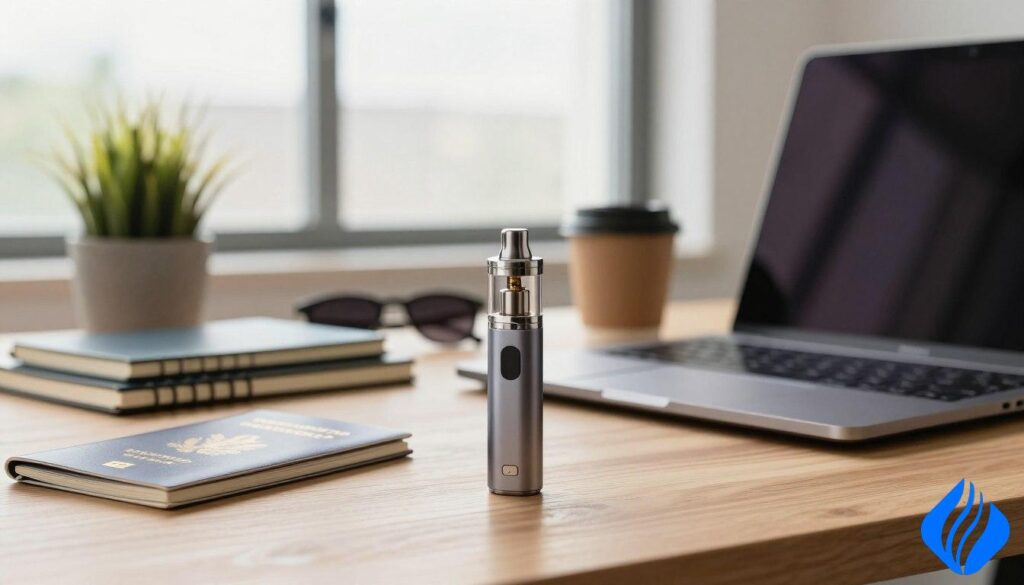
Workplace vaping sparks complaints and productivity concerns. Surveys of large U.S. employers show nearly one in five reported vaping on the job and most non-users felt bothered. Our approach mirrors HR: check federal, state, and local laws, review employer policy, and follow venue rules.
We focus on compliance and safe device handling. Expect advice on break rules, outdoor areas when legal, and travel tips for airports, hotels, and conferences. Reliable disposables are often preferred by travelers for convenience and fewer parts to pack.
For deeper policy guidance and checklists, see our detailed guide on workplace rules and travel safety at vaping at work.
Key Takeaways
- Many employers treat vaping like smoking; indoor bans are common.
- As of 2026, follow state/local laws plus employer and venue rules.
- Safety basics: keep lithium batteries in carry-on and prevent leaks.
- Take designated breaks or use nicotine replacements if needed.
- Travel tip: disposables are convenient and simpler to pack.
- When unsure, check the handbook, posted signage, or ask HR.
What Determines Whether Vaping at Work Is Allowed in the United States
Rules about using e-cigarettes on the job are set by a patchwork of laws and private policies. The hierarchy is simple: federal baselines, state clean indoor air laws, local ordinances, then an employer’s policy and the building or lease rules.
Regulation is piecemeal. Less than half of states explicitly ban e-cigarette use in indoor workplaces. Many employers still lack written vaping policies—48.4% reported having one; 30.2% did not; 21.4% didn’t know.
Why smoke-free often includes e-cigarettes
Employers and property managers favor clear rules. Saying “smoke-free” is easier to enforce than listing every device type. Claims of nicotine-free liquid rarely change enforcement. Policies commonly restrict the action and the device, not just contents.
Where rules become stricter
Certain industries and building policies exceed legal minimums. Health services, education, government, and warehousing often ban all e-cigarettes and tobacco products on premises and surrounding places.
“If any layer says ‘no,’ treat it as no—discipline can follow even without a municipal ticket.”
For a concise review of workplace guidance and research, see vaping in the workplace. We’ll expand on state and local examples in the next section and cover travel venues with stricter enforcement.
Can you vape at work under state and local laws?
Legal answers hinge on geography: your physical job site’s laws matter most. As of 2026, a compliance-first approach serves employees best. Check state, city/county, and your workplace policy before using any device.
States that ban indoor use
Public health guidance lists these states with explicit indoor workplace bans: California, Colorado, Delaware, Florida, Hawaii, Maine, New Jersey, New York, North Dakota, Oregon, Rhode Island, Utah, Vermont. Washington, D.C., and Puerto Rico also prohibit indoor use.
When the law is unclear
Many states do not spell out rules. That does not mean use is permitted. Employers often set stricter restrictions. Local city or county ordinances may still ban indoor aerosol in workplaces.
Spotting local rules and staying compliant
- Look for posted signage and city health pages.
- For hybrid or client sites, follow the host workplace and local laws.
- If unsure, follow the handbook → check signs → ask HR/facilities.
Quick safety tip: When legality is unclear, use designated outdoor areas and respect door-distance rules until confirmed otherwise.
Common Workplace Areas Where Vaping Is Usually Prohibited
Many common office zones are treated as no-use areas to protect indoor air and coworker comfort. We outline the spots that draw the most complaints and the greatest enforcement risk.
Indoor offices, conference rooms, and shared workspaces
Enclosed offices and meeting rooms are almost always off-limits. Shared spaces expose colleagues to aerosol and complaints rise quickly.
Bathrooms, stairwells, and stealth hotspots
These spots often tempt stealth use. Studies show 57.7% of respondents saw coworkers using devices indoors. Poor ventilation and detectors make them high-risk.
Company vehicles, warehouses, and job sites
Fleets are treated like enclosed workplaces. Warehouses may ban devices for safety and flammability reasons. Client sites usually follow stricter rules.
Entrances and buffer-zone rules
Many properties ban use near doors, loading docks, or HVAC intakes. Some policies set outdoor buffers—commonly 20 feet—from entrances.
“If any layer says ‘no,’ treat it as no—discipline can follow even without a municipal ticket.”
| Place | Why it’s restricted | Typical policy |
|---|---|---|
| Offices/Conference rooms | Indoor air exposure; complaints | Zero use indoors |
| Bathrooms/Stairwells | Poor ventilation; detectors | Prohibited; monitored |
| Company vehicles | Customer image; next-driver exposure | Zero tolerance |
| Entrances/Perimeter | Air intake and doorway exposure | Buffers often 20 ft |
Practical tips: Plan breaks, keep devices stowed indoors, and avoid uniformed or customer-facing areas. We will cover detectors later and explain how to spot them.
Workplace Vaping Policies: What Employers Typically Put in Writing
A strong policy names products, sets locations, and spells out consequences. That clarity reduces disputes and helps managers apply rules evenly.
What to define. Policies should list prohibited products: e-cigarettes, disposables, pods, mods, and nicotine-free devices. A clear list removes loopholes.
Design models
Most companies pick one of two models. One allows designated outdoor vaping areas with signage and distance buffers.
The other is 100% vape-free across indoor spaces, parking lots, and company vehicles. Employers choose based on safety, image, and local law.
Writing for real life
- Specify exact locations where use is allowed or banned.
- Require signage, break alignment, and off-site meeting rules.
- Apply the policy to visitors, contractors, and temps.
Communicate and document
Include handbook language, manager talking points, posted signs, and a written acknowledgment form. Only 48.4% of employees reported a formal written policy—make yours count.
What employees should look for: handbook, intranet, onboarding packet, or HR point of contact. Pair rules with practical options like break guidance and cessation support to stay fair and humane.
Health, Indoor Air, and Productivity: Why So Many Workplaces Go Vape-Free
Shared air matters. Indoor aerosol changes air quality and raises clear health concerns for adults and other occupants. Employers weigh those changes against comfort, safety, and business image.
Indoor air quality and secondhand aerosol exposure
Research shows aerosols from e-cigarette devices can raise particle levels indoors and introduce aldehydes and metals into air. That evidence—summarized in an indoor air research review—drives precautionary policies.
What U.S. data reveals about office impact
Surveys report 61.6% of employees observed workplace vaping, and 63.2% felt bothered. Over half said it lowered productivity for non-users.
Trigger effects and cessation concerns
Nearly half of tobacco users reported that seeing others use devices sparked urges to smoke or resume use. That relapse risk matters for employers offering quit support.
Why many support e-cigarette-free policies
Support is strong: 73.5% of non-users and 53.5% of device users favor restrictions. Reasons include fewer conflicts, clearer rules, and a more professional environment.
“Visible clouds, lingering scents, and device use during meetings can undermine trust with coworkers and clients.”
| Issue | Workplace impact | Employer response |
|---|---|---|
| Indoor particle increase | Air quality downgraded | Indoor bans or buffers |
| Secondhand exposure | Health concerns for adults and sensitive staff | Policy + quit support |
| Trigger for smokers | Relapse and reduced productivity | Designated breaks; cessation help |
Balanced view: Harm reduction for smokers matters, yet indoor use still poses health risks and practical problems. Practical solutions include clear break rules, designated outdoor areas where lawful, and visible support for quitting. For product options and travel-friendly choices, see our premium e-cigarette selection.
Consequences at Work: Discipline, Termination, and Documentation
Disciplinary outcomes depend on clear rules and fair process. When a policy or local law forbids vaping in the workplace, an employer may discipline or terminate an employee for on-site violations. We urge managers to balance firmness with advance notice.
When an employer may terminate
An employer may fire an employee for violating posted rules, handbook language, or state and local law. Repeated breaches, use in safety-sensitive areas, or incidents that harm clients often lead to immediate action.
Progressive discipline and consistent enforcement
Best practice follows clear steps: verbal warning, written warning, final warning, then termination. Employers sometimes skip steps for safety or reputational incidents.
Documentation basics for managers and HR
Document every incident. Include date, location, witness statements, policy citation, and any signage. Keep the file factual and time-stamped.
Customer-facing roles and reputational risk
Visible use near clients or entrances poses brand risk. Many companies treat such events as higher severity even if the act occurred outdoors but in uniform.
“Consistent, documented enforcement reduces complaints and protects both staff and employer.”
| Situation | Typical response | Documentation needed |
|---|---|---|
| First minor breach | Verbal warning; note in file | Incident note, witness |
| Repeated breaches | Written warning; corrective plan | Signed warning, policy excerpt |
| Safety/customer incident | Immediate suspension or termination | Detailed report, witness statements |
| Disputed supervisor okays use | Confirm in writing or follow policy | Email confirmation or manager note |
Employee self-protection tip: Request written policy and clarify designated areas before relying on verbal permission.
As of 2026: Vaping on Business Travel and Work Trips (Airports, Planes, and Hotels)
Travel hubs enforce battery and use limits more tightly than many local laws. We focus on safe packing, airport rules, and hotel realities so travelers face fewer surprises.
TSA/FAA packing and battery safety
Non-negotiable rule: lithium batteries MUST be in carry-on luggage. Checked bags are forbidden for spare cells because of fire risk.
Power devices off. Protect buttons and store spare cells in a battery case, not loose in pockets.
Leak prevention and packing tips
Store pods and tanks upright. Use sealed bags for liquids. Expect pressure changes during ascent and pack accordingly.
Layovers, airports, and hotels
Follow terminal signage and use only designated smoking areas. Many hotels treat indoor use like smoking and charge cleaning fees for violations.
“Pack smart, use legal breaks, and choose simpler products for fewer packing hazards.”
| Option | Packing effort | Key benefit |
|---|---|---|
| Mod + spare batteries | High | Customizable; greater risk |
| Pods/tanks | Medium | Refillable; watch leaks |
| Disposable devices | Low | Fewer parts; travel friendly |
Quick do’s and don’ts:
- Do: pack batteries in carry-on and follow airport rules—see FAA/TSA guidance on flying with devices.
- Don’t: stow batteries in checked luggage or use indoor hotel rooms where banned.
- Do: choose reliable disposables for fewer parts; learn more packing information on travel rules.
As of 2026: Disney, Conferences, and Other Venue-Specific Workplace Scenarios
As of 2026, theme parks and large event centers prioritize guest comfort over individual device use. Organizers often set rules that exceed local law. Badges, security, and codes of conduct enforce those restrictions quickly.
Theme parks and large venues
Many parks restrict vaping to marked zones or ban it in guest areas. Follow park maps and posted signs. Stealth use in restrooms risks removal and fines.
Convention centers and corporate events
Assume no vaping indoors. Session rooms, expo halls, and networking areas are covered. Event staff and badge scanners will enforce rules to avoid complaints.
Employer and attendee guidance
We advise companies to remind staff of venue policies before travel. Clear emails and break guidance reduce incidents. Visible use near entrances harms professional image.
“Organizers favor broad rules to protect most attendees and avoid disruption.”
| Venue type | Do | Don’t |
|---|---|---|
| Theme park | Use designated zones; follow maps | Use devices in ride queues or indoor plazas |
| Conference | Step outside to designated areas | Use devices in session rooms or expo halls |
| Company event | Follow host policies; brief employees | Assume leniency without written permission |
| Large public place | Store devices securely; expect checks | Attempt stealth use in bathrooms |
- Venue compliance checklist: check venue rules, pack devices safely, brief employees, locate designated areas, and follow signage.
As of 2026: Cruises, Mexico Trips, and High-Risk Restricted Areas
International travel and shipboard stays raise firm legal and safety flags. Ship lines and ports set rules that often go beyond local laws. That means higher penalties and active enforcement.
Cruise and port rules
Cruise operators usually limit use to marked smoking zones. Using products in cabins or on balconies can trigger fees or disciplinary steps.
Ports may add another legal layer. Expect varied enforcement by country and by terminal.
Mexico travel warning
Strong warning: fines, confiscation, and enforcement variability are real risks in Mexico. Authorities may seize items or issue steep fines for violations.
High-risk public buildings
Hospitals, schools, government sites, and correctional facilities maintain strict bans. Enforcement is typically firm and immediate.
Traveler’s checklist
- Do: store batteries in carry-on and follow host laws.
- Do: brief staff on venue rules before travel.
- Don’t: assume permissive local practice; avoid use when in doubt.
- Don’t: leave devices in checked luggage or cabins if banned.
“When in doubt, don’t use — penalties abroad can outweigh a few puffs.”
How Vape Detectors Work and How to Spot Them in Workplaces and Hotels
Modern sensor systems quietly flag indoor aerosol and trigger alarms long before a human report. These devices sample air for particles and chemical signatures linked to vaping. When levels rise, staff receive alerts or logs for follow-up.
Common locations
Facilities place sensors where stealth use is most likely: bathrooms, hallways, stairwells, patient areas, and near smoke alarms. Hotels often add monitors in corridors and next to room entryways.
What signage and tamper warnings look like
Watch for notices reading “air quality monitoring,” “vape detection,” or small ceiling panels marked with tamper warnings. These signs warn that an incident will be logged and reported.
Why stealth use still triggers complaints and consequences
Visible vapor and lingering odor prompt coworkers or guests to report incidents. A single complaint can create formal documentation that follows an employee or guest.
Tip: If a space is uncertain, assume monitoring is active and step to a designated outdoor area where legal and permitted.
| Place | Why monitored | Likely outcome |
|---|---|---|
| Bathroom | Poor ventilation; frequent stealth use | Alert logged; fine or cleaning fee possible |
| Hallway / Stairwell | Transit area; complaints rise quickly | Staff follow-up; disciplinary note |
| Patient-care area | Health risk and strict policy | Immediate removal; termination risk in health settings |
Support and Alternatives: Break Policies, Cessation Help, and Reasonable Workplace Options
A balanced approach pairs limits with help so employees keep their jobs and health. We favor policies that reduce triggers while offering real support for adults trying to stop nicotine use.
How vape-free rules help quitting attempts. Removing visible use cuts urges; nearly half of smokers report relapse when they see others. Clear limits make routines less dependent on nicotine breaks and give users space to plan quitting.
What employees can reasonably request
Ask for written break guidance, defined outdoor areas when legal, and a timeline for any changes. Reasonable workplace options include scheduled breaks and signage that protects non-users.
Workplace quit support and digital programs
Employers should pair restrictions with cessation support. Offer referrals, nicotine replacement, and digital programs like the EX Program (Truth Initiative + Mayo Clinic). Most adults using e-cigarettes plan to quit; employer support closes a large gap—84.8% want help, but only 31% of workplaces offer programs.
“Pair limits with practical help — it protects employees and lowers turnover.”
For travel-heavy staff, plan breaks, use approved nicotine replacements, and avoid risky venue use. Our stance is compliance-first and empathetic: we provide options, not shame.
Conclusion
The bottom line is simple: laws, policies, and venue rules set the limits—plan accordingly. As of 2026, workplace vaping remains common, but many adults report being bothered and productivity can fall.
Key facts: about 19.1% self-report use on the job, 61.6% observe colleagues, 63.2% feel bothered, and 52.1% link use to lower productivity. Those trends help explain why many employers favor clear vaping policies and smoking-style bans.
Practical next steps: check the handbook, confirm state and local laws, follow building signage, and default to designated outdoor areas only when allowed. For travel, keep lithium batteries in carry-on, pack to prevent leaks, and obey airport and hotel rules.
Don’t stealth use. Detectors, complaints, and documentation carry real consequences. We recommend clear break plans, cessation support, and traveler-friendly disposable products for simpler packing—compliance first, convenience second.
 English
  German
  Dutch
Dutch  Danish
  Czech
Czech  Italian
  Slovenian
  French
  Hungarian
  Spanish
  Polish