

Do vapes have calories? This is the burning question for every health-conscious vaper on Keto or intermittent fasting. While e-liquids technically contain energy, the metabolic reality of inhaling them is vastly different from eating them. Here is the definitive, science-backed breakdown of how vaping actually impacts your diet goals.
Introduction: The Intersection of Inhalation Toxicology and Nutritional Biochemistry
The rapid proliferation of Electronic Nicotine Delivery Systems (ENDS), commonly known as vapes, has introduced a novel vector for chemical exposure that intersects with human metabolism in ways previously unexamined in nutritional science. As the user base shifts towards health-conscious demographics—including those adhering to ketogenic diets, intermittent fasting protocols, and caloric restriction—A critical physiological question arises: Do vapes have calories? And if so, does the inhalation of aerosolized carriers and sweeteners elicit a metabolic response comparable to ingestion?
This inquiry is not merely a trivial curiosity for the obsessive dieter but a complex intersection of inhalation toxicology, nutritional biochemistry, and neuroendocrinology. Historically, scientists calculate caloric intake using the Atwater system, which presumes ingestion, digestion, and absorption through the gastrointestinal (GI) tract. However, the mechanism of vaping introduces nutrients—specifically carbohydrates and sugar alcohols—directly into the respiratory system and systemic circulation, effectively bypassing the portal vein first-pass metabolism associated with oral consumption. This unique route of administration necessitates a re-evaluation of how the body processes energy derived from non-traditional sources.
Health-conscious populations, particularly those in the United States, United Kingdom, and Europe, increasingly utilize vaping as a smoking cessation tool while simultaneously engaging in rigorous dietary protocols. The anxiety regarding “hidden calories” in e-liquids is not unfounded, given that the primary ingredients, Propylene Glycol (PG) and Vegetable Glycerin (VG), are chemically classified as sugar alcohols and are known substrates for gluconeogenesis and glycolysis. To provide a nuanced answer, one must look beyond the simple combustion energy of the molecules and consider the bioavailability of inhaled aerosols, the enzymatic capacity of pulmonary tissue, and the systemic signaling cascades triggered by sweet taste receptors located extra-orally.
This analysis synthesizes data on aerosol dosimetry, pulmonary retention, enzymatic pathways, and cephalic phase insulin responses (CPIR) to definitively quantify the energetic contribution of vaping. It posits that while the caloric load of vaping is mathematically non-zero, its physiological impact is governed more by hormonal signaling and metabolic substrates than by thermodynamic energy contribution. This report explores the hypothesis that while the caloric density is negligible for weight gain, the metabolic “signal” provided by glycerol and sweeteners may be sufficient to modulate insulin sensitivity and autophagy, thereby interacting with specific dietary goals such as ketosis and intermittent fasting.
Caloric Density of E-Liquid: Do Vapes Have Calories at the Molecular Level?
To understand the caloric potential of vaping, it is essential to first analyze the energetic properties of its base components. A carrier solvent mixture of PG and VG predominantly forms the base of most e-liquids. typically in ratios ranging from 50/50 to 30/70. These substances serve as the vehicle for nicotine and flavorings, creating the visible aerosol upon heating.
Vegetable Glycerin (Glycerol)
Vegetable Glycerin, or glycerol (1,2,3-propanetriol), is a sugar alcohol derived from the hydrolysis of triglycerides. In nutrition labeling, regulators classify glycerol as a carbohydrate, yet it behaves metabolically as a lipid backbone and a gluconeogenic precursor. It is a triol, possessing three hydrophilic hydroxyl groups, which are responsible for its hygroscopic nature and its solubility in water. This hygroscopicity is crucial for aerosol generation but also results in the dehydration of airway mucosal surfaces upon inhalation.
From a caloric perspective, glycerol is energetically dense. Nutritional data indicates it provides approximately 4.32 calories per gram (kcal/g), which is slightly higher than the standard 4 kcal/g attributed to carbohydrates and sugar. While European regulations often standardize this to 2.4 kcal/g for labeling purposes due to incomplete absorption in the gut during normal digestion, the physiological energy yield upon systemic infusion—which inhalation mimics—is closer to the 4.32 kcal/g figure. This discrepancy arises because ingested glycerol is not fully absorbed, whereas inhaled or intravenously administered glycerol enters the systemic circulation with high efficiency, available for immediate metabolic oxidation.
Propylene Glycol (1,2-Propanediol)
Propylene Glycol is a diol used extensively as a food additive and solvent. Unlike glycerol, which is a direct lipid metabolite, PG is a synthetic liquid that is metabolized into substrates that enter the energy cycle. It is chemically classified as a carbohydrate for nutritional labeling purposes and carries a caloric value of approximately 4 kcal/g.
While PG provides energy, it is not a “sugar” in the traditional sense. It interacts with glucose metabolism pathways via conversion to pyruvate and lactate. This distinction is vital for understanding its impact on blood glucose levels; while it provides carbon atoms for the energy cycle, it does not spike blood glucose in the same direct manner as sucrose or glucose. Its metabolism occurs primarily in the liver, where it is oxidized to lactaldehyde and then to lactate, feeding into the Cori cycle.
Calculating Vape Juice Calories: Theoretical vs. Physiological Energy
If one were to consume e-liquid orally—a hazardous action due to nicotine toxicity—the caloric contribution would be directly calculable based on the mass and caloric density of its components. For a standard 10ml bottle of e-liquid, the density varies by mix but averages around 1.15 g/ml (VG is ~1.26 g/ml, PG is ~1.04 g/ml). This means a 10ml bottle contains approximately 11.5 grams of liquid. With an average caloric density of roughly 4 kcal/g, the total energy content of the bottle is approximately 46 kcal.

Therefore, a moderate vaper consuming 2–5 ml of liquid per day is technically volatilizing 8–23 kcal of potential energy per day. However, the critical scientific inquiry is not what is in the bottle, but what is retained by the body. The assumption that inhaled calories are equivalent to ingested calories is physiologically flawed, as the route of administration drastically alters the metabolic fate and efficiency of energy acquisition.
| Component | Chemical Class | Caloric Density (kcal/g) | Metabolic Pathway |
| Vegetable Glycerin (VG) | Sugar Alcohol / Lipid Backbone | 4.32 | Glycerol-3-Phosphate ->Gluconeogenesis (Liver) |
| Propylene Glycol (PG) | Diol / Carbohydrate | ~4.00 | Lactaldehyde -> Lactate -> Cori Cycle |
| Sucralose | Non-Nutritive Sweetener | 0 (Human) | Excreted / Potential Insulin Modulation (T1R3) |
| Nicotine | Alkaloid | Negligible | Stimulant / Thermogenic (Increases BMR) |
Aerosol Dosimetry: Inhalation, Deposition, and Retention
To accurately assess the caloric impact of vaping, one must analyze the dynamics of aerosol deposition within the human respiratory tract. E-cigarette aerosols are dynamic; they undergo evaporation, condensation, and hygroscopic growth within the high-humidity environment of the respiratory tract. The efficiency of energy acquisition depends heavily on the deposition fraction of the aerosol in the respiratory tract and the subsequent absorption into the bloodstream.
Particle Size and Deposition Dynamics
The Mass Median Aerodynamic Diameter (MMAD) of e-cigarette aerosols typically falls between 0.6 and 1.2 micrometers (µm). This particle size distribution is critical for determining where the aerosol deposits. Larger droplets and those subject to hygroscopic growth typically settle in the head and oral cavity. Studies suggest a significant fraction—up to 50% for certain formulations—can deposit in the oropharyngeal region.
Particles in the 1 µm range deposit in the tracheobronchial (TB) region via sedimentation and impaction. Smaller particles (<0.5 µm) penetrate to the deep lung (alveolar region), where gas exchange occurs. Research estimates that 7% to 30% of particles deposit in the alveolar region. This deep lung deposition allows for rapid systemic absorption, bypassing the liver’s first-pass metabolism.
Caloric Retention Rates: Do You Exhale or Absorb Vaping Calories?
Unlike cigarette smoke, which contains solid particulates, e-cigarette aerosol features volatile liquids. The mucosal lining rapidly absorbs these liquids, ensuring high systemic retention. Research measuring exhaled air versus inhaled vapor indicates that The body retains inhaled PG and VG at a remarkably high rate. Studies show that the body retains 89% of VG and 92% of PG systemically.
This finding invalidates the common lay belief that “you breathe the calories out.” The human body absorbs the vast majority of the inhaled e-liquid mass. If you vape 5 ml (approx. 5.75 g) of liquid, your mucosal tissue and bloodstream take in roughly 5.2 grams of PG/VG. This high retention rate confirms that the theoretical caloric load calculated from the bottle is nearly identical to the absorbed load, minus a small fraction lost to exhalation.
The “Swallowed” Fraction: A Hidden Route of Ingestion
A critical, often overlooked vector for caloric absorption is the unintentional ingestion of aerosol condensation. Aerosol impacting the oral cavity (tongue, cheeks, pharynx) coalesces back into liquid form. This condensate mixes with saliva; the user then swallows it, sending the liquid into the gastrointestinal tract for standard digestion.
Estimates suggest that up to 50% of the nicotine deposition occurs in the mouth and pharynx. If we apply this to carrier solvents, it implies that users actually ingest half of the vaped liquid orally instead of absorbing it through the lungs. This distinction is vital because ingested PG/VG stimulates gastric cephalic responses and enters the portal vein, directly influencing liver metabolism, whereas inhaled PG/VG enters systemic circulation, bypassing the liver initially.
Summary of Dosimetry
Using available data, we can construct a typical daily consumption scenario. For a user vaping 5 ml of e-liquid per day:
- Total Mass: ~6 grams.
- Absorbed Mass: ~5.4 grams (assuming 90% retention).
- Route of Entry: Approximately 2.7g swallowed (GI tract) and 2.7g absorbed (Lungs).
- Total Energy Load: ~22 kcal/day.
While 22 kcal is negligible in the context of a 2000 kcal diet (representing roughly 1% of daily intake), it is chemically present. The metabolic handling of these calories, however, is where the complexity lies, particularly for individuals with specific metabolic concerns such as diabetes or those on ketogenic diets.
| Respiratory Region | Deposition Fraction (%) | Fate of Deposited Mass |
| Head / Oropharyngeal | 35% – 50% | Ingestion (Swallowed with saliva -> GI Tract) |
| Tracheobronchial | 30% – 40% | Absorption (Mucociliary escalator / Systemic uptake) |
| Alveolar (Deep Lung) | 10% – 25% | Rapid Absorption (Direct to systemic circulation) |
| Exhaled | 10% – 15% | Lost to environment |
Metabolic Fate of Propylene Glycol
Once Propylene Glycol enters the bloodstream—whether through the alveolar capillary bed or intestinal absorption—it undergoes metabolic conversion. It is not an inert substance but a biologically active molecule that feeds into central energy pathways.
The Lactate Pathway
The liver primarily metabolizes propylene glycol, and to a lesser extent in the kidney, by the enzyme alcohol dehydrogenase (ADH). The metabolic pathway oxidizes PG to lactaldehyde, which further transforms into lactate (lactic acid) or pyruvate.
This process produces lactate, which fuels the Cori cycle. In this pathway, the liver receives lactate (created by anaerobic glycolysis in the muscles) and converts it into glucose. The liver then sends this glucose back to the muscles, where the body metabolizes it back into lactate. This means that PG is chemically glucogenic; it provides carbon substrates that the liver can utilize to synthesize glucose.
Impact on Blood Parameters
Clinical trials involving PG inhalation and infusion demonstrate measurable physiological changes. Infusion or high-dose exposure to PG can elevate serum lactate levels. This elevation mimics the metabolic byproducts of anaerobic exercise. In extreme cases, which are rare in vaping but common in industrial accidents or high-dose pharmaceutical administration, this can lead to lactic acidosis.
In sheep studies, PG administration resulted in increased plasma lactate concentrations, peaking within 40 minutes. However, unlike glycerol, PG infusion did not acutely spike blood glucose levels in the same magnitude, suggesting a slower or more regulated conversion to glucose via lactate intermediates. This indicates that while PG provides energy, the body’s metabolic pathways limit the rate of glucose conversion, preventing the immediate glycemic excursions seen with direct sugar ingestion.
Implications for Vapers
For a vaper, the continuous low-level inhalation of PG results in a steady trickle of lactate into the bloodstream. This is unlikely to cause acidosis in healthy individuals but represents a non-glucose source of carbohydrate energy. For those on strict ketogenic diets, the introduction of exogenous lactate and pyruvate theoretically competes with ketone bodies for oxidation. However, this small daily intake rarely reaches the threshold necessary to halt ketogenesis completely. The body will utilize the lactate for energy or gluconeogenesis, but the total caloric contribution remains minimal.
Metabolic Fate of Vegetable Glycerin (Glycerol)
Glycerol acts as a more direct metabolic substrate than PG. As the backbone of triglycerides, it plays a central role in energy homeostasis, particularly during fasting states when the body relies on lipolysis for energy.
Gluconeogenesis and Glycolysis
Upon absorption, The enzyme glycerol kinase phosphorylates glycerol to form glycerol-3-phosphate. This intermediate is a metabolic pivot point. The body converts it into dihydroxyacetone phosphate (DHAP) and oxidizes it through glycolysis to produce ATP immediately. Alternatively, in the liver, particularly during fasting states, glycerol-3-phosphate is a primary substrate for synthesizing new glucose via gluconeogenesis.
Inhalation vs. Ingestion: The Route Matters
Research indicates disparate metabolic fates based on the route of administration. Oral glycerol rapidly enters the portal vein, reaching the liver where glycerol kinase activity is high. Studies show oral glycerol efficiently converts to glucose, raising blood sugar levels.
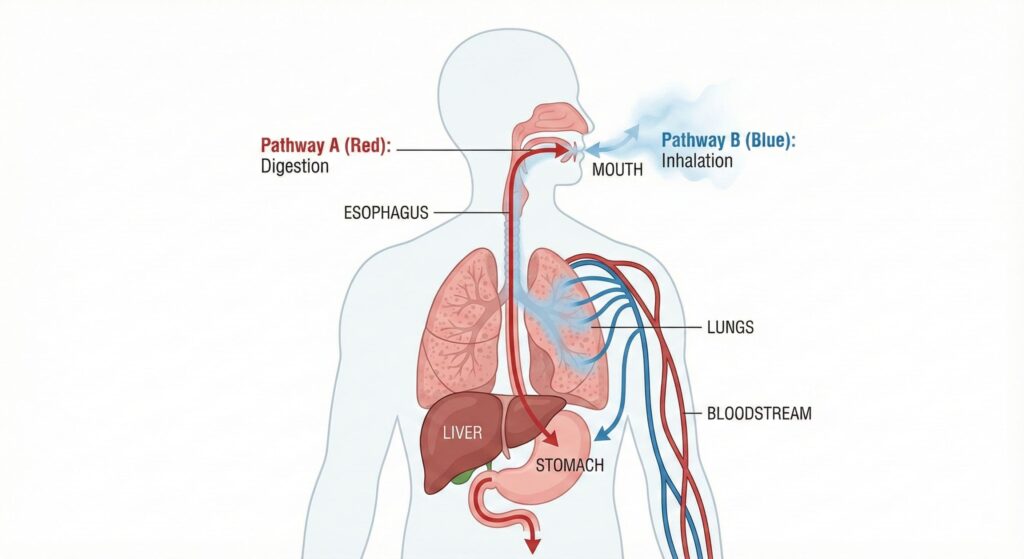
In contrast, inhaled glycerol enters the systemic circulation directly. While it eventually reaches the liver, it also perfuses peripheral tissues. Interestingly, studies on intravenous glycerol (mimicking systemic absorption) showed a higher conversion to lactate compared to oral administration. This suggests that non-hepatic tissues (like muscle or lung) may metabolize glycerol into lactate when it bypasses the liver’s first pass. This peripheral metabolism may blunt the immediate glycemic impact compared to ingestion.
Glycemic Impact
Does vaping glycerol spike blood sugar? Animal models provide some insight. Exposure of mice to glycerol aerosols resulted in increased circulating glycerol levels. In female mice, this exposure led to increased hepatic triglycerides, indicating that the inhaled glycerol was actively metabolized and stored as fat. Crucially, acute exposure did not significantly spike blood glucose in fasted mice, though it mildly altered glucose tolerance over chronic exposure.
Human data on intravenous glycerol shows that while it is anti-ketogenic, distribution volume and peripheral metabolism blunt its ability to spike glucose compared to oral administration. Therefore, inhaled VG provides a substrate for glucose production. While the “spike” may be dampened compared to eating sugar, the continuous influx of glycerol during heavy vaping provides a steady supply of gluconeogenic precursors. For a diabetic or a strict keto dieter, this is a source of “hidden” glucose precursors, although the total mass (2-5g/day) is roughly equivalent to a fraction of a teaspoon of sugar spread over 16 hours.
The Insulin Question: Cephalic Phase and Sweet Taste Receptors
Perhaps the most contentious issue for health-conscious vapers is not the caloric content itself, but the hormonal response to the sensation of sweetness. The “Cephalic Phase Insulin Release” (CPIR) and the activation of extra-oral taste receptors represent a potential mechanism by which vaping could impact metabolism independent of calories.
Cephalic Phase Insulin Release (CPIR)
CPIR is a reflex where the brain instructs the pancreas to release insulin in anticipation of glucose, triggered by the taste, smell, or sight of food. The mechanism involves sweet taste receptors (T1R2/T1R3) in the mouth signaling the vagus nerve, which stimulates beta cells in the pancreas.
Most e-liquids are intensely sweetened, often with sucralose (Splenda) or ethyl maltol, in addition to the natural sweetness of VG. The data on non-nutritive sweeteners (NNS) triggering CPIR is mixed. Some studies show that swishing sweet solutions without swallowing can trigger a small insulin spike. Others suggest that without the presence of actual glucose in the gut, the CPIR is transient and minimal.
However, smelling sweet odors alone has been shown to induce a transient insulin response in animals and humans. Since vaping involves intense olfactory stimulation (retro-nasal olfaction), it is biologically plausible that highly sweet vape flavors trigger a low-grade CPIR. This anticipatory insulin release could theoretically lower blood glucose slightly, leading to increased hunger or cravings.
Pulmonary and Systemic Taste Receptors
Sweet taste receptors exist far beyond the tongue; the gut, pancreas, brain, and lungs all express these sensors. Specifically, the pulmonary endothelium and airway smooth muscle house the sweet taste receptor subunit T1R3. Research demonstrates that sucralose activation of these receptors regulates endothelial barrier function. This proves that inhaled sweeteners are biologically active ligands in the lungs, not just inert flavoring agents.
While pulmonary receptors primarily regulate airway mechanics and immunity , the systemic absorption of sucralose from e-liquids is a concern. Sucralose was once thought to be unabsorbed, but evidence suggests it can affect glucose metabolism. Studies indicate that sucralose consumption can decrease insulin sensitivity and enhance the insulin response to glucose loads in obese individuals. If the bloodstream absorbs inhaled sucralose—a likely outcome due to high alveolar membrane permeability—the substance could theoretically trigger pancreatic beta cells or intestinal receptors, potentiating insulin release.
The “Uncoupling” Hypothesis
Vaping presents a unique physiological state: intense sweet signaling (via taste and smell) coupled with negligible caloric delivery. This mismatch may disrupt the predictive coding of metabolism. The body prepares for a sugar load (insulin release, gastric motility) that never arrives. Over time, this “uncoupling” has been hypothesized to lead to glucose intolerance or increased cravings, as the body seeks to reconcile the sensory signal with actual energy intake. While this hypothesis is still being explored, it suggests that the sensory aspect of vaping is not metabolically neutral.
Do Vapes Have Calories for Keto? Impact on Fasting and Autophagy
For the specific demographic of health-conscious vapers—those on Keto or Fasting regimes—the data synthesized above leads to nuanced conclusions regarding their specific dietary goals.
Vaping and Ketosis
The primary concern for keto dieters is whether the ~4 kcal/g of PG/VG or the sweet taste will “kick” them out of ketosis. Ketosis is a metabolic state governed by hepatic glycogen depletion and low insulin levels.
From a caloric perspective, the ~20 kcal/day from vaping is insufficient to refill liver glycogen stores, which hold approximately 100g or 400 kcal of glycogen. From a mass balance perspective, vaping cannot physically stop ketosis. However, glycerol is anti-ketogenic because it provides a glucose substrate. Intravenous glycerol studies show a reduction in ketones, but this required gram-quantities infused rapidly. The slow trickle of glycerol from vaping likely keeps the anti-ketogenic effect below the clinical threshold.
The verdict for keto dieters is that vaping is technically “dirty keto.” You are inhaling substrates (glycerol/lactate) that can convert to glucose, and sweet flavors that might trigger insulin. However, the quantities are likely too small to halt ketosis in a fat-adapted individual. The only risk is if the specific individual has a hypersensitive insulin response to the sweet flavor (CPIR), which could theoretically pause ketone production transiently.
Vaping and Intermittent Fasting (Autophagy)
“Breaking a fast” has two definitions: weight loss (caloric) and autophagy (cellular). For weight loss fasting, vaping does not contribute enough calories to offset the caloric deficit of fasting. It is “fasting-safe” for weight loss purposes.
However, for autophagy fasting, the criteria are stricter. Autophagy is highly sensitive to insulin and nutrient sensing (mTOR pathway). Even small elevations in insulin or amino acids can inhibit autophagy. Since glycerol acts as a carbohydrate and can be converted to glucose, and since sweet flavors can trigger insulin release, vaping technically engages the nutrient-sensing pathways. Studies on chickens showed that even minor metabolic shifts impact autophagy markers.
For purist autophagy fasting, vaping is likely a disruptor. The influx of gluconeogenic substrates (glycerol) and the potential insulin trigger from sweeteners creates a “fed” signal, however faint, that may dampen the depth of the fasted state.
Behavioral and Sensory Mechanisms: The Craving Paradox
The impact of vaping on weight is not merely metabolic; it is behavioral. The sensory experience of vaping interacts with the brain’s reward system in ways that can either aid or hinder dietary adherence.
Sensory Specific Satiety (SSS)
Sensory Specific Satiety (SSS) is the phenomenon where the pleasantness of a specific food declines after consumption. Vapers often report using sweet flavors to satisfy cravings without eating. This utilizes SSS—vaping a vanilla custard flavor might saturate the brain’s desire for that specific sensory profile, preventing the consumption of actual custard.
Olfactory and gustatory stimulation activates the orbitofrontal cortex (OFC). High-intensity sweet odors from vaping can satisfy the hedonic “wanting” for sweets via dopamine release, without the caloric penalty. This mechanism can be a powerful tool for weight management, allowing users to indulge in flavors without the associated calories.
Ghrelin and Appetite
Conversely, there is a risk. The hormone ghrelin, which stimulates hunger, is linked to olfactory sensitivity. Ghrelin enhances olfactory sensitivity. When fasting, ghrelin levels rise, making smells more potent. Vaping sweet flavors during this heightened state could trigger intense food-seeking behavior if the “uncoupling” effect dominates.
However, nicotine is a known appetite suppressant. It acts on the hypothalamus to reduce food intake and increase resting metabolic rate. For many vapers, the anorectic effects of nicotine vastly outweigh any potential insulin-driven hunger from sweeteners. This explains why weight gain is common after quitting vaping, but not necessarily during active use.
Comparative Analysis: Smoking vs. Vaping
To provide context, it is essential to compare the metabolic impact of vaping to combustible cigarettes. Cigarettes contain sugar (casing) and generate smoke particles that deposit in the lungs. However, the caloric transfer is non-existent due to combustion. The primary metabolic driver is nicotine (increasing metabolic rate) and oxidative stress (inducing systemic inflammation and insulin resistance).
Vapes deliver the same nicotine (metabolic booster) but add a carrier (PG/VG) that has caloric value. The caloric value of PG/VG (approx. 20 kcal/day) is trivial compared to the metabolic boost provided by nicotine (which can increase daily expenditure by 5-10%, or ~150-200 kcal). Therefore, the net caloric balance of vaping is likely negative (weight loss promoting) due to nicotine’s thermogenic and appetite-suppressing effects, despite the liquid containing calories.
Final Verdict: Do Vapes Have Calories and Do They Matter?
The question “Do vapes have calories?” elicits a tripartite answer based on physics, physiology, and practicality.
- The Physical Reality: Yes. E-liquids are composed of high-energy carbohydrate and lipid-backbone molecules (PG and VG) with a caloric density of ~4 kcal/g.
- The Physiological Reality: Yes, these calories are absorbed. Inhalation retention rates are >90%. The absorbed compounds enter metabolic pathways: Glycerol feeds into gluconeogenesis (raising glucose potential) and Propylene Glycol feeds into the Cori cycle (raising lactate). Furthermore, the condensation of vapor in the mouth leads to the direct ingestion of a portion of these calories.
- The Practical Reality: The total energy load is negligible. A heavy vaper consumes roughly 20-25 kcal per day from their device. This is metabolically invisible in the context of Total Daily Energy Expenditure (TDEE).
Key Takeaways for the Health-Conscious Vaper:
- For Weight Loss: Vaping calories are irrelevant. You will not gain fat from the VG in your tank. The appetite suppression from nicotine likely results in a net calorie deficit.
- For Keto Dieters: Vaping is technically “dirty keto.” You are inhaling substrates (glycerol/lactate) that can convert to glucose, and sweet flavors that might trigger insulin. However, the quantities are likely too small to halt ketosis in a fat-adapted individual.
- For Fasting (Autophagy): Vaping likely interferes with deep cellular autophagy. The nutrient sensing pathways (insulin, mTOR) may be triggered by the sweet signal and the steady trickle of glycerol. For maximum autophagy benefits, abstinence during the fasting window is recommended.
- For Diabetics: Be aware that heavy vaping of sweet liquids delivers sucralose and glycerol systemically. While unlikely to cause acute hyperglycemia, it contributes to the overall glycemic load and may subtly affect insulin sensitivity over time.
In summary, while vapes do carry a caloric charge and biological activity, they are not a dietary “food” source in the conventional sense. They act as a metabolic signaling mechanism—a way to modulate the brain’s reward system with flavor and nicotine, accompanied by a whisper of caloric energy that the body quietly metabolizes. The Sokvape analysis concludes that while the calories are real, their impact on weight is negligible, but their impact on fasting and insulin signaling warrants consideration for the most rigorous health enthusiasts.Explore our premium e-liquid collection
| Vaping Habit | Liquid Consumed (ml) | Total Mass (g) | Systemic Absorption (g) | Est. Caloric Load (kcal) |
| Light User | 1 ml | 1.15 | 1.04 | ~4.2 |
| Moderate User | 3 ml | 3.45 | 3.11 | ~12.5 |
| Heavy User | 10 ml | 11.50 | 10.35 | ~41.4 |
 English
  German
  Dutch
Dutch  Danish
  Czech
Czech  Italian
  Slovenian
  French
  Hungarian
  Spanish
  Polish