

A single cigarette has about 10 mg of nicotine. But, you don’t inhale all of it. On average, you absorb 1.1–1.8 mg per cigarette. This is why just counting puffs doesn’t work. You need a model that looks at how much nicotine you actually get.
If you’re switching to a vape, this guide helps you figure out how many packs of cigarettes it’s like. It compares the nicotine in a vape to what a pack of cigarettes has. It also looks at how much e-liquid you use and the cost of vaping versus smoking.
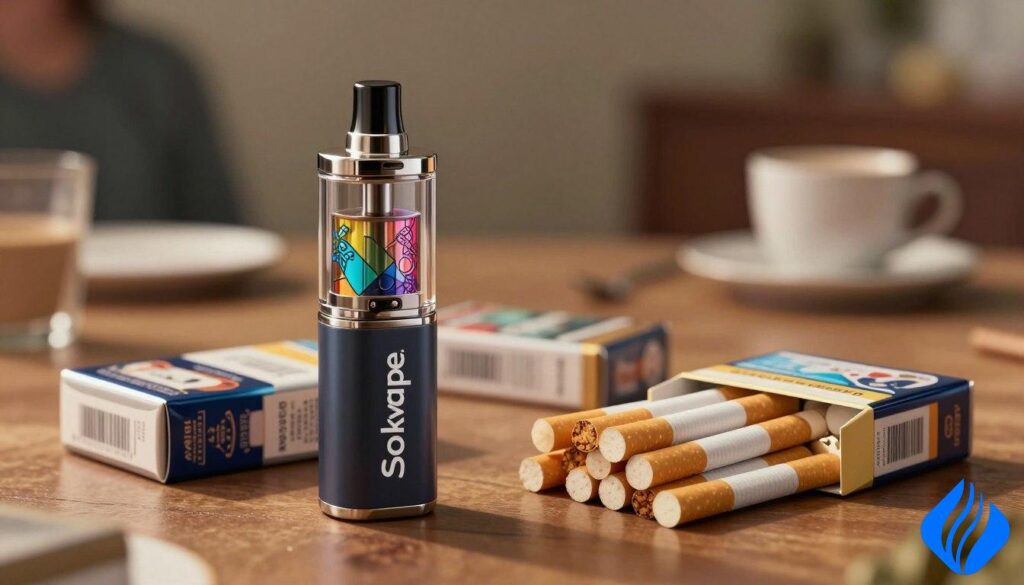
The key is simple: nicotine strength (mg/ml) × e-liquid volume (ml) × absorption rate. This lets you figure out how many packs of cigarettes a vape is like. You’ll learn why counting puffs doesn’t always work. You’ll also see how different devices and how you inhale affect how much nicotine you get.
We use independent reviews, like Public Health England’s, for context. But we focus on the dose you actually absorb. By the end, you’ll know how to estimate nicotine equivalence. You’ll understand how it relates to your daily routine and budget.
Key Takeaways
- Nicotine equivalence depends on dose absorbed, not just the label or puff count.
- A cigarette contains about 10–12 mg, but you absorb roughly 1.1–1.8 mg per stick.
- Use mg/ml × ml consumed × absorption to estimate how many packs of cigarettes are in a vape.
- Puff count to cigarettes is unreliable because device power, coil, and inhale style change delivery.
- Nicotine concentration and mg of nicotine in a vape must be compared to your real daily intake.
- Different devices (2 ml disposables, 5% high-capacity, 10 ml bottles) map to packs in different ways.
- Vaping vs smoking cost varies by device type and your daily consumption.
What “Nicotine Equivalence” Really Means in 2025
You judge nicotine equivalence by what your body actually takes in, not just the label. Vapes show the mg of nicotine, but how much you get depends on the device and your vaping style. So, comparing milligrams needs context, not just slogans.
Nicotine Equivalence Explained: Real Dose Delivered vs. Labeled Strength
Labeled strength is simple math: mg/ml × ml used. But your dose is different. It depends on how your body absorbs it, which changes with the size of the aerosol, the device’s power, and how you inhale.
A practical way to think about it is absorbed mg per day, not just bottle strength.
For quick checks, many users apply an estimated absorption range to their daily use. You can see numeric examples of puff count to cigarettes and pod totals in this nicotine equivalence guide, then compare to your routine.
Why absorption matters more than raw milligrams
Raw labels overstate what reaches your bloodstream. The nicotine absorption rate can shift from session to session, and that changes how the same liquid feels. Two users can vape the same mg of nicotine in a vape and report different effects because their technique and gear alter delivery.
This is why a milligram comparison works best when tied to your habits. Track how much liquid you use, then adjust for how your device hits. That estimate gets you closer to cigarette‑like intake.
The difference between puffs, milligrams, and per-day use
One puff is not one cigarette. Puff length, coil heat, and cloud size vary, so puff count to cigarettes is only a rough yardstick. Milligrams on the label describe the liquid’s content, not what you actually absorb.
Focus on a per‑day estimate. Add up ml consumed, apply a realistic absorption range, and compare that to what you’d absorb from a pack. This connects mg of nicotine in a vape to daily outcomes in a way that reads true to your experience.
| Metric | What It Describes | Why It Varies | How To Use It |
|---|---|---|---|
| Label mg/ml | Concentration of nicotine in liquid | Different formulations and salts | Inputs for milligram comparison |
| Milliliters consumed | Volume you vape per day | Device efficiency and routine | Multiply with mg/ml for total mg |
| Nicotine absorption rate | Fraction of labeled mg you absorb | Power, particle size, inhalation style | Apply a range to estimate dose |
| Puff count | Number of inhalations | Puff length and coil heat | Use as a secondary, rough proxy |
| Daily absorbed mg | Your comparable cigarette intake | Behavior and device changes | Best yardstick for nicotine equivalence |
How Much Nicotine Is in a Cigarette vs. What You Absorb
When comparing vapes to cigarettes, focus on absorbed milligrams, not puffs or labels. This means looking at the mg of nicotine in a vape, its concentration, and how much you absorb. Recent studies on nicotine delivery in modern devices highlight the importance of absorption over counts.
Standard cigarette content: 10–12 mg per stick
A factory-made cigarette usually has 10–12 mg of nicotine in the tobacco rod. This is the chemical amount, not what actually gets into your blood. Use this number as a starting point for comparing milligrams, but remember it’s just the beginning when looking at puff counts or vape nicotine levels.
Actual intake: about 1.1–1.8 mg absorbed per cigarette
In reality, you absorb about 1.1–1.8 mg per cigarette. This amount can change based on the cigarette’s design, how you draw, and other factors. This is the key figure for discussing nicotine absorption and comparing it to vapor products.
Per pack math: 20–36 mg absorbed from 20 cigarettes
When you multiply the amount absorbed per cigarette by 20, you get 20–36 mg. This total helps you compare the nicotine in a vape to a cigarette pack. It also shows why comparing puffs to cigarettes isn’t always accurate.
Puffs vs. Cigarettes: Why Puff Count is Not the Same as Nicotine Dose
Puffs can vary in size and length, and devices produce different amounts of aerosol. Two equal puff counts can mean very different doses. To compare fairly, focus on absorbed milligrams and nicotine absorption rate, not just puff counts. For more on how design changes affect delivery, see the industry overview.
- Key takeaway for conversion: use absorbed mg as your base unit.
- Cross-check any puff count to cigarettes claim with a milligram comparison.
- Adjust for nicotine concentration and device efficiency before drawing conclusions.
Vape Types Compared: Disposables, Pods, and Bottled E-Liquid
In 2025, you’ll find three main types of vapes. Each has its own look, but what really matters is how much liquid you use and the nicotine level. Watch out for claims about 600 puffs vs 20 cigarettes, the 5% nicotine found in the U.S., and how e-liquid types work in your device.
2 ml TPD disposables (≈600 puffs) and common salt strengths
In TPD markets, 2 ml disposables often come with 20 mg/ml salts and about 600 puffs. This means you get a labeled 40 mg in the tank. But, how much you actually get depends on your vaping style and device power.
These small sticks are easy to carry and use. They offer smooth hits because salts can handle higher concentrations. This means you get a steady dose of nicotine, perfect for mouth-to-lung vaping.
5% nicotine disposables (5,000+ puffs): U.S. market realities
In the U.S., high-capacity disposables from Elf Bar (EB Create), Lost Mary, and Hyde have 5% nicotine and 5,000–10,000 puffs. They hold about 10–20 ml, leading to large nicotine totals. Some see them as similar to cigarettes.
Puff counters can be tricky. A 5% nicotine level might make a device last less time, depending on your vaping style. It’s better to focus on ml consumed and how fast your cravings go away.
10 ml e-liquid bottles: freebase vs. nicotine salts
Refillable pods and small tanks use 10 ml bottles or more. You have two options: salts (10–20 mg/ml) for smooth hits at low power, or freebase (3–12 mg/ml) for a stronger throat hit at higher wattage.
If you’re switching from cigarettes, salts in pods might feel closer to what you expect at lower power. Freebase is better for open devices that make more vapor per puff.
Disposable Vapes vs. Combustible Cigarettes: Form Factor and Delivery Efficiency
Disposables and combustible cigarettes aren’t directly comparable by shape. A sleek stick can hold many “pack equivalents,” while a bulky mod might deliver less per puff. What really matters is nicotine concentration, liquid volume, and how you inhale.
Start with brand claims, then track your own use. This way, you can match 600 puffs vs 20 cigarettes logic to your vaping routine. It helps make sense of any claims you see about elf bar cigarette equivalents.
how many packs of cigarettes are in a vape
You want to know how a vape compares to cigarette packs. The best way is to look at nicotine intake, not just what’s on the label. This method helps you understand how many packs of cigarettes are in a vape, avoiding guesses about puff length or device power.
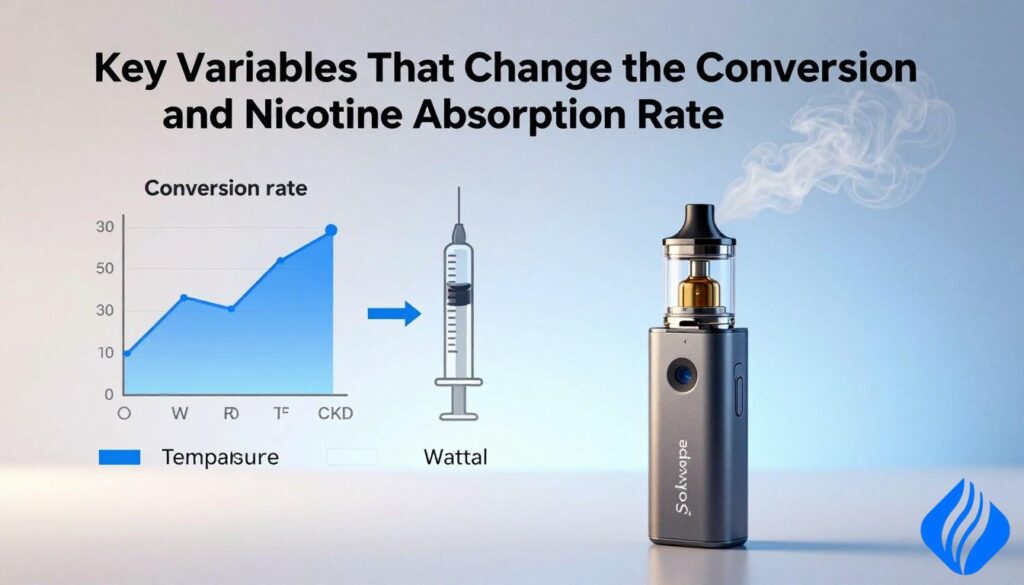
Core conversion model: mg/ml × ml consumed × absorption
Start with a simple model for nicotine equivalence. Multiply the nicotine strength in mg/ml by the milliliters you vape. Then, add an absorption fraction based on your vaping style and device. This approach gives a detailed milligram comparison, not just a rough puff count.
- Strength: labeled nicotine in mg/ml (freebase or salts)
- Volume: liquid consumed in ml
- Absorption: percent your body takes in per session
The result, in absorbed milligrams, can be compared to the typical per-pack range from smoking. This comparison makes 600 puffs vs 20 cigarettes more than just hype.
20 mg/ml salts in 2 ml: labeled 40 mg vs. absorbed dose
A 2 ml disposable at 20 mg/ml has 40 mg total. In a standard mouth-to-lung setup, you might absorb about 30% to 50%. That means you get roughly 12–20 mg absorbed from the device.
When you compare this to what many smokers get from a pack—about 20–36 mg—you can place the vape on a realistic scale. This comparison is tighter than any puff count to cigarettes claim on a box.
600 Puffs vs. 20 Cigarettes: Translating Puff Counts to Packs
Claims like 600 puffs vs 20 cigarettes are not one-to-one. Puff length, wattage, and coil design change aerosol mass per puff. A better path is to translate the full device’s absorbed milligrams to packs.
If your 2 ml device nets about 16 mg absorbed, that can land around 0.5–0.8 of a pack in nicotine terms. Finishing two of those devices could align with roughly one to one-and-a-half packs, depending on how you vape and the power profile of the hardware.
- Strength-driven estimate: favors mg-based math over puff slogans
- Device and behavior matter: small changes shift 600 puffs vs 20 cigarettes outcomes
- Absorption is the bridge: it converts your use into a cigarette baseline
The Math of 20 mg/ml Salt Nicotine vs. a Pack of 20 Cigarettes
You want to know the real nicotine you get, not just what’s on the label. A 2 ml pod at 20 mg/ml has 40 mg of nicotine. But, how much you get depends on your device and how you vape.
Key idea: The nicotine in your vape is just the start. How much you absorb is what really matters. So, two people vaping the same pod can get different amounts.
Nicotine in Vapes vs. Cigarettes: Labeled Content vs. Per-Pack Absorbed mg
A 2 ml, 20 mg/ml salt device has 40 mg of nicotine. But, a pack of cigarettes gives you about 20–36 mg. This is because not all nicotine in your vape gets into your blood.
Think about the nicotine you actually absorb. This way, you can compare what you vape to what a pack gives you more fairly.
Typical absorption ranges for salts at MTL power
With low-watt mouth-to-lung pods, many see about 30–50% of the nicotine absorbed. So, from a 40 mg fill, you might get 12–20 mg. This depends on how you vape, the coil, and your draw.
Consistent puffs and good wicks help you absorb more nicotine. But, short, erratic pulls or weak aerosol can lower that number.
When 2 ml equals, exceeds, or falls short of one pack
If you absorb about 12 mg, 2 ml is less than a pack. Around 18–20 mg, you’re close. But, if you absorb more than 50%, you get more than a pack.
This is why two people can vape the same pod and feel different effects. It’s all about how you vape.
Total Nicotine in a Vape vs. Absorbed mg Per Pack: The Real Equivalence
Comparing 40 mg to 20–36 mg is not the whole story. The better way is to look at absorbed mg. For many, a 2 ml, 20 mg/ml salt is about 0.6–1.0 of a pack. This depends on nicotine concentration and how well you absorb it.
Use absorbed mg for any comparison. It helps you see the real nicotine you get from your vape.
5% Nicotine Disposables (5,000+ Puffs): How Many Packs Is That?
High-capacity disposables show big numbers, but what does that mean for your daily use? Brands like Elf Bar and Lost Mary offer long-lasting vapes with smooth flavors. It’s important to look at nicotine strength and absorbed dose, not just puff counts.
Total labeled nicotine in high-capacity devices
A 5% disposable has about 50 mg/ml salts. If it holds 10 ml, that’s 500 mg of nicotine. A 15 ml one has 750 mg, and a 20 ml one has 1,000 mg. These amounts are much higher than a single pack of cigarettes.
But, not all of this nicotine gets into your blood. Let’s say 30–50% of it does. So, a 10 ml 5% device might give you 150–250 mg of nicotine. This means it could be like 4–12 packs of cigarettes, depending on how you vape.
Expected consumption timelines for daily pack smokers
If you smoke a pack a day, a 10 ml 5% device might last you a few days to a couple of weeks. It depends on how much you vape and how efficient the device is. Your vaping speed also plays a role.
Instead of focusing on puff counts, think about how much e-liquid you use each day. This way, you can better understand how many packs of cigarettes a disposable is like for you.
Nicotine Strength vs. Cloud Size: Why 5% Isn’t Always Stronger in Practice
The feel of 5% nicotine can change based on power and airflow. Bigger clouds might make each puff feel less intense. You adjust your vaping to keep the nicotine feeling the same.
In short sessions, you might need fewer puffs with higher nicotine. But in longer sessions, you might take more puffs. This is why comparing disposables to cigarettes is better based on milliliters used and absorbed dose, not just puff counts.
10 ml Bottles and Pods: Practical Equivalence for Daily Use
You probably check how long a pod lasts and if it fits your old habits. Think about nicotine equivalence to match your nicotine intake from cigarettes. This helps keep your vaping or smoking costs in check.
10 ml at 20 mg/ml: labeled 200 mg, realistic absorbed dose
A 10 ml bottle at 20 mg/ml has 200 mg on the label. Using a MTL pod, you might absorb 60–100 mg of nicotine. This is similar to what many smokers take from two to five packs.
This makes it easier to compare vape nicotine to cigarettes. See how long a bottle lasts to adjust your nicotine intake.
Pod consumption patterns: ml per day vs. “packs per day”
Most people use 1–3 ml of pod daily. At 2 ml/day on 20 mg/ml, a 10 ml bottle lasts 4–5 days. This gives about 12–20 mg of nicotine per day, close to what many smokers take.
Keep an eye on your ml per day and how you feel. Adjust the strength or volume to match your needs. This way, you control your nicotine intake based on your own needs, not just the label.
Nicotine Salt vs. Freebase E-liquid: Delivery, Bioavailability, and Throat Hit
When comparing e-liquid salt nic vs freebase, consider power, comfort, and dose. Freebase works well with high-watt pod-mods but can be harsh at high strengths. This might make you use lower concentrations and more vapor.
Nicotine salts are smoother in compact pods and work well at lower wattage. They provide a steady experience and help you use less. If you’re watching your costs, salts in efficient pods can make a bottle last longer.
Practical tip: start with a nicotine level that meets your needs, then adjust. Use the mg of nicotine in a vape that satisfies you, measure your ml/day, and reduce strength or usage as needed.
Key Variables That Change the Conversion
Matching puff count to cigarettes depends on your device, liquid, and vaping style. The nicotine concentration on the label is just a starting point. Real delivery changes with power, coil, and technique.
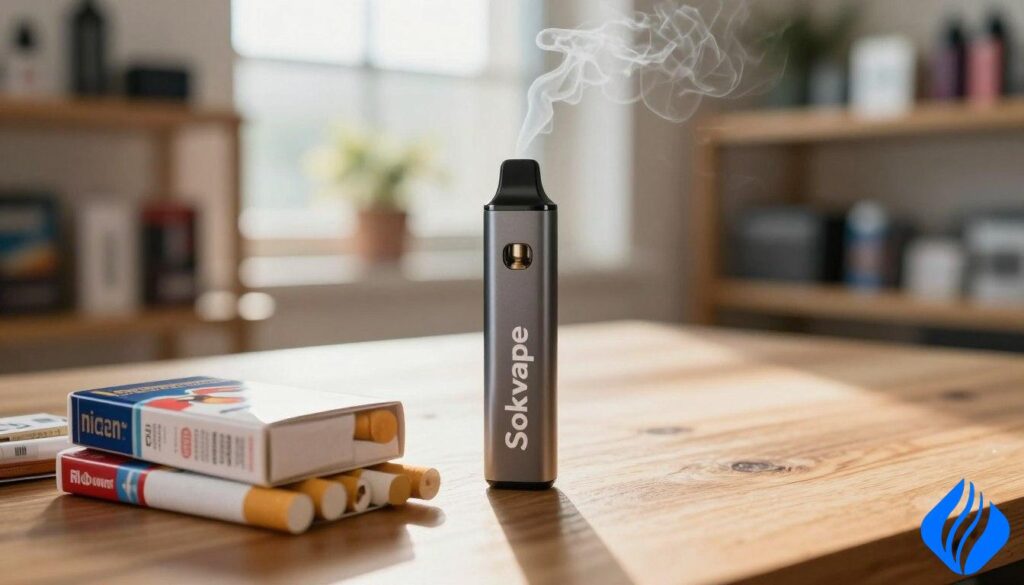
Device wattage and coil resistance: vapor mass per puff
Higher wattage with low-resistance coils makes more aerosol per second. You might need to use less nicotine but use more liquid. At 8–15 W MTL, you get moderate vapor. At 25–60 W RDL or DL, vapor mass increases fast, changing how many puffs equal a cigarette.
Puff duration and style: MTL vs. RDL vs. DL
Short, tight MTL puffs focus delivery to the throat and upper airway. Longer RDL or DL pulls, often 2–5 seconds, move aerosol deeper. This changes efficiency. Breath-hold habits also matter. A slower draw can increase residence time, altering how much nicotine reaches your bloodstream per session.
Nicotine Absorption Rates: How Physiology and Vaping Technique Impact Delivery
Lung capacity, inhalation depth, and metabolism vary widely. Two people using the same pod at the same setting can end the day with very different results. Your cadence, device heat-up, and wicking all influence the nicotine absorption rate. This is why puff count to cigarettes is a range, not a single number.
E-liquid formulation: salts, pH, and flavor additives
Nicotine salts, often benzoate or lactate, lower harshness and can raise comfort at modest power. Changes in pH, viscosity, and flavor solvents shift particle size and deposition. This impacts apparent strength. This affects any milligram comparison and how you interpret the mg of nicotine in a vape relative to a pack.
| Variable | Typical Range | Effect on Delivery | Impact on puff count to cigarettes | Practical Note |
|---|---|---|---|---|
| Wattage & Coil | 8–60+ W; 0.15–1.2 Ω | Higher power = more vapor mass per puff | Lower strength can match intake via higher ml | Adjust nicotine concentration as vapor volume rises |
| Puff Duration | 1–5+ seconds | Longer pulls increase aerosol and residence time | Fewer puffs may equal a cigarette’s dose | Track average pull length when estimating parity |
| Style (MTL/RDL/DL) | Tight to open airflow | Deeper draws shift deposition to the lung | Style changes mg-per-puff equivalence | Match airflow to comfort and desired intake |
| Formulation | Salts vs. freebase; pH range | pH and solvents alter particle size | Same label strength can feel stronger or weaker | Test salts at lower power for smoother delivery |
| Physiology | Lung volume, metabolism | Absorption efficiency varies by person | Conversion is an estimate, not fixed | Use real-world response to fine-tune strength |
When you bring these factors together, you get a clearer milligram comparison that respects how devices actually perform. Use your routine—settings, draw length, and liquid choice—to refine the mg of nicotine in a vape you plan to use. This helps set a realistic puff count to cigarettes for your day.
Health Perspective and Harm Reduction Context
Understanding how vaping fits into harm reduction is key. The main difference between Disposables and combustible cigarettes is combustion. Combustion creates tar and harmful toxins. Vaping avoids this burn, but your choices matter, from nicotine strength to device and frequency.
Public Health England: “95% less harmful” stance in context
Public Health England says vaping is about 95% less harmful than smoking. This is because it avoids combustion. But, this view is for the population, not a personal guarantee. Your risk changes based on nicotine absorption, device quality, and how fully you switch.
When comparing an elf bar to a pack of cigarettes, consider nicotine equivalence. This math can guide you. But, the real benefit comes from replacing smoke entirely. Dual use keeps smoke exposure present.
What “less harmful” does and does not mean for you
Less harmful means fewer toxins from combustion than cigarettes. It does not mean no risk. A higher 5% nicotine strength can satisfy cravings with fewer puffs. Yet, your nicotine absorption rate varies by technique and hardware.
When mapping nicotine equivalence, track your puffs and vaping frequency. A device marketed as an elf bar cigarette equivalent will vary in delivery. Your results depend on puff length, coil heat, and frequency.
Nicotine dependence vs. combustion risks
Nicotine can sustain dependence, raise heart rate, and make quitting harder. The major cancer and COPD risks come from burning tobacco, not nicotine itself. That’s why the debate focuses on smoke elimination first.
If you switch, aim to reduce exposure over time. Taper your 5% nicotine strength when ready, and monitor your nicotine absorption rate as you change devices or e-liquids. Using nicotine equivalence as a guide helps you plan a steady step-down without returning to smoke.
Cost Comparison: Vape vs. a Pack-a-Day Habit
First, you notice the cost at the checkout. Let’s look at the cost of vaping versus smoking. State taxes make cigarettes more expensive, and your habits affect the total cost. Think in terms of “pack equivalents” and how many packs of cigarettes a vape can replace.
Quick tip: when you see 600 puffs vs 20 cigarettes on a disposable, treat it as a rough ceiling, not a promise. Your draw length, device power, and nicotine strength all change the elf bar cigarette equivalent for your day-to-day use.
Vaping vs. Smoking Cost: Weekly and Monthly Expense Breakdown
In many states, a pack of cigarettes costs $7–$12. This means a pack-a-day habit costs around $50–$80 per week. Monthly, it’s about $210–$360. Over a year, you could spend between $2,500 and $4,300.
Switching to disposables can save money. A 5% unit priced at $15–$25 can last from a few days to over a week. If it replaces four to ten packs for you, weekly costs are $10–$40, and monthly costs are $45–$150.
Refillable pods are even cheaper. Bottles cost $5–$10, and occasional pods or coils add $3–$6. This can lead to weekly spending of $7–$20 and monthly costs of $30–$80 for many former smokers.
| Pattern | Typical Weekly Spend | Typical Monthly Spend | Notes on Equivalence |
|---|---|---|---|
| Pack-a-day cigarettes | $50–$80 | $210–$360 | Varies by state taxes; 20 cigarettes per day |
| Disposable vape (5% 5,000+ puffs) | $10–$40 | $45–$150 | Depends on how many packs of cigarettes are in a vape for your usage |
| Refillable pod/e-liquid | $7–$20 | $30–$80 | Lower ongoing costs; bottle and coil budgeting |
Disposables vs. refillables: upfront and ongoing costs
Disposables are simple: buy, vape, repeat. The initial cost is just the device. But, ongoing costs depend on how fast you use it and your view of 600 puffs vs 20 cigarettes.
Refillables require a device purchase and small, regular e-liquid and pod or coil buys. Over time, this can be cheaper than disposables, once you find your daily vape amount.
- Disposables: predictable unit price, variable lifespan.
- Refillables: slightly higher start, lower per-day cost with bottles.
- Both: actual savings hinge on how many packs of cigarettes are in a vape for you.
How switching affects your annual spend in the U.S.
Switching to Disposables can save a lot of money. If you avoid buying too much, you might spend less than $2,500–$4,300 a year. Many users spend in the hundreds to low-thousands annually.
Refillables can save even more. With regular bottle buys and occasional coil changes, yearly costs often fall in the mid-hundreds. Your savings depend on your vaping style, brand choice, and how you compare 600 puffs vs 20 cigarettes over time.
Matching a device to your needs and tracking your use makes cost comparisons easier. Keep an eye on your elf bar cigarette equivalent and how fast you finish each device or bottle.
Real-World Use Cases and Quick Reference Conversions
You want numbers you can use, not lab talk. Think in terms of what you finish in a day and how that maps from puff count to cigarettes. Focus on nicotine concentration, your airflow style, and the mg of nicotine in a vape you actually absorb.
Ignore box hype and match your routine to outcomes. A simple way is to compare your ml per day and how that feels next to 600 puffs vs 20 cigarettes. This keeps the puff count to cigarettes idea grounded in how you vape, not just a label.
2 ml/20 mg/ml disposable used over two days: pack equivalence
Finishing a 2 ml device at 20 mg/ml across two days means 40 mg on the label. With typical absorption, you’re taking in a modest share of that. Most users land well under a pack’s daily intake when they spread it across two days.
If you notice stronger cravings, your cadence may be too light for the elf bar cigarette equivalent you expect. Shorter, more frequent puffs can change results without chasing higher strength.
5% 5,000-puff device for heavy vs. moderate users
A 5% device with 5,000 puffs usually holds around 10–12 ml. Heavy users might empty it in a week or so, while moderate users stretch it to two or three weeks. The same device can feel like half a pack for one person and more than a pack for another.
Track daily satisfaction. If your draw style is tight and slow, the mg of nicotine in a vape may feel stronger per puff. That skews puff count to cigarettes comparisons toward fewer puffs per “pack equivalent.”
Pod systems at 12 mg freebase vs. 20 mg salts
With pods, setup dictates delivery. A 12 mg/ml freebase in a warm, RDL pod at 3–5 ml per day can mirror a pack’s daily feel. A 20 mg/ml salt at 1–2 ml per day in MTL can land in a similar range thanks to higher nicotine concentration and efficient absorption.
Choose the balance that curbs cravings without harshness. The right pairing keeps your 600 puffs vs 20 cigarettes comparisons steady over time.
Elf Bar Cigarette Equivalents: Translating Disposable Sticks to Packs
Popular disposables like Elf Bar or Lost Mary often span several “pack equivalents,” but your true elf bar cigarette equivalent depends on ml per day and how satisfied you feel. Don’t rely on the counter alone; your routine is the better guide.
When in doubt, anchor on daily ml and how many sessions match your old routine. That turns puff count to cigarettes into a practical tool, not a guess.
| Use Case | Device & Strength | Typical Daily Intake | Real-World Notes | Quick Conversion Cue |
|---|---|---|---|---|
| Two-day disposable | 2 ml at 20 mg/ml | About half the device per day | Often below one-pack feel per day due to absorption | Light-to-moderate “pack equivalent” per two days |
| Heavy user, 5% high-capacity | 10–12 ml at 5% (≈5,000 puffs) | 1–2 ml/day with long sessions | Warmer draws raise perceived strength | Can approach or exceed a pack feel on busy days |
| Moderate user, 5% high-capacity | 10–12 ml at 5% (≈5,000 puffs) | 0.5–1 ml/day with steady pacing | Smoother use over weeks; fewer spikes | Often around half-pack to one-pack feel |
| RDL pod, freebase | 12 mg/ml freebase | 3–5 ml/day | Airier draw, larger vapor mass | Near pack feel despite lower mg of nicotine in a vape per ml |
| MTL pod, salts | 20 mg/ml nicotine salts | 1–2 ml/day | Tight draw boosts efficiency | Comparable to a pack’s daily feel with fewer puffs |
| Elf Bar/Lost Mary reference | Common 5% Disposables | Varies by cadence | Brand counts are estimates, not guarantees | Match 600 puffs vs 20 cigarettes by how satisfied you are |
Conclusion
You asked how many packs of cigarettes are in a vape. The best answer is based on nicotine equivalence, not just puff count. A pack of 20 cigarettes has about 20–36 mg of nicotine absorbed. On the other hand, a 2 ml vape with 20 mg/ml nicotine has 40 mg labeled, but you might absorb 12–20 mg, which is close to one pack for many.
High-capacity 5% Disposables with 10–20 ml have hundreds of milligrams of labeled nicotine. Over weeks, they can give you several pack equivalents, depending on how you use them. Refillable pods let you control nicotine concentration and ml per day, making your nicotine intake more stable and cost-effective. Remember, device wattage, coil resistance, and puff duration can change how much nicotine you get, so estimates should be seen as ranges.
To get a practical idea, use mg/ml × ml consumed × absorption to figure out how many packs of cigarettes are in a vape for you. Watch your nicotine concentration and daily milligram comparison to gradually reduce it if you want to. Vaping is seen as less harmful than smoking because it avoids combustion. In the United States, switching to refillable pods can also save you money compared to buying cigarettes every day.
For more details on puff count, labeled content, and absorption ranges, check out this guide on how many packs of cigarettes are in a vape. Use these ranges to adjust your device and plan a steady, realistic taper that fits your lifestyle.
 English
  German
  Dutch
Dutch  Danish
  Czech
Czech  Italian
  Slovenian
  French
  Hungarian
  Spanish
  Polish