

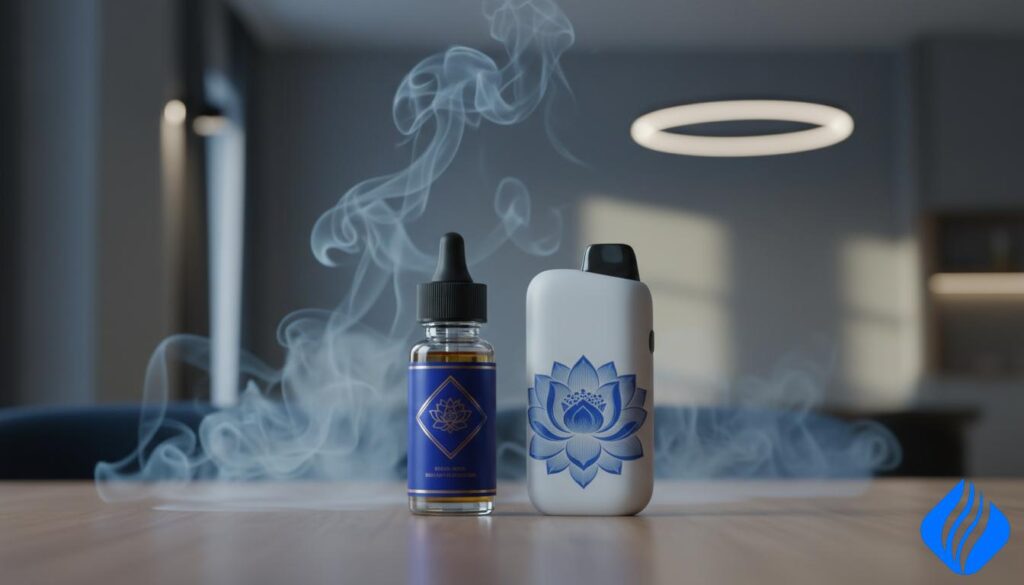
what is blue lotus vape is a phrase we unpack immediately for readers in the United States. We define two real meanings: herbal extracts from Nymphaea caerulea and nicotine disposables that borrow the name as a flavor theme. This distinction drives risk, legality, and user intent.
We preview the comparison framework we use for disposables: battery capacity (mAh), e-liquid volume (ml), nicotine strength (nic salt %), coil type (mesh vs dual mesh), and charging port (USB‑C). These specs predict runtime and consistency more than marketing puff counts.
We explain the decision paths: one path seeks plant effects and carries psychoactive and legal caveats; the other seeks a floral flavored disposable with different regulatory exposure. Our hands-on testing covers throat hit, vapor production, and flavor drift after extended use.
Note: This guide is informational, not medical advice. We flag safety and legal context, and place nicotine warnings in the safety/conclusion section.
Key Takeaways
- We separate herbal Nymphaea caerulea extracts from nicotine disposables to reduce shopper confusion.
- Technical specs (mAh, ml, coil, USB‑C) matter more than advertised puff counts.
- We use Puffs per Dollar and Flavor Consistency as normalized comparison metrics.
- Hands-on tests report changes over time, not just initial flavor.
- Legality and safety vary by state; adult readers (21+) should read the safety section fully.
- Wholesale buyers can find cost savings and supply reliability at sokvape.com; verify sourcing and compliance.
What the Nymphaea caerulea Plant Is and Why People Vape It Today
Nymphaea caerulea is the botanical name behind many products labeled as blue lotus. The species also appears as blue Egyptian lotus, blue water lily, or sacred lily on packaging. Clear naming helps buyers spot the true ingredient.
Traditional roots versus modern retail
The plant was used traditional medicine in ancient Egypt. Today that history feeds interest but does not guarantee safety or standardized dosing. Modern U.S. markets sell teas, tinctures, and smoked forms with uneven potency.
Formats you will encounter
- Dried flowers for tea or smoking.
- Concentrated extracts and prefilled herbal cartridges.
- Infused blends and alcoholic preparations.
Product labels vary. Look for the full botanical name, ingredient panels, and transparent potency claims. We link trusted overviews for further reading at blue lotus flower guide. This section stays botanical; device comparisons come later.
Active Compounds, Psychoactive Properties, and Expected Effects
We examine the main active compounds and how they shape user experiences. Our aim is to explain mechanisms at a high level and set expectations without dosing guidance.
Apomorphine and nuciferine: what they are and why they matter
Apomorphine acts as a dopamine agonist and links to reward signaling. That biochemical action helps explain mild euphoria reported by some users.
Nuciferine is often cited for calming effects. Its mechanisms are less defined, and some literature describes antipsychotic‑like behavior in lab models.
Relaxation, mild euphoria, and mood changes: user reports
People commonly report gentle relaxation, simple shifts in alertness, and subtle mood elevation. We label these as expected, variable psychoactive effects rather than guaranteed outcomes.
Note: intensity varies by product potency, individual sensitivity, and method of delivery.
When effects can turn negative: paranoia, hallucinations, and agitation
Psychoactive properties can flip to harm when exposure is higher, extracts are inconsistent, or other substances are present. Documented red flags include paranoia, hallucinations, and marked agitation.
For those seeking simple mood enhancement, we recommend planning for safe stopping, avoiding driving, and consulting the safety section for harm reduction steps.
- Key compounds: apomorphine, nuciferine.
- Common effects: relaxation, mild euphoria, mood shifts.
- Serious concerns: paranoia, hallucinations, agitation — seek help if these occur.
Benefits Blue Lotus Claims vs. What Evidence Actually Supports
Claims around this plant promise calm, deeper sleep, and elevated mood — but the evidence is uneven.
Common claims and the reality
Marketing and user reports list anxiety relief, sleep support, mood enhancement, and aphrodisiac benefits.
We separate claimed effects from those backed by solid trials. High‑quality clinical studies are limited. That gap matters for dosing and expectations.
Research gap and regulatory status
FDA not approved for human consumption. No standard dose exists. Without trials, onset, duration, and intensity are unpredictable across extracts and formats.
Antioxidants: useful, not curative
This plant contains flavonoids such as quercetin, kaempferol, and myricetin. These are antioxidants, but antioxidant content alone does not prove improved chronic‑disease outcomes or specific health benefits.
Practical guidance
- Inspect labels: confirm full botanical names and ingredients.
- Avoid stacking: don’t mix with alcohol, cannabis, or CNS drugs.
- Be skeptical: treat wellness claims as unproven.
If you choose to use blue lotus, treat it as a psychoactive botanical and not a medical therapy. For floral disposable products, skip this evidence debate and focus on device specs instead.
Is Blue Lotus Legal in the United States and Is It FDA Approved?
We review how regulation affects availability and safety for this botanical. FDA status: the plant is not approved for human consumption in the united states. That gap limits labeling confidence and formal dosage guidance.
Where it is sold and notable exceptions
In most civilian markets the product and related products are legal to sell and buy. Still, rules vary by state.
- General rule: legal federally but unregulated for consumption.
- Exception: Louisiana restricts sale and possession.
- Practical advice: always check local rules before ordering online.
Military policy and consumer safety
The U.S. military bans these items for service members due to psychotropic concerns and lack of FDA approval. Civilians may face different rules, but service members can face disciplinary action for possession.
| Jurisdiction | Status | Consumer note |
|---|---|---|
| Federal (FDA) | Not approved for consumption | Potency and purity vary |
| State (general) | Generally legal | Some states add limits |
| Louisiana | Restricted/illegal | Do not import or possess there |
| U.S. Military | Prohibited for members | Disciplinary risk despite civilian legality |
If adults still choose to buy blue lotus, prioritize vendors with lab reports, clear ingredient lists, and conservative personal limits. Always check local requirements and stop use if adverse symptoms occur. Safety should guide purchase and use decisions.
Blue Lotus Vape Safety, Interactions, and Who Should Avoid It
We prioritize safety. Vaping blue lotus involves inhaling concentrated plant compounds with real psychoactive properties. Inhalation can also irritate the lungs, independent of substance.
Who should skip it: pregnant or breastfeeding people, minors, and anyone with a history of psychotic disorders or severe mood instability. These groups face higher risk to long‑term health and mental stability.
Mixing risks — combining use with alcohol, cannabis, or prescription CNS‑active drugs can amplify sedation, confusion, and dangerous perceptual changes. Avoid stacking substances when vaping.
“Case reports have described altered mental status after inhaled or infused products, including sedation, paranoia, and hallucinations.”
Real‑world warning signs to stop immediately: escalating agitation, paranoia, persistent hallucinations, chest pain, disorientation, or uncontrolled movements. These symptoms may mimic acute psychiatric events.
- Harm reduction: start low, avoid driving, don’t combine substances, and stop if symptoms worsen.
- Consumption note: use the lowest effective exposure and have a sober observer if trying a new product.
- Nicotine warning: If you are using any disposable product that contains nicotine, nicotine is an addictive chemical. Keep all nicotine products away from children and pets.
| Risk Category | Who | Key Action |
|---|---|---|
| Mental‑health risk | Psychosis, bipolar | Avoid entirely |
| Pregnancy/breastfeeding | Expectant parents | Do not consume |
| Polysubstance risk | Alcohol/cannabis/CNS drugs | Do not mix |
| Acute reaction | Anyone | Seek emergency care for severe symptoms |
Always check labels and lab reports before use. If in doubt, stop and consult a clinician.
what is blue lotus vape in Practice: Blue Lotus Extract Vapes vs. Nicotine Disposables
We draw a clear line between two market paths: herbal, entheogenic extract systems meant to deliver botanical alkaloids and disposable nicotine devices that borrow a floral name for flavor only.
Herbal extract products vs. nicotine salt disposables
Herbal units should list the botanical name and extract type. They vary in alkaloid content and expected psychoactive properties.
Nicotine disposables must state nicotine % and e-liquid ml. Those specs predict addiction risk and stamina more reliably.
Why puff counts mean different things
Nicotine devices tie puff claims to e-liquid volume, coil design, and battery output. That makes comparisons easier.
Herbal systems depend on extract thickness, temperature control, and draw style. Puff claims are therefore far less standardized.
- Comparison rule: normalize by ml and real-world performance.
- Buyer check: choose a disposable for flavor; choose an extract product only if you seek botanical effects and accept higher uncertainty.
We do not recommend combining botanical psychoactives with nicotine unless you understand interactions and accept added risk.
Core Technical Data to Look For When Buying a Disposable
When comparing disposable devices, technical specs reveal real value beyond marketing puff claims. We focus on measurable fields you can read on any listing and use for side‑by‑side comparison.
Key spec template: mAh, ml, nicotine %, coil type, and USB‑C. These fields anchor puffs and runtime when brands quote big numbers.
Battery capacity (mAh): higher mAh gives longer runtime and steadier voltage. That prevents weak hits late in life.
E‑liquid volume (ml) & advertised puffs: use ml as an anchor. Draw length and coil efficiency shrink real puffs below headline counts. Calculate puffs per dollar with estimated real puffs ÷ price.
Nicotine strength: 2% salts feel smoother; 5% raises throat impact and speeds consumption.
Coil type: a mesh coil boosts surface area and initial flavor; dual mesh aids ramp‑up and better flavor consistency over time.
Charging port: modern usb-c improves connection reliability. Still avoid inappropriate fast chargers and monitor heat during charging.
- Use this template to compare competitor listings.
- Prioritize clear labels and labelling for safer purchase and use.
Comparison: Blue Lotus-Themed Disposables vs. Geek Bar, Lost Mary, and Raz
We compare floral-flavored disposables with leading competitors to help shoppers judge real value. Below we show the specs to pull from listings and how to turn them into usable metrics.
Puffs per dollar: price, ml, and real puff delivery
Pull these fields: battery (mAh), e-liquid (ml), nicotine %, coil type, USB‑C. Use them to compute realistic puffs per dollar.
Headline puff counts vary. For fair math, convert ml to expected puff counts using conservative draw lengths and adjust for coil efficiency. Compare the result to the asking price to get true puffs per dollar.
Flavor consistency: mesh vs. dual-mesh designs
Devices with mesh or dual‑mesh coils keep clarity longer. They resist gunk on sweet or icy profiles. That yields steadier taste over a device’s life and better value for frequent users.
Where floral notes sit on the taste map
Floral-style flavors read lighter than candy or ice profiles from Geek Bar, Lost Mary, and Raz. That makes them good for all‑day vaping but subtle for sweetness seekers or those chasing strong throat hits.
| Feature | Floral‑themed | Geek Bar / Lost Mary / Raz |
|---|---|---|
| Typical profile | Light floral | Candy / ice / bold fruit |
| Flavor consistency | Mesh preferred | Dual‑mesh often better |
| Value metric | puffs per dollar (use ml & coil) | puffs per dollar (use ml & battery) |
Note: a floral disposable does not reproduce botanical alkaloids or entheogenic effects. If you plan to buy blue lotus extract products, always check local rules. For device shopping, browse Disposable Vapes and the Hot Sale page to compare specs and current listings.
Hands-On Testing Insights: Throat Hit, Vapor Production, and Flavor After 5000 Puffs
Our hands-on testing focuses on endurance and real-user feel. We logged draw feel, output stability, and palate changes during long sessions. These are observational, not lab certifications.
Throat hit comparison
Throat hit shifts with nicotine. At 2% salts the draw stays smooth and suits all-day use. At 5% the bite is stronger and can feel harsh if the coil runs hot late in life.
Vapor production
Vapor production tied to airflow and coil design. A mesh coil gives clear early flavor and balanced clouds. Dual mesh holds flavor stability longer under heavy pulls.
Flavor after ~5000 puffs
By ~5000 puffs sweetness often flattens and notes dim. A sudden burnt note signals wick drying; stop use immediately. Floral-style profiles age more gracefully than candy-forward rivals.
Consistency scorecard & value
Versus Geek Bar and Lost Mary, floral profiles kept better flavor consistency but produced lighter clouds. Devices with higher ml, solid mAh, and usb-c rechargeability improved estimated puffs per dollar.
Authenticity and Ownership Checks Without an FAQ Section
We provide a compact ownership checklist so you can troubleshoot function and confirm legitimacy before use. Short, practical steps reduce risk and improve user safety.
How to know if it’s empty
Watch for a sustained flavor drop and vapor thinning. These signs often mean depleted liquid or a dry wick.
Repeated LED blinking or auto‑cutoff that persists after a full charge typically indicates an empty or failed unit. If the draw tastes burnt, stop immediately.
How to recharge safely
Use a known good usb-c cable and a standard charger. Avoid high‑wattage fast‑charge bricks.
Charge on a nonflammable surface and check for heat. If the device becomes unusually hot, unplug and discontinue use to protect safety.
Is it authentic
Unregulated markets raise counterfeit risk. Verify QR codes on the maker’s site before first use. Start at this verification link: sokvape.com and follow the on‑site flow to confirm the serial or QR token.
Counterfeit products can contain unknown coil materials, erratic batteries, and inconsistent e‑liquid. Authenticity checks protect flavor consistency and user safety.
More browsing and final reminders
For spec‑transparent lines compare established pages like RandM and Bang. For cartridge overviews see this guide: cartridge comparison.
Always check labels, store devices safely, and always check local rules on purchase or consumption. If you plan to buy blue products, prioritize verified sellers and follow age restrictions.
Conclusion
We close by drawing clear purchase lines between herbal extracts and flavored disposables.
One track centers on the blue lotus flower (Nymphaea caerulea). Those products aim at botanical, psychoactive effects such as gentle relaxation or mild euphoria. Evidence for long‑term benefits remains limited. FDA approval does not exist, and risks rise with mixed substance use.
The other track targets taste and nicotine delivery. Compare battery (mAh), e‑liquid (ml), nicotine %, mesh vs dual‑mesh, and USB‑C. Use Puffs per Dollar and Flavor Consistency to judge value.
Verify authenticity via QR checks on sokvape.com, follow ownership hygiene, and respect legal limits in the United States. Nicotine is addictive. This guide is for adults 21+. Always stop for severe agitation, paranoia, or hallucinations and always check local rules before purchase.
 English
  German
  Dutch
Dutch  Danish
  Czech
Czech  Italian
  Slovenian
  French
  Hungarian
  Spanish
  Polish