

What is kratom vape has become a core question for U.S. adults weighing inhaled botanical options. We open with tech context: modern devices use dual mesh coils and smart screens that change heating profiles. This matters because heat, carrier liquids, and device control alter both delivery and risk.
We define this term plainly. The method heats a botanical extract into an inhalable aerosol. This buyer’s guide targets adult consumers (21+). It is informational only.
Safety first: there are no FDA-approved inhaled botanical products. Research is limited, dosing is uncertain, and respiratory irritation risk is higher than with oral use. We flag nicotine dependence where retail devices overlap with nicotine products.
We explain our evaluation approach. We check spec transparency, realistic performance claims, and harm-reduction framing. Later sections cover hands-on tests like throat hit, vapor stability, and flavor after 5000 puffs.
Key Takeaways
- We define terms and set scope for adult U.S. readers.
- No FDA-approved inhaled botanical products; exercise caution.
- Device heat and carriers add extra variables and risks.
- We evaluate transparency, specs, and realistic claims.
- Nicotine overlap creates added dependence risk.
Buyer’s guide overview for kratom vape products in the United States
This buyer’s guide targets adult U.S. users seeking clear, evidence-forward checks when assessing products. We focus on spec disclosure, authenticity checks, and realistic performance and safety expectations. Our aim is to inform, not promote.
Who this guide is for and what informed choices mean now
We write for adult users comparing kratom vape products and related vape products. Prioritize transparent labeling, predictable device behavior, and refusal of unsupported efficacy claims.
Market reality and higher uncertainty
Vaping kratom carries more unknowns than many vapor methods. Extract formulation, carrier liquids, and heat exposure vary widely. Experts flag alkaloid heat sensitivity and a lack of dosing guidance.
- Variation: potency and composition differ across products.
- Reported effects: users report throat irritation and harshness with some unregulated offerings.
- Research gap: inhaled use lacks robust clinical study and regulatory endorsement.
Harm-reduction frame and article roadmap
If a reader proceeds despite documented risks, our focus is to reduce avoidable harm via better device selection, authenticity checks, and conservative behavior.
- Safety and dosing considerations
- Legal status and compliance
- Device specs and hands-on testing
- Competitor comparisons and FAQs for varying experience levels
What is kratom vape and how does it work?
We map device roles, formulation makeup, and key trade-offs in inhaled botanical delivery. Devices heat a botanical formulation to produce inhalable vapor, which changes absorption speed and the risk profile compared with oral consumption.

Common product types
- kratom vape pens, cartridges, and disposables — compact hardware with fixed coils and limited temperature control.
- Dry herb vaporizers — larger units with chamber heating and clearer temp control, but different contamination risks.
- Each form brings unique risks: coil temperature, contamination potential, and refill vs sealed designs matter.
What’s inside
Formulations usually blend a botanical extract with carrier liquids and flavorings. The main alkaloids of interest are mitragynine and 7‑hydroxymitragynine. Heat can change these compounds, so thermal stability matters more than branding.
Why users consider this method
- Faster onset than oral routes.
- Convenience and portability compared with measuring or brewing.
- Greater discretion in public settings.
We note a key trade-off: faster delivery does not equal predictable dosing. Coil type, airflow, and puff length all affect delivered dose and outcome.
Kratom chemistry vs vape heat: why effects can be unpredictable
We examine how heat alters key botanical molecules and why that matters for inhaled delivery.
Thermal stability is the core technical issue. Studies and internal data point to degradation of mitragynine and 7-hydroxymitragynine outside roughly 39–176°F. Many handheld devices heat near 400–500°F, so the mismatch raises immediate concerns.
Molecular breakdown and user outcomes
When these alkaloids face high temperatures, their chemical structure can change. That can lower measured potency and alter flavor.
Users may report a harsher draw. That harshness can stem from degraded compounds or carrier byproducts, not stronger effects. Those sensations can mislead users about actual results.
Why this matters for effectiveness and risks
- Label vs delivered dose: Heat can change what reaches the lungs, so labeled alkaloid levels may not reflect delivered dose.
- Unknown byproducts: Heating carriers and alkaloids can form compounds not well characterized in inhalation studies.
- Marketing limits: “Full‑spectrum” or “high potency” claims do not replace stability data or third‑party verification.
In short, the chemistry-backed mismatch between alkaloid stability and device temperatures increases uncertainty and risks. This technical point underpins the harm‑reduction guidance that follows.
Potential effects of vaping kratom: what users report vs what’s proven
We separate firsthand reports from clinical data to clarify claimed effects and measured outcomes.
Reported effects by users span from mild stimulation to relaxed sedation. Many attribute lower-intake stimulation to mitragynine, while higher intake links to sedative responses attributed to 7‑hydroxymitragynine. These accounts are anecdotal and vary by product and device.
What is proven remains limited. Controlled inhalation studies for these alkaloids are scarce. Heat can alter chemical profiles, so reported sensations may not match delivered alkaloid amounts.
Onset and control compared with traditional forms
Inhalation often produces faster onset than tea, capsules, or powder. Faster onset does not mean more predictable control. Traditional forms allow measured grams, counted capsules, or repeatable tea recipes. That consistency helps track dosage better than variable puff duration.
- Anecdotes: quick feel, variable intensity.
- Evidence gap: little dosing data for inhaled delivery.
- Practical note: avoid extrapolating from nicotine or CBD vaping; alkaloids behave differently under heat.
Safety concerns and harm-reduction considerations
Our focus here is on respiratory effects, dosing uncertainty, and the regulatory gaps that shape consumer risk.
Lung and throat irritation to watch for
Safety starts with recognizing irritation. Users report throat scratch, coughing, harsh draws, and peppery aerosols.
Stop if breathing feels tight or persistent cough develops. Those signs suggest a formulation or coil temperature problem.
Why dosage is hard to measure by vapor
Delivered dose varies by puff length, device power, coil saturation, and user technique.
That weak control can push people to increase inhalations chasing effectiveness. Overshoot can cause nausea, dizziness, or worse.
Regulatory gap and nicotine disclosure
There are no FDA-approved products for this inhaled botanical method. Guidance and standardized testing are limited in the United States.
Many mass-market devices contain nicotine, an addictive chemical. Always check labels and never assume “herbal” means nicotine-free.
Practical harm-reduction priorities
- Avoid mystery liquids; choose transparent sourcing and third-party testing.
- Treat respiratory harshness as a stop signal, not normal.
- Limit puff frequency and note any repeated side effects.
| Concern | Common signs | Dosage factor | Harm-reduction step |
|---|---|---|---|
| Respiratory irritation | Throat scratch, cough | Coil temp, carrier | Stop use; seek tested products |
| Dosing uncertainty | Variable effects | Puff length & power | Limit puffs; track responses |
| Regulatory gap | No standard labels | Unknown composition | Prefer transparent, tested products |
| Nicotine exposure | Addiction risk | Hidden in some products | Verify label; avoid unknown cartridges |
Legal status and compliance in the U.S. right now
Regulatory status across the United States varies widely, and that patchwork affects purchase and possession risk. We do not offer legal advice. Instead, we outline practical compliance steps adults should expect when considering these products.
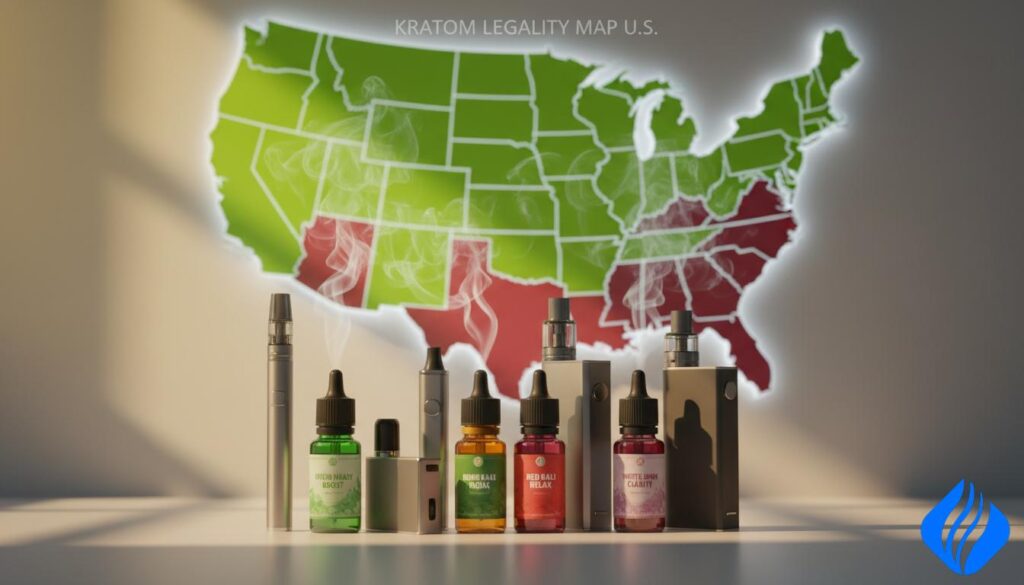
State and local variation
kratom is not uniformly legal. Some states and cities restrict or ban possession. A product available online may be prohibited where you live.
Second regulatory layer for vapor products
Independent rules can apply to any vape or cartridge. Regulators may act on nicotine content, flavors, packaging, or shipping rules. That creates a double layer of requirements.
- Why confusion arises: a single item can trigger botanical rules, vapor rules, and age checks.
- Age-gating: reputable retailers often require 21+ verification and third-party checks.
- Practical checklist: confirm local legality, confirm device classification (nicotine vs non‑nicotine), and check shipping limits.
For safe procurement, verify local law before use. For retail options and verification practices, visit a trusted seller page such as where to buy vapes online.
Traditional kratom forms vs vaping: what to choose for consistency
Our focus here is practical: which delivery route gives the most predictable results.
Comparing formats on control and predictability
We compare common formats—tea, capsules, powder, gummies, and extracts—for two buyer needs: control and predictability.
- Tea: measured grams per steep give repeatable routines. Onset is slower but steady.
- Capsules: precise dosing and easy tracking. They reduce guesswork and accidental escalation.
- Powder: flexible dosing. Scales and records make it consistent for regular users.
- Gummies: convenient, but potency can vary by batch and brand.
Why extracts can be a safer fast-onset alternative
Extracts concentrate active compounds and can deliver faster onset than tea or capsules. They avoid high-heat degradation that occurs with many inhalation devices.
Use caution: higher potency means smaller, measured doses. Start low and record effects to maintain safety and predictability.
| Format | Control | Predictability | Onset |
|---|---|---|---|
| Tea | Good — measured grams | High when prepared consistently | Slow to moderate |
| Capsules | Very good — fixed dose | High with consistent sourcing | Moderate |
| Powder | Good — scalable doses | High if weighed | Moderate |
| Extracts | Requires care — concentrated | High when labeled and tested | Faster than oral; avoids heat breakdown |
If you’re shopping for a vape device instead: specs that matter most
When choosing a mainstream device, hardware specs shape both performance and safety. We focus on clear numbers so you can compare listings and avoid guesswork.
Core technical data to check
Battery capacity (mAh) — Larger cells keep output steady. A strong battery avoids weak puffs late in the charge cycle. Smaller cells can sag and change delivery.
E-liquid volume (ml) — Bigger tanks mean longer run time. They only help if wick and coil match the flow. Low capacity can cause dry hits and flavor drop.
Nicotine strength and potency
Nicotine options commonly list 2% or 5% nic salt. 5% produces a stronger throat hit and raises dependence risk. Choose strength intentionally and track effects.
Coil type and charging
Mesh vs. dual mesh — Mesh heats evenly for consistent flavor. Dual mesh often improves saturation and midlife performance but demands quality control.
USB‑C charging offers faster, standardized power and easier cable management. It is the practical baseline for modern pens and products.
- Transparency check: require mAh, ml, coil type, and charging standard on listings.
- Practical tip: charge to manufacturer specs and use recommended settings.
Hands-on testing insights: throat hit, vapor production, and flavor after 5000 puffs
Using consistent puff cadence, we logged draw-to-draw stability and flagged any drift before and after 5,000 puffs. Our protocol kept intake time, rest intervals, and airflow settings the same for each trial.
Throat hit profile
Throat feel varies by nicotine strength and airflow. In our tests, 2% nicotine felt smoother on most devices. 5% nicotine raised the perceived hit, especially on tight MTL draws.
Vapor output consistency
Vapor steadiness tracked to coil saturation, battery health, and airflow design. Devices with even mesh coils showed stable aerosol and fewer burnt hits. Ramping or weak draws signaled coil starvation or sagging power.
Flavor evolution after 5000 puffs
Sweet profiles often faded by midlife. Sweetener residue dulled top notes, and coil wear brought dry or peppery tones. These shifts can mislead users about actual potency or effects.
Red flags during testing
- Sudden harshness or burnt notes — stop use.
- Leaking into the mouthpiece or repeated blinking with little vapor.
- Device runs hot during normal draws or shows battery instability.
Results: pick devices that hold flavor into midlife, avoid late-life burnt drift, and prioritize battery reliability to preserve the user experience.
Competitor comparison: value and flavor consistency vs Geek Bar, Lost Mary, and Raz
To judge real-world value, we measure puff yield against price and score flavor across three life phases. This practical comparison uses mainstream disposables as baselines so readers can judge alternative products by stable metrics.
Puffs per Dollar: how to calculate value
Puffs per Dollar is a simple metric: divide the marketed puff rating by the retail price. Treat marketing counts as estimates. User draw length and cutoff logic change delivered counts.
- Geek Bar: high marketed puffs, mid price — good headline value.
- Lost Mary: balanced price and real-world midlife stability.
- Raz: often lower claim but steady midlife performance.
Flavor Consistency scorecard
We rate three phases: first 500 puffs, midlife, and late-life. Most disappointment occurs after the fresh coil window when sweetener buildup and coil wear change notes.
| Brand | First 500 | Midlife | Late-life |
|---|---|---|---|
| Geek Bar | Excellent | Good | Fair |
| Lost Mary | Very Good | Very Good | Good |
| Raz | Good | Good | Fair |
Where mainstream disposables typically win vs experimental botanicals
Mainstream vapes usually offer tighter QC, predictable coils, and clear nicotine labeling. Experimental botanical products can vary more in carrier chemistry and heat reactions.
“Choose stability over the biggest puff claim if you value steady flavor and fewer harsh late-life draws.”
Smart shopping pathways
For price checks and current listings, visit our Disposable Vapes and Hot Sale pages. For spec matching, compare RandM and Bang collections: RandM | Bang.
Results: the best value product keeps flavor stable into midlife and avoids harsh late-life drift. Prioritize midlife consistency and verified specs over maximum puff claims for true convenience and predictable results.
How to spot an empty device, recharge safely, and confirm authenticity
A clear checklist for empty-device signs, USB‑C charging basics, and authenticity checks helps prevent common hazards. We focus on practical cues you can verify in minutes. Emphasizing safety reduces avoidable harm with disposable vapes and refill pens.
How to know if it’s empty
Signs: sudden flavor drop-off, reduced vapor volume, tighter draw, frequent blinking lights, or dry‑hit harshness. These point to wick starvation or drained charge.
Do not chain‑puff to squeeze last hits. That raises coil temperature and increases harmful byproducts.
How to recharge safely
Prefer USB‑C for faster, standardized charging. Use a known good cable and adapter. Charge on a hard, non‑flammable surface and avoid covering the device.
Stop charging and dispose if the device gets very hot, shows swelling, leaking, or a cracked casing. Those are hard stop conditions for continued use.
Is it authentic?
Check packaging print quality, batch/lot info, and any scratch-off codes. Scan the product QR and confirm the result lands on sokvape.com via this link: https://www.google.com/url?sa=E&source=gmail&q=sokvape.com.
Counterfeit products often fail on battery quality and liquid handling, which hurts both performance and safety.
User FAQ
- How to know if it’s empty? Flavor fades, vapor drops, blinking, and dry hits — stop and inspect.
- How to recharge safely? Use USB‑C, reputable charger, hard surface, watch temperature, and avoid overnight charging.
- Is it authentic? Inspect packaging, verify scratch/QR codes, and confirm scans land on the official domain above.
Buyer checklist: verify packaging, test for empty signs before extended draws, prefer USB‑C charging, and confirm QR authenticity. These steps improve reliability and protect the user experience with disposable vapes and vape pens.
For troubleshooting charging problems, see our guide on related device faults and solutions at charging & troubleshooting.
Conclusion
Our conclusion focuses on harm reduction, predictable dosing, and hardware transparency for informed buyers.
Inhaled botanical formats introduce measurable chemistry and dosing uncertainty that can make effects unpredictable and raise respiratory risks.
The technical reason is brief: the plant’s active compounds and alkaloids break down under high heat, so assuming stronger delivery from a heated device is unreliable.
For consistent potency and effectiveness, measured forms such as powder, capsules, or tea offer better control. Carefully labeled extracts can be a faster-onset alternative without exposing material to extreme heat.
Protect yourself: verify authenticity, avoid mystery liquids, treat harshness as a stop signal, and remember many disposable vape devices and vape pens contain nicotine. Confirm strength before purchase.
If you favor mainstream hardware, prioritize transparent specs (mAh, ml, coil type, USB‑C), compare Puffs per Dollar and Flavor Consistency, and review trusted listings such as Disposable Vapes, Hot Sale, RandM, and Bang.
 English
  German
  Dutch
Dutch  Danish
  Czech
Czech  Italian
  Slovenian
  French
  Hungarian
  Spanish
  Polish