Short answer: No total ban. HB 900 (Session Law 2024-31) narrowed legal products by requiring listings on the NC Department of Revenue vapor directory.
We explain what changed this year and why shelf shifts felt sudden. HB 900 took effect May 1 with a 60-day grace period. Major removals began July 1 after retailers had until June 29 to pull non-compliant items.
What matters now is whether a product is FDA-authorized or documented as PMTA-filed and appears on the state directory. That rule applies to retail nicotine products only; THC items are handled separately.
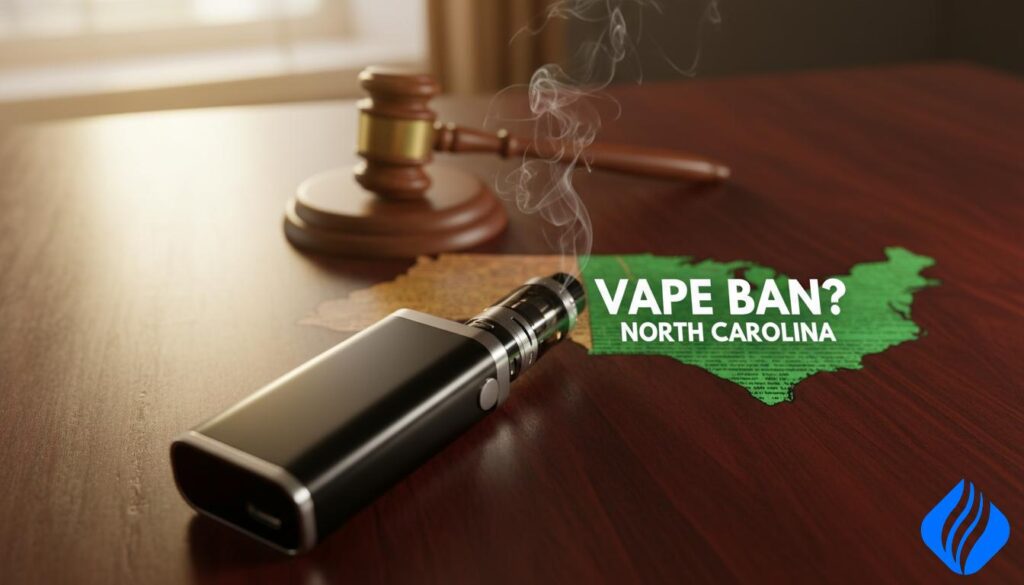
Visual breakdown of HB 900: While not a total vape ban, North Carolina now restricts sales to products listed on the NC Department of Revenue vapor directory as of July 2025.
We note one confusing detail: state statute lists 18 as the age threshold, but federal T21 sets 21+ as the practical compliance baseline. We will keep the focus on safety, compliance, and clear definitions so readers can check a product’s status without legalese.
HB 900 restricts which products retailers may sell; it is not a blanket prohibition.
Effective dates: May 1 (law), 60-day grace, major shelf changes on July 1.
Only products on the NC Department of Revenue directory are legal for retail sale.
State age language says 18, but federal T21 makes 21+ the compliance norm.
Disposables often disappeared from shelves when listings were missing.
We will define FDA-authorized, PMTA-pending, and filed requests in plain terms.
Are they banning vapes in north carolina, or restricting which vape products can be sold?
Short answer: HB 900 does not outlaw vaping itself. Instead, the law narrows lawful retail sales to products listed on the NC Department of Revenue vapor directory that meet federal pathways.
What HB 900 does and doesn’t do
What it does: The bill ties retail legality to FDA authorization or a documented PMTA filing recorded on the state page. That means only listed items qualify for sale under the new law.
What it doesn’t do: HB 900 is not a blanket prohibition of nicotine use and does not regulate THC products under this framework. Retailers simply had to remove inventory that lacked the required directory status.
Key dates that changed shelf availability
The law took effect May 1 with a 60-day compliance period. Retailers had until June 29 to pull non-compliant products. July 1 marked visible removals across many stores and the practical start of enforcement.
Reporting showed popular disposable brands disappeared quickly when listings were missing. For more local reporting on timing and store impact, see this update: disposable vape removals timeline.
Age rules in practice: state statute vs federal T21
State statute still lists 18 as the written threshold, but federal law raised the tobacco sales age to 21 in 2019. In practice, adults should expect 21+ ID checks and enforcement.
Why approval language confuses readers: News reports often say “FDA approval,” but the state accepts products that are FDA-authorized or can show a filed PMTA request. That filed request standard explains why some products returned to shelves while others did not.
Next:we’ll explain how the county directory lists product statuses and which categories were hit hardest during the pull period.
What’s legal in North Carolina after HB 900: the NC Department of Revenue directory
Retail legality now hinges on whether a product appears on the Department of Revenue certification list. As of July 2025, only items listed as FDA-authorized or with a documented PMTA filing may be sold under the new law.
How the vapor certification directory works and why FDA status matters
The department revenue directory is a public registry that records which vape products meet federal pathways. The list reflects FDA authorization or evidence that a manufacturer filed a PMTA request.
FDA-authorized vs PMTA-pending and the “filed request” standard
FDA-authorized means a product cleared through federal review. PMTA-pending items may stay on the directory when the manufacturer submits proper documentation. That “filed request” language explains why some familiar brands returned to shelves while others did not.
Brands and product types most affected
Many disposable items lacked qualifying filings, which hit popular names such as Elf Bar, Raz, and Lost Mary. By contrast, tobacco-flavored pod systems from NJOY, Logic, and Vuse were more likely to appear on the directory.
Retail pull date, consumer impact, and licensing
Retailers had until June 29 to remove non-compliant stock. The shift left fewer flavors on display and concentrated sales among directory-listed products.
What to ask at the counter: check directory status, manufacturer documentation, and that the shop holds a Department of Revenue license.
Enforcement, penalties, taxes, and youth vaping context driving the new law
We view enforcement as a mix of civil fines, license risk, and public-health goals focused on youth prevention. Retailers found the compliance stakes real: fines, product seizure, and possible license revocation if items lack directory status.
Who enforces? The statute places responsibility with the Department of Revenue, but local reporting shows an open question about day-to-day enforcement. That uncertainty left some shops unsure how steep the penalties might be for a single person error.
New taxes took effect July 1. Expect higher receipts: a targeted tax on alternative nicotine and a switch to a weight-based tax for snuff. These changes explain price shifts and some sales declines.
Why policymakers acted: Officials cited youth vaping rates—about one in eight high school students—and student health as the rationale. The law was framed by Roy Cooper as aligning state rules with federal standards and restricting unregulated products to limit youth access.
Topic
Practical effect
Retail risk
2026 multi-state note
Enforcement
Fines, seizures, license review
High for non-listed items
KY and VA increased licensing and bans
Tax changes
New charges on alternative nicotine; weight-based snuff tax
Higher prices, lower sales
Some states added similar levies
Youth-focused rationale
Limit flavored access and illegal disposables
Policy aims to cut student use
UT, CA, AL adopted stricter flavor or hemp rules
Market impact
Shelf removals, price pressure, ~30% drop reported
Stores lost share; panic buying seen
Travelers should check other state rules and registries
For readers who want primary text, consult the related bill text for exact penalties and definitions. Remember federal T21 sets 21+ as the sales baseline nationwide.
Conclusion
The bottom line for adults, under HB 900 (Session Law 2024-31) is simple: as of July 2025 retail sales are limited to products listed on the NC Department of Revenue directory — either FDA‑authorized or PMTA‑filed.
Key dates matter: the law took effect May 1, retailers had until June 29 to pull non‑compliant stock, and visible shelf changes began July 1. Many familiar disposables left stores and prices rose on remaining items.
For safe, legal purchases, check directory status, shop licensed retailers, and plan as a 21+ consumer given Federal T21. For travel or broader compliance, note similar 2026 moves in KY, UT, AL, VA, and CA.
Our goal: help adults make informed, compliant choices and avoid unregulated or counterfeit risks.
FAQ
Q: Are they banning vapes in North Carolina? Update
A: HB 900 is not an outright ban on vapor products. It restricts sale of certain products that lack required federal reviews or state certification. The law creates a directory at the North Carolina Department of Revenue listing approved vapor products. Products not on that list or lacking FDA authorization or an accepted premarket filing became restricted for sale after set pull dates.
Q: Are they banning vapes in North Carolina, or restricting which vape products can be sold?
A: The law focuses on restricting categories and individual products rather than banning all vaping. Retailers may only sell items that meet FDA standards or appear on the state’s certified product directory. That means many flavored disposable devices and some cartridge products were removed from shelves unless they had an approved federal submission or state certification.
Q: What HB 900 does and doesn’t do in North Carolina
A: HB 900 requires product-level eligibility tied to federal filings and a state directory. It raises penalties and adds licensing and tax provisions for alternative nicotine products. It does not criminalize adult possession or use, nor does it change the federal minimum purchase age of 21. The law targets sales channels and product approvals to limit youth access.
Q: Key dates that changed what’s on shelves, including the July 2025 enforcement window
A: The law set phased compliance dates. Initial pull dates required retailers to stop selling uncertified products by specific deadlines, with a significant enforcement window around July 2025 when many remaining uncertified items faced removal. Retailers and distributors were expected to update inventories and register products with the Department of Revenue before those dates.
Q: Age rules in practice: North Carolina law vs Federal T21 (21+)
A: North Carolina follows the federal Tobacco 21 standard: sale of nicotine products to anyone under 21 is prohibited. HB 900 does not lower the age. Retailers must check ID for purchasers who appear under 30 and comply with both state licensing rules and federal age restrictions.
Q: What’s legal in North Carolina after HB 900: the NC Department of Revenue directory
A: The Department of Revenue maintains a directory of certified vapor products that meet state criteria. Only items listed there — typically those with FDA authorization, accepted PMTA filings, or a filed request accepted by state reviewers — are permitted for sale. Consumers can consult the directory for the current list of authorized products.
Q: How the vapor certification directory works and why FDA status matters
A: The directory links state eligibility to federal review status. FDA marketing authorizations (or accepted premarket tobacco product applications) give products a clear path to listing. For products without final FDA authorization, a “filed request” or pending PMTA may qualify temporarily if it meets state reporting rules. Ultimately, FDA determinations remain central to long-term legality.
Q: FDA-authorized vs PMTA-pending products and the “filed request” standard
A: FDA-authorized products have explicit marketing orders. PMTA-pending products are under FDA review. North Carolina allows some pending products to remain eligible if a timely filing exists and state documentation is provided. The “filed request” standard requires proof of federal submission and state registration to avoid immediate removal.
Q: Brands and product types most affected, including many disposable vapes
A: Disposable pod systems, flavored disposables, and some non-cartridge devices were among the most affected categories because many lacked completed federal filings. Established brands that submitted PMTAs or received authorization fared better. Independent and less-regulated brands saw the largest shelf removals.
Q: What retailers had to do by the pull date and what consumers may notice now
A: Retailers needed to audit inventories, remove uncertified products, register eligible items with the Department of Revenue, and update licenses. Consumers may notice fewer flavors, higher prices on compliant products, and changes in shelf assortment as retailers replace noncompliant items with approved alternatives.
Q: Licensing requirements for retailers selling vapes in North Carolina
A: HB 900 expanded licensing and reporting duties for sellers of alternative nicotine products. Retailers must maintain appropriate state licenses, keep records verifying product eligibility, and comply with tax registration for the new product categories. Failure to comply risks fines and potential license suspension.
Q: Fines, license risk, and the open question of who enforces day-to-day
A: The law increases civil penalties and creates license-related sanctions for noncompliant sales. Enforcement responsibilities are shared among state agencies, local health departments, and law enforcement, though day-to-day oversight often falls to state revenue and public health officials conducting compliance checks.
Q: New taxes on alternative nicotine products and related tobacco tax changes
A: HB 900 introduced or clarified taxes on alternative nicotine products alongside existing tobacco taxes. Retailers must collect these taxes and remit them to the Department of Revenue. The tax changes aim to align fiscal policy with public-health goals and affect pricing across product lines.
Q: Why policymakers cite youth access and student vaping rates
A: Policymakers point to rising youth vaping and high school survey data showing frequent nicotine use among students. HB 900 frames product eligibility and sales controls as tools to reduce youth appeal and limit access to flavored and disposable products linked to adolescent use.
Q: Market impact reports from shops: shelf changes, price shifts, and sales drops
A: Many shops reported reduced SKU counts, temporary sales declines, and price increases for compliant items. Some retailers shifted to nicotine pouches and FDA-cleared products. Over time, market share has trended toward brands that invested in PMTA submissions and compliance.
Q: Where can adult consumers find current, verified information about legal products?
A: For the latest list of permitted products, check the North Carolina Department of Revenue vapor product directory and FDA announcements on marketing authorizations. We also recommend asking licensed retailers for proof of product certification and keeping receipts and product labels as documentation.
Q: How should a retailer prepare now to stay compliant?
A: Retailers should maintain active state licenses, verify product entries in the Department of Revenue directory, require supplier documentation of FDA filings or authorizations, update inventory systems, and train staff on age verification and recordkeeping to avoid fines and license actions.
Q: Does HB 900 affect nicotine pouches and non-combustible products?
A: The law covers a broad set of alternative nicotine products beyond traditional e-cigarettes, including some noncombustible items like nicotine pouches. Tax and sales rules apply where the statute defines product classes, so sellers should confirm specific product treatment with the Department of Revenue.
Q: How long will product eligibility and the directory be relevant?
A: The directory is intended as an ongoing compliance tool. Product eligibility will evolve with FDA decisions and new filings. Retailers and consumers should periodically review the directory and FDA updates because items can move on or off the list as reviews conclude.
Q: Who can we contact for legal interpretation or compliance help?
A: For legal interpretation, consult a licensed attorney with tobacco and regulatory experience. For compliance questions, contact the North Carolina Department of Revenue and the state Division of Public Health. Trade associations and accredited compliance consultants can also provide practical guidance.


 English
  German
  Dutch
Dutch  Danish
  Czech
Czech  Italian
  Slovenian
  French
  Hungarian
  Spanish
  Polish