

Dual Mesh Coil technology and smart-screen devices have altered product performance and nicotine delivery, so we begin with a clear policy frame for service members and families.
We outline how U.S. military policy treated e-cigarette use as equivalent to tobacco on many installations. Rules often restricted use to designated areas and classified workplaces broadly.
Health alerts from defense officials during past CDC investigations urged caution about modified or street-sourced products and listed symptoms to watch for.
Our article separates written policy from real-world enforcement, previews hands-on device testing later, and explains why rules mattered for readiness and discipline.
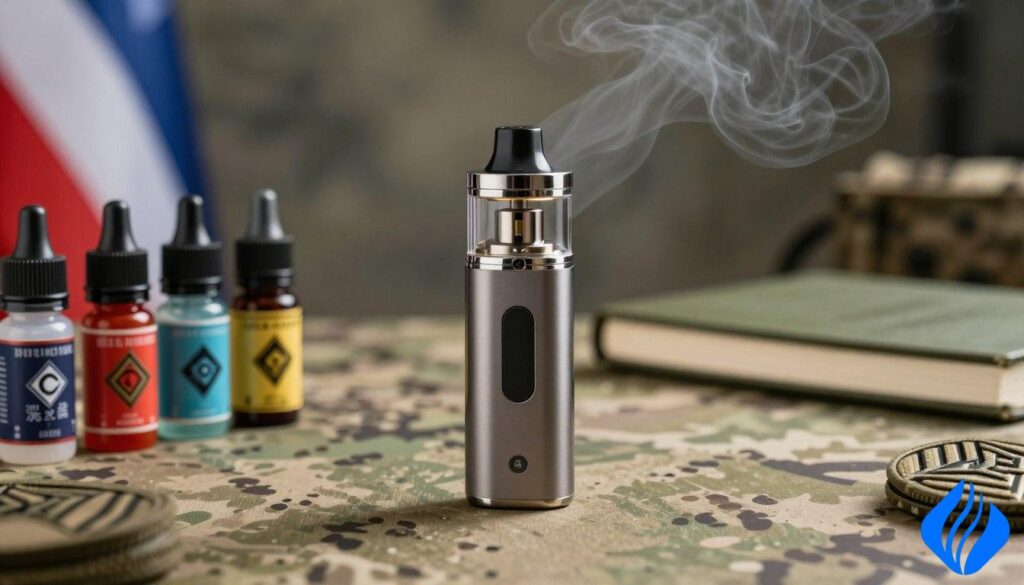
For background reporting and official guidance, see this analysis of e-cigarette impacts on service members and policies linked here.
Key Takeaways
- Policy-first focus: Many commands treated electronic cigarettes like tobacco, limiting where use was allowed.
- Health guidance: Defense agencies advised caution during lung-illness investigations, especially for modified products.
- Enforcement risk: Service members faced possible disciplinary action for violations under UCMJ rules.
- Practical scope: We will clarify on-duty vs off-duty, uniform rules, and base areas defined as workplaces.
- Later sections: Hands-on device data and comparisons will explain how design affects use and dependency.
Current U.S. Military Vaping Rules and Where Vaping Is Restricted
Command memoranda at many installations treat electronic nicotine devices the same as tobacco. USAG-HI-65 explicitly applied tobacco rules to e-cigarettes and cited AR 600-63, para. 7-3a.
Workplace was defined broadly as any interior area where people perform work. That included offices, hangars, shops, medical and admin buildings, and spaces shared with contractors and civilians.
Designated smoking areas and organizational expectations
Most bases limited use to designated smoking areas. Leaders linked that rule to good order and discipline and consistent community behaviors. Bases avoided carve-outs for modernization or low-odor devices.
Consequences and enforcement
Violations exposed service members to Article 92 under the UCMJ. Others faced administrative actions, debarment, or prosecution. Officials emphasized readiness harms—reduced physical fitness, higher illness, and absenteeism—as the policy rationale.
Note: Product choice does not override workplace rules; items listed under a Disposable Vapes category must follow posted on-base restrictions: Disposable Vapes.
Can you vape in the military while on duty, in uniform, or on base?
We answer operationally: using electronic nicotine devices during duty hours or inside duty spaces often falls under local policy and leader direction. Allowing use only inside designated smoking areas does not automatically permit use during formations, briefings, or mission tasks.
Readiness and fitness drive that approach. AR 600-63 links tobacco use to reduced physical fitness, higher illness rates, and absenteeism. Commanders cite predictable availability and fewer disruptions as key reasons rules apply to all delivery formats.
Workplace definitions are broad. Offices, hangars, shops, shared contractor workspaces, barracks, vehicles, and many outdoor common areas may be treated as restricted locations. Civilians and contractors often follow the same posted rules to avoid conflict.
- On duty: Restricted by local memos and supervisor direction.
- In uniform: Visibility is a professionalism concern; many commands limit use near public areas and formations.
- On base: Map rules by category—workplaces, housing, outdoor commons, and vehicles.
Higher use among junior members increased enforcement importance. Inconsistent application fuels friction and perceived unfairness. Our practical plan: check your installation memo, ask your chain of command, and follow posted signage. We will later offer safe-use and authenticity checks plus charging guidance (USB‑C) for consumer safety.
| Location | Typical Rule | Who it Covers |
|---|---|---|
| Workplaces (offices, hangars) | Use restricted except designated areas | Service members, civilians, contractors |
| Barracks/Housing | Varies by installation; many restrict indoor use | Residents and guests |
| Outdoor common areas | Often allowed but may be limited near entrances | All personnel |
| Vehicles | Frequently restricted for safety and cleanliness | Drivers, passengers, assigned staff |
For related travel guidance, see this page for logistics and device handling rules.
Health Risks, Alerts, and Why Military Health Officials Have Warned Against Vaping
During a disease control investigation, DHA and CDC guidance urged risk avoidance as investigators tracked severe lung illness and reported deaths.
What defense health officials said
Core message: refrain from unregulated products and seek prompt care for key symptoms.
- Symptoms: cough, shortness of breath, chest pain, nausea/vomiting/diarrhea, fatigue, fever, weight loss.
Why street products and mods raised concern
Chemical exposure from altered additives or black‑market liquids created unknown risks. Officials noted device modification increased dose variability and contamination potential.
THC vs nicotine-only cases
Many severe reports involved THC products, yet some affected people reported nicotine-only use. That uncertainty drove broad warnings rather than narrow reassurances.
Device design and consumer data
We tested common rechargeable disposables for context. Hands-on notes: throat hit ranged from smooth to stronger. Dual mesh gave higher vapor and steadier flavor early on; flavor often flattened after ~5000 puffs. Puffs per Dollar varies by draw style and advertised counts, so compute advertised puff count ÷ price paid for a quick estimate.
| Device | Battery (mAh) | E-liquid (mL) | Nicotine | Coil | Charging |
|---|---|---|---|---|---|
| Geek Bar Pulse | ~650 | ~16 | 5% (some 2%) | Dual mesh | USB‑C |
| Lost Mary OS5000 | ~650 | ~13 | 5% | Mesh | USB‑C |
| Raz TN9000 | ~650 | 12–14 | 5% | Mesh | USB‑C |
For spec reference points and authenticity prompts, see Disposable Vapes, Hot Sale, RandM, and Bang. For related reporting on defense guidance, read this service report.
Final point: FDA has not approved electronic cigarettes as an accepted cessation method, and lack of long-term proof informed the conservative stance adopted by health officials.
Conclusion
Our operational summary stresses that posted policy governed on-base behavior for service members, troops, and families. Local rules often treated electronic devices like cigarettes and smoking, so assume similar limits unless a written memo states otherwise.
Health officials urged caution during past CDC probes after reports of severe lung illness and at least one death. Source uncertainty—THC cases alongside nicotine reports—meant broad warnings rather than narrow reassurances. About half of severe reports involved illicit or modified products; about half involved other sources.
Practical notes: Puffs per Dollar and Flavor Consistency help judge device value, but higher-output units may alter nicotine uptake and behaviors. Our compliance-first plan: read your installation memo, follow designated-area signage, avoid unregulated products, and seek care if symptoms appear over days or a week.
User FAQ — How to know if it’s empty? Flavor fades, vapor drops, lights blink, or hits taste dry; stop use rather than push through. How to recharge safely? Use a reputable USB‑C charger, never charge unattended on bedding or in vehicles, stop if the device heats. Is it authentic? Verify the QR code via the seller’s verification link at here; checks reduce risk but do not eliminate it.
Nicotine warning: Nicotine is addictive. This content is for adults 21+ and is not medical advice.
Final point: Always follow base policy and posted signage. Compliance protects readiness, health, and others.
 English
  German
  Dutch
Dutch  Danish
  Czech
Czech  Italian
  Slovenian
  French
  Hungarian
  Spanish
  Polish