

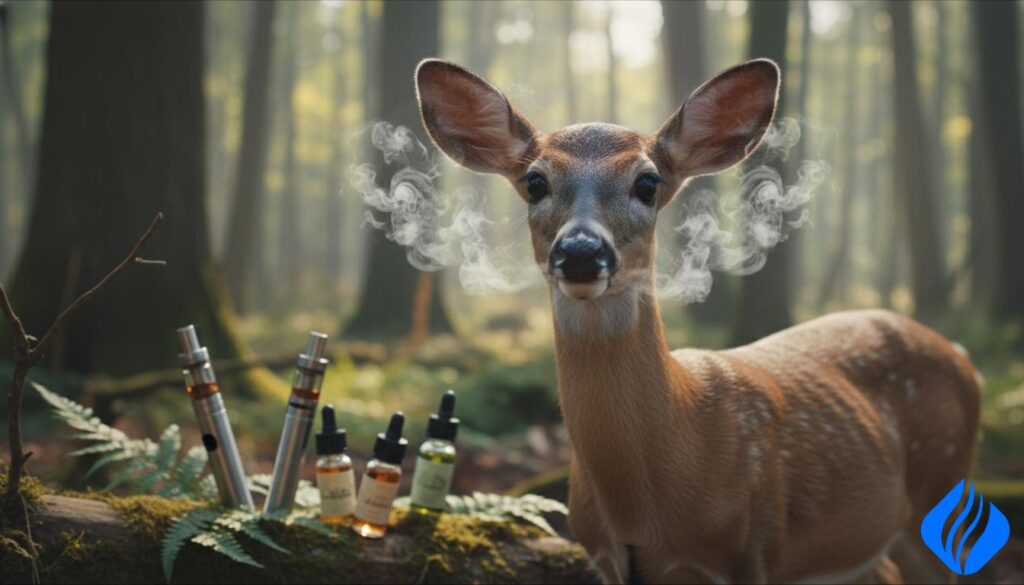
Can deer smell vapes is a search many hunters use before heading to the stand. We lead with a stark fact: whitetails have about 290 million olfactory receptors, so odor control matters.
We will define what “detect” means — not just a whiff, but alert behavior, route changes, or altered activity. Our goal is a practical, safety-first how-to that blends scent science with field-tested vaping guidance.
We will explain wind, thermals, and terrain effects. We will preview hands-on notes and product specs (mAh, ml, nicotine salts, mesh/dual mesh, USB‑C). We’ll compare units by Puffs per Dollar and Flavor Consistency and stress responsible nicotine use and battery safety.
For scent deployment and masking tactics, see this concise primer on scent fundamentals and field methods: mastering scent use for hunting.
Key Takeaways
- Whitetail noses are powerful; odor control is essential for hunting success.
- We define detection as behavioral change, not simple presence of odor.
- Wind, thermals, and terrain strongly affect vapor drift.
- We’ll provide product specs and Puffs per Dollar comparisons.
- Responsible nicotine handling and battery safety are part of field prep.
Why deer scent detection matters for hunters in the woods
Scent is the primary early-warning system that shapes almost every encounter in the woods. Animals use odor to judge risk. A mature buck under pressure will pick scent over sight every time.
How getting winded works: your odor cone travels with the air. Often that cone reaches an animal before your eyes do. Hunters report the same reality: “you’ll never see the ones that do smell you.” Silent departures are usually a scent problem, not low population.
Unnatural smells — flavored aerosol, device odor, or residues — register as foreign in the woods. That unfamiliar input often equals perceived danger for the animal. Distinguish unavoidable baseline human scent from avoidable add-ons like flavored vapor or scented gear.
- Scent is the most trusted early-warning system for wary animals and pressured bucks.
- Getting get winded is a physics issue: odor intersects a nose before your eyesight intersects the animal.
- Reducing your total scent footprint is practical hunting. Eliminate extras; don’t chase perfection.
Next, we quantify what a nose can detect so hunters can judge risk when they use scented products in the field.
How powerful is a deer’s nose compared to humans and dogs?
Comparing noses gives practical guidance: receptor counts translate directly into how far your scent can travel. We use numbers so hunters can plan stand placement and movement.
Olfactory receptor counts: white-tailed deer have about 290 million. Humans have roughly 6 million. Many working dogs range from 100–300 million. That places a deer nose near the top of mammalian detection capability.

How far scent can travel in ideal conditions
In steady wind and open terrain, a deer may detect human odor at roughly 800–1,000 yards. That is over half a mile. Use this as a worst-case model for stand placement.
How long human scent can linger
Scent persistence varies. Odor can fade in hours with sun and wind. In humid early season conditions, residues may affect an area for several days — some estimates extend to up to 10 days. Rain reduces persistence but does not erase all traces immediately.
Practical takeaways
- Receptor counts mean detection power: deer compete with or exceed many dogs and far outperform humans.
- Scent reaches hundreds of yards: small, unusual additives to your profile matter at distance.
- Persistence matters: odor clings to vegetation and gear, creating a trail over time and across the next day.
| Species | Approx. Olfactory Receptors | Practical Detection Range |
|---|---|---|
| Humans | ~6 million | Short-range (tens of yards typical) |
| Working dogs | 100–300 million | Hundreds to 1,000+ yards depending on conditions |
| White-tailed deer | ~290 million | ~800–1,000 yards in ideal wind/terrain |
Next we evaluate whether vaping adds a distinctive, detectable signal and how it behaves in real hunting scenarios.
can deer smell vapes when you’re on stand or moving to your location?
Yes — we should assume vape-related odors are detectable, especially downwind. Exhaled aerosol carries concentrated flavor molecules and sweet notes. Those compounds contrast with leaf litter and soil. That mismatch reads as an unfamiliar cue to animals.
Why this matters: non-native volatile compounds trigger alert behavior faster than routine human scent. Aerosol plumes ride wind and thermals and can reach bedding or feeding areas well before you do.
Vape odor vs cigarette smoke
Compare profiles: cigarette smoke is pungent and oily. It clings to fabrics and gear aggressively. Vaping may seem lighter to people. Yet it leaves a distinct aroma signature and aerosol residue that wildlife can detect.
Residual transfer to hands, clothes, and gear
Odors cling to hand surfaces, glove cuffs, release aids, bow grips, and clothing cuffs. Walking while vaping paints a scent trail across transition zones between cover and feed. That trail increases risk for a close-range hunt.
Weapon type and margin for error
Bowhunters operate in a tight tolerance. Close distances magnify the cost of a detectable odor. Gun hunters have more buffer, but wind is still non-negotiable. Always treat vaping the same way you would a scented hand warmer or strong food.
- Decision rule: If it would change your approach to other strong odors at the stand, avoid vaping in that location.
- Small amounts travel far depending on wind, thermals, and terrain.
| Aspect | Vaping | Cigarette smoking |
|---|---|---|
| Perceived intensity to humans | Often lighter | Stronger, pungent |
| Residue on gear | Distinct aroma; clings to fabric and plastics | Heavy residue; coats clothing and leather |
| Hunting risk | Detectable downwind; risky for close hunts | Highly detectable; raises alarm in many scenarios |
Wind, thermals, humidity, and terrain that carry vaping odors
Wind is the primary delivery system for any scent. A gust can push an aerosol plume hundreds of yards downwind. If the wind is wrong, distance rarely saves you.
Wind direction and speed
Light wind can be worse than calm. A thin breeze can carry an odor farther and place it exactly in a travel corridor. Check wind before you move.
Still air “scent bubble”
When air is dead, odors pool around you. That buildup forms a compact concentration. In close-range hunts this scent bubble raises risk.
Thermals by time of day
Morning cooling pushes scent downslope into bottoms. Afternoon warming lifts odor upslope toward ridges. Match your location to the thermal pattern for that day.
Turbulence in thick cover and swamp edges
Vegetation and wet basins create eddies. Scent can swirl, pool, and dump unpredictably. Humidity also keeps molecules suspended longer through the season.
- Field rule: test wind with milkweed or powder before committing.
- Treat any variable wind or shifting thermals as high consequence for scent use.
- Cover scent helps mask contrast but does not alter airborne physics.
For a deeper primer on animal sensing in varied conditions, see our deer senses primer.
How to reduce vape-related scent before deer hunting
We recommend a short pre-hunt routine that focuses on laundering, storage, and personal care. The goal is realistic reduction, not total elimination. Small steps cut distinctive residues and help you manage risk in the field.
Wash and prepare hunting clothes the right way
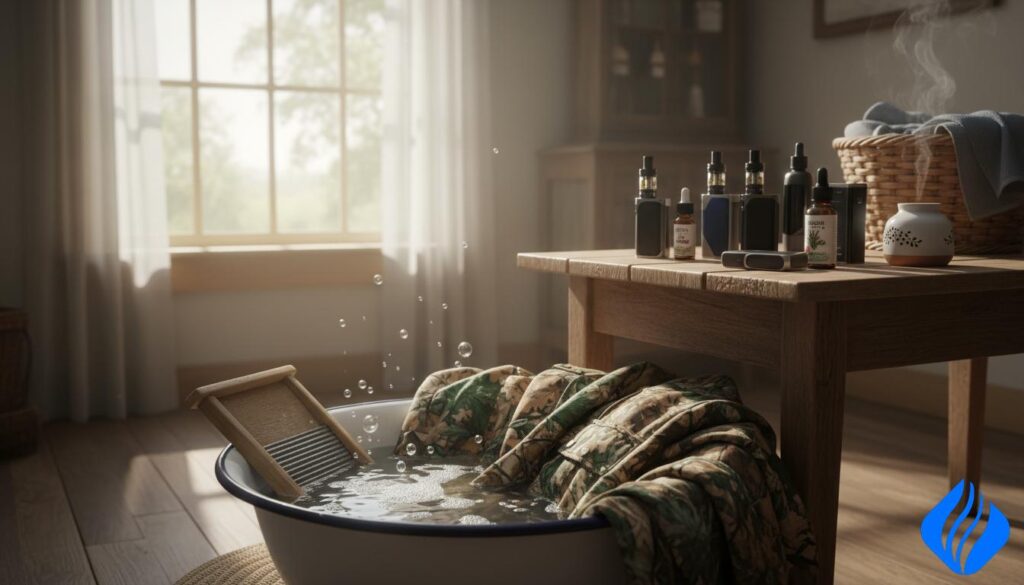
First, run an empty washer cycle with baking soda to strip scented buildup. Then wash hunting clothes with an unscented detergent made for scent removal.
Use a second rinse if residues persist. This removes trapped laundry detergent and softener that can add sweet notes.
Drying and storage tactics
Hang-dry outdoors when possible to let sun and air neutralize residues. Once dry, seal hunting clothes in clean plastic bags or totes.
Handle stored gear with gloves. That reduces transfer from truck seats, food, or household odors to your kit en route to the stand.
Boots, hygiene, and diet
Rubber boots leak less odor than breathable leather. Treat boots as scent sources—clean and store them separately.
Use scent-free soap, shampoo, and deodorant. Pay attention to hair, neck, and hands where smells transfer to collars and straps.
Avoid strong foods and stay hydrated. Breath odor compounds exhaled aerosols and raises detection risk on cold mornings.
Practical checklist and maintenance
- Run baking soda cycle in washer, then wash hunting clothes with unscented detergent.
- Hang-dry outside; seal clothes in bags for transport.
- Store boots separately; prefer rubber boots for low odor escape.
- Use scent-free body products; use unscented hand sanitizer after handling devices.
- Use scent control sprays as a maintenance layer only; wind and placement remain primary controls.
How to vape more discreetly outdoors without contaminating your hunting area
A focused routine reduces the chance that aerosol or residue will compromise your hunt. We outline steps you can follow in the woods to limit scent transfer and preserve your stand.
When to avoid vaping entirely and when to step away from the core area
Decision rule: avoid use when wind or thermals are variable, when you sit in tight cover, or during close-range archery hunts.
- Lowest risk: off-site, upwind, or well away from bedding and high-traffic routes.
- Avoid entirely: variable wind, thermal swaps, tight cover, and close-range stands.
- If needed, step to your truck or a clear location, then return only after airing out.
Hands and mouth: quick odor-control steps after vaping
Wipe your hand and mouth with unscented wipes or hand sanitizer. Swap gloves before you touch release aids or bow grips.
Use breath-control: hydrate and avoid scented foods pre-hunt. These small moves limit transferable odor at crucial times.
Managing trash and devices so smells don’t linger at your stand
Store empties, pods, and packaging in an airtight bag. Keep devices sealed in pockets or a pack to reduce residual aroma on gear and boots.
In our handling tests, tight-airflow disposables leaked less aroma into pockets. High-airflow units left more residue at lip contact points.
| Product | Puffs per Dollar | Flavor Consistency | Airflow Leakage (handling) |
|---|---|---|---|
| Geek Bar | High | Good over full life | Moderate |
| Lost Mary | Medium | Very consistent | Low |
| Raz | High | Variable late-life | Higher |
Value note: we evaluate disposables on Puffs per Dollar and Flavor Consistency because a device that fades early often prompts more puffs and more airborne odor during a sit. Browse specs if you want to compare models: Disposable Vapes and Hot Sale. For scent-risk context, see our related testing on field detection here.
Safety, authenticity, and responsible nicotine use in the field
Field safety starts with honest handling: nicotine, batteries, and device authenticity matter as much as wind and scent control. We stress adult-only, responsible use. Nicotine is an addictive chemical. Do not increase intake to compensate for restricted use during hunting season.
Technical checklist for controlled use:
- Battery capacity: list in mAh — higher mAh supports steadier output.
- E-liquid volume: list in ml — helps estimate runtime.
- Nicotine strength: typically 2% or 5% nic salt; choose lower to reduce frequency.
- Coil type: Mesh vs Dual mesh — dual mesh often raises vapor and detectable odor.
- Charging port: prefer USB‑C for field-ready cables.
Hands-on testing: mesh coils give a smoother throat hit. Dual-mesh feels stronger and produces more vapor. After ~5000 puffs, many disposables flatten in flavor. That drop can push users to over-puff and increase odor.
| Model | Puffs per Dollar | Flavor Consistency |
|---|---|---|
| Geek Bar | High | Good mid-life; some fade past 5k |
| Lost Mary | Medium | Very consistent through service life |
| Raz | High | Variable; more early fade reported |
FAQ
How to know if it’s empty? Reduced vapor, muted flavor, or blinking lights. Stop to avoid dry hits and burnt odor.
How to recharge safely? Use quality USB‑C, avoid extreme temps, don’t charge unattended, and stop if it heats up.
Is it authentic? Scan the packaging QR code and verify via https://www.google.com/url?sa=E&source=gmail&q=sokvape.com. Check RandM and Bang pages for posted specs before purchase: RandM, Bang.
Conclusion
We close with a clear operational standard: treat wind and thermals as the final authority for any scent decision. Make choices that reduce risk, not justify convenience.
Core takeaway: deer detect unusual airborne cues. Use this rule of thumb: avoid use near the stand, keep odors off hands, clothes, and gear, and let wind rule placement in the field.
Scent control reduces risk but is not invisibility. Even thorough routines fail if odor drifts downwind into a travel corridor. Be realistic about what reduction achieves during the season.
Simple operating standard: when conditions are unstable, skip use until you are out of the woods. Consider a recognized hunter education course to sharpen field habits, decision-making, and safety.
Final note: prioritize safety, authenticity checks, and battery best practices. Responsible nicotine handling protects you and preserves ethical hunting time in the field.
 English
  German
  Dutch
Dutch  Danish
  Czech
Czech  Italian
  Slovenian
  French
  Hungarian
  Spanish
  Polish