

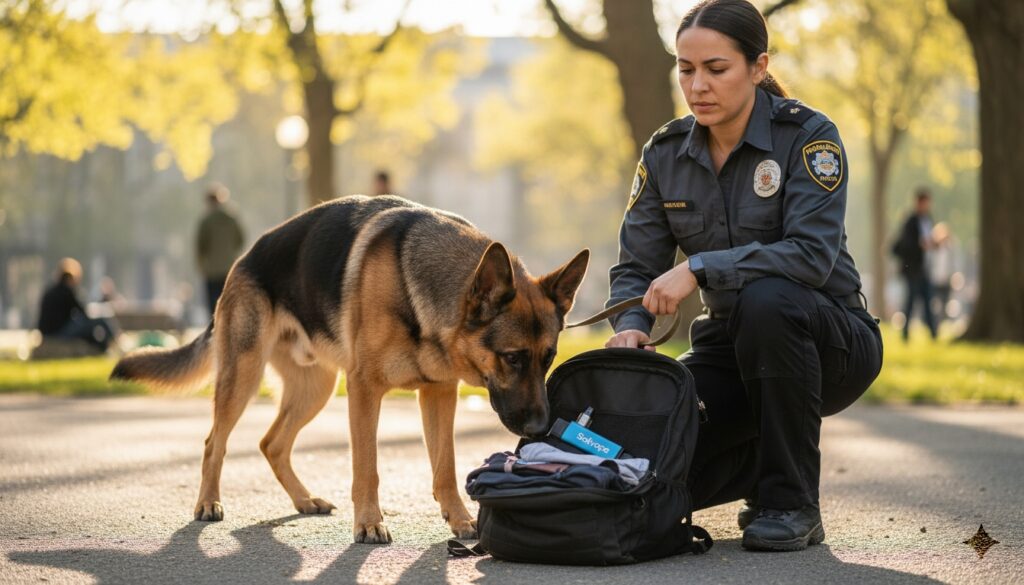
Many think drug dogs only sniff out narcotics. But, 2026 security is more advanced. Now, with VaporWake tech and nicotine-detecting dogs, the answer to ‘can drug dogs smell vapes’ is more complex.
Studies reveal dogs can smell 10,000 to 100,000 times better than humans. They can sniff out e-liquid chemicals, even when sealed. This skill is key for law enforcement and others, making it vital to grasp this new reality.
Key Takeaways
- The question ‘can drug dogs smell vapes’ now has a complex answer due to advanced detection technologies.
- VaporWake technology and nicotine-specific K9 units are on the rise.
- Dogs can detect the chemical components of e-liquids, such as nicotine and artificial flavorings.
- K9 detection capabilities have expanded, affecting vaping regulation and enforcement.
- Understanding the science behind K9 scent detection can help users and law enforcement navigate this evolving issue.
Introduction to Drug Dogs and Their Capabilities
Drug-sniffing dogs are vital to law enforcement. They use their keen sense of smell to find illegal drugs. These dogs have helped make many drug seizures, proving their skill in canine detection.
An Overview of Drug-Sniffing Dogs
These dogs are trained to find smells of drugs like cocaine and heroin. They learn through positive rewards and drills. This training helps them find drugs in different places.
Their sense of smell is much better than ours. It’s over 40 times stronger. This makes them very reliable in finding drugs.
The Rise of Vaporwake Dogs
Vaporwake dogs are a new type of detection dog. They can find smells from e-cigarettes and vaporizers. They learn to track vapor trails, helping find substances others might miss.
The Science Behind Canine Olfactory Senses
Dogs’ sense of smell is amazing. Their noses have up to 300 million smell receptors. Humans have only 6 million.
Also, dogs’ brains are better at smelling. The part for smells is 40 times bigger than ours. This makes them the best at finding scents.
How Does Olfaction Work in Dogs?
Dogs are famous for their amazing sense of smell. Their noses are built to detect a wide range of smells, including those from vape products. This is thanks to their unique nose anatomy and many olfactory receptors.
Anatomy and Physiology of Canine Olfaction
A dog’s nose is designed for sniffing out scents. It has up to 300 million olfactory receptors, compared to humans’ 6 million. This means dogs can smell things much better than we can.
Dogs also have a special organ called the vomeronasal organ. It helps them detect pheromones and other chemical signals. When a dog sniffs, it uses its nose to catch scent molecules. This lets them identify different smells, like those from THC vapes and nicotine.
The Role of Volatile Organic Compounds (VOCs)
Volatile organic compounds (VOCs) play a big role in how dogs smell things. These are gases that come from solids or liquids, like vape products. Dogs’ noses are very good at finding these compounds, even in small amounts.
Research shows that dogs can tell the difference between nicotine and THC vapes. They do this by detecting VOCs. This skill helps them alert their handlers to the presence of these substances, even if they’re hidden. Our discussion on how drug-sniffing dogs detect scents offers more details on their incredible abilities.
The Science of E-Liquid Scent Detection
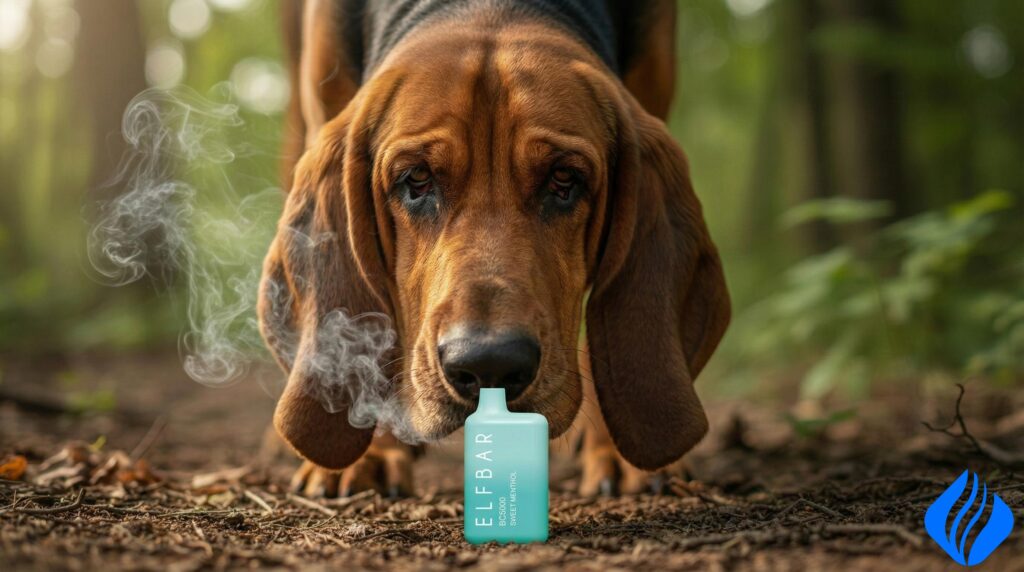
Nicotine detection dogs can sniff out vaping products. They focus on the main parts of e-liquids: nicotine, propylene glycol, and vegetable glycerin. Each part affects the smell and makeup of vaping products.
Can Dogs Detect Nicotine?
Dogs trained to find nicotine can do it well. They can smell the unique smell of nicotine. Studies show they can tell nicotine from other smells over 90% of the time. This skill is useful in places like schools and prisons.
Detecting Propylene Glycol and Vegetable Glycerin
Dogs can also find propylene glycol and vegetable glycerin in e-liquids. These substances have their own smells that dogs can pick up. Together, these smells help dogs find vaping products.
| Component | Role in E-Liquid | Detection Profile |
|---|---|---|
| Nicotine | Primary addictive substance | Distinct chemical structure, strong odor |
| Propylene Glycol | Carrier for flavors, vapor production | Slightly sweet, subtle odor |
| Vegetable Glycerin | Thicker vapor production, sweetness | Slightly sweet, neutral odor |
Dogs’ skill in finding these e-liquid parts shows how advanced their training is. They help keep places like schools and airports vape-free.
Can Drug Dogs Smell Vapes?
It’s important to know what’s in e-liquid to see if drug dogs can smell vapes. E-liquid, or vape juice, has propylene glycol (PG) and vegetable glycerin (VG) as its base. It also has nicotine and artificial flavorings, which have their own smells. These smells can be detected by drug dogs.

Understanding E-Liquid Composition
PG and VG are in e-liquid and don’t smell much to humans. But, they can have a scent that dogs can pick up. Nicotine in e-liquids also has a smell. And, the artificial flavorings add to the scent, making it easier for dogs to detect.
Artificial Flavorings and Burnt Coil Scents
Artificial flavorings in vape liquids are key in detecting vaping. They can smell like fruits or desserts. Even a little bit of these flavorings can make a strong smell that dogs can find.
The smell of a burnt coil in a vape device also helps dogs detect vapes. When a coil burns, it smells different. This smell, along with the many flavors, makes it easy for dogs to tell if someone is vaping.
| Component | Detectability |
|---|---|
| Propylene Glycol | Moderate |
| Vegetable Glycerin | Moderate |
| Nicotine | High |
| Artificial Flavorings | Very High |
| Burnt Coil | High |
Drug Dogs and THC Oil Detection
To understand if drug dogs can find THC oil in vapes, we need to look at how they are trained. These dogs are taught to sniff out specific smells. Their amazing sense of smell is what makes them good at this job.
Differences Between Nicotine and THC Detection
The main difference in detection between nicotine and THC oil is their chemical makeup. Nicotine, found in e-liquids, has certain smells. THC oil, on the other hand, is about detecting cannabinoids. How dogs are trained and used depends on these differences.
Training Drug Dogs for THC Oil
Training dogs to find drugs involves exposing them to small amounts of substances. For THC oil, the challenge is greater. Dogs must learn to spot THC in oils and extracts, not just the plant itself. They are trained to recognize both traditional cannabis and THC oils.
Recently, some drug dogs have stopped looking for marijuana. They now focus on other drugs because of legal changes. Not all dogs are trained to find THC oil. But those that are can spot it, even in hidden places like vapes and edibles.
In short, drug dogs are very good at finding THC oil among other smells. Their training and sense of smell are key to their success. For more on how well drug dogs can find vape cartridges, check out this detailed guide.
Challenges in Vaping Detection at Airports
Airport security has become stricter, focusing more on vaping devices. With vaping’s rise worldwide, TSA has updated its rules. Knowing how to handle vaping at airports can make security checks easier.

TSA and Airport Security Protocols
The TSA has strict rules for safety, including vaping policies. E-cigarettes are okay in carry-ons but not in checked bags. This is because they could start fires.
When going through security, take out all vaping devices from your carry-on. But, the liquid part must follow the 3.4 ounces rule. It should fit in a quart-sized clear bag.
- Remove e-cigarettes and vapes from carry-on for screening.
- Limit e-liquid containers to 3.4 ounces as per TSA regulations.
- Store all liquids in a quart-sized clear plastic bag.
Legal Considerations for Traveling with Vapes
Traveling with vapes raises legal questions, depending on where you go. Knowing the laws of your destination is critical. Some places ban vaping, which can result in big fines or jail time.
In the U.S., TSA rules apply to domestic flights. But, international travelers need to check their destination’s laws. This avoids legal trouble.
Being ready for TSA rules is important. Knowing the regulations can prevent delays and legal problems. Keeping up with changes makes travel safer and less stressful.
Vape Detection in Schools and Public Places
Vaping in schools is a growing worry for teachers and parents. The rise of stealth vaping in schools has led to new ways to fight it. Also, vaping in public places needs strict rules to keep everyone safe.
Stealth Vaping in Schools
Stealth vaping is hard to spot because it’s done secretly. Students use clever ways to hide their vaping devices. This often happens in places where teachers can’t watch, like bathrooms and locker rooms. Schools must find new ways to catch and stop this.
How Schools are Addressing Vaping
Schools are fighting vaping with different strategies. They use vape detectors, dogs to sniff out vaporizers, and teach about vaping dangers. They also have strict rules against vaping on school grounds.
| Method | Description |
|---|---|
| Vape Detectors | Electronic sensors installed in restrooms and locker rooms to detect the presence of vapor emissions. |
| Drug-Sniffing Dogs | Specially trained canines that can identify specific chemical compounds in vape pens. |
| Education Programs | Initiatives aimed at informing students about the dangers of vaping and promoting healthier lifestyle choices. |
To tackle vaping in schools, schools need tech and education. By following public place rules and using these methods, schools can reduce stealth vaping among students.
Disposable Vapes and Detection Challenges
Disposable vapes are hard to detect because of their special makeup and short life. These things make it tough to spot their smell all the time.
Understanding the Composition of Disposable Vapes
Disposable vapes have parts that make them tricky to find. They are not like regular vapes, which you can take apart. Instead, they are all in one, with a battery, atomizer, and e-liquid cartridge.
The e-liquid mix includes propylene glycol, vegetable glycerin, nicotine, and flavorings. This mix can make a smell that’s different from other vapes.
Why Disposable Vapes are Harder to Detect
There are a few big reasons why finding disposable vapes is hard. Here’s why:
- Low E-Liquid Levels: They have less e-liquid, so they don’t give off as many smells as bigger vapes.
- Unique Flavor Profiles: There are many flavors, from sweet to minty. Each one smells differently.
- Compact Design: Being small means they don’t release much smell. This makes it hard for dogs to find them.
The smell of disposable vapes is also hard to pick out because it blends with other smells. As we learn more about vape parts, we see how each part makes it harder to find their scent.
The Effectiveness of K9 Units in Different Environments
K9 units are very good at finding scents, but how well they do it changes with the setting. They work differently in big places like airports and small areas like warehouses. The environmental impact on scent detection is huge.
Olfactory Challenges in Different Settings
Every place has its own smell challenges. In busy places like airports or concerts, many smells can hide the ones they’re looking for. But in tight spaces, smells can get stronger, making it easier for them to find what they need.
The materials and design of these places also affect how smells spread and stay. For example, how well a place is ventilated can change how smells are carried.
Training Variations Across K9 Units
How well a K9 unit does its job also depends on its training. Dogs trained for airport work get special training for all the smells they’ll face. They might practice in fake airport setups to get used to all the smells.
In places like warehouses, they might learn to find smells that have had time to settle. No matter where they work, training them in different settings helps them do their job better.
To learn more about K9 units and drug dogs, including tips on avoiding detection, see this guide.
Understanding how training and the environment affect a K9 unit’s work is key. It shows why training needs to be tailored to each place. This way, we can make K9 units even better at their jobs in all kinds of places.
Conclusion
In this guide, we’ve looked into how drug detection dogs work, focusing on if they can smell vapes. We learned about their amazing sense of smell and how they can find substances in vapes. We also talked about the special training they get to find nicotine and THC oils.
We saw how these dogs are used in places like airports and schools. Their training and skills help keep us safe. As vaping changes, so will the training of these dogs, keeping us safe and following the law.
Looking ahead, new tech and research will make drug dogs even better. These dogs will keep helping us stay safe and healthy. They are a key part of keeping us safe from harmful substances.
 English
  German
  Dutch
Dutch  Danish
  Czech
Czech  Italian
  Slovenian
  French
  Hungarian
  Spanish
  Polish