

Federal Tobacco 21 sets the minimum age to purchase vaping and tobacco products at 21 nationwide. That means the short answer to “can i buy a vape at 18” is no. Federal law, in effect since December 2019, overrides any lower state limits and leaves no exceptions for military service or nicotine-free items.
We explain what “legal age” means for purchasing, possession, and sales enforcement. We will cover what products are regulated, how retail age checks work, and what happens when sellers ignore the law.
For responsible adults 21 and older, we preview the technical review section. Expect specs such as battery (mAh), fluid (ml), puff counts, coil type, and USB‑C. We will compare puffs-per-dollar and flavor stability versus competitors like Geek Bar and Lost Mary, based on hands-on testing.
Our approach is objective. We prioritize compliance, safety, and clear technical guidance — not ways to bypass age rules. For state-specific checks and more on federal versus state laws visit how old to vape: legal age.
Key Takeaways
- Federal law sets the minimum age to purchase vaping products at 21 nationwide.
- No federal exceptions exist, including for military personnel or nicotine-free products.
- We will explain regulated product types, retailer verification, and legal risks.
- Technical reviews will list battery, ml, puff count, coil, and port specs for adults 21+.
- Our focus is compliance, safety, and data-driven product comparisons.
Can I buy a vape at 18 in the United States right now?
Since December 2019, federal statute establishes 21 as the floor for retail tobacco purchases across the United States. In plain terms: right now in the U.S., you must be 21 to purchase vaping and tobacco products, regardless of local materials that reference lower ages.
The federal Tobacco 21 rule sets 21 as the nationwide minimum age
Tobacco 21 creates a nationwide minimum age floor. States may add restrictions or tougher penalties. They may not lawfully permit retail sales below 21.
Why “my state says 18 or 19” doesn’t override federal law
Older state language or outdated materials sometimes still cite 18 or 19 years. Those references do not change federal control of interstate retail sales.
Common checkout and online age-gate confusion
Typical points of confusion at the register include expired or vertical IDs, out-of-state credentials, and explanations like “nearly 21.” Online, clicking an age gate is not legal proof of eligibility. Reputable sellers use verification services and delivery ID checks.
- Hierarchy to remember: federal purchase rule → state-level add-ons (possession, location bans) → store policies stricter than law.
- Common clerk issues: expired IDs, vertical IDs, and out-of-state cards.
- Online notes: verification services or signature/ID at delivery are required for compliance.
Practical guidance: Retailers that offer sales to customers under 21 are noncompliant and pose legal risk. If you are 18–20, expect refusal from responsible sellers. Next, we discuss which products fall under Tobacco 21 and how enforcement works in practice.

What Tobacco 21 covers: nicotine vapes, zero-nicotine devices, and “parts”
Regulatory scope focuses on the entire vaping ecosystem—hardware, consumables, and parts. Under the FDA’s Deeming Rule, e-cigarettes and their e-liquid are treated as tobacco products or components. That means age limits apply to more than bottles labeled with nicotine.
What falls under the rule:
- Devices — disposables, mods, pods, and empty units marketed for inhalation.
- Parts — coils, tanks, refillable pods, batteries, and chargers sold for vaping use.
- Liquids — nicotine and 0 mg blends when sold as vaping consumables.
There are no loopholes for empty devices or battery-only sales if the item is sold as a vaping part. Retailers must treat these products as age-restricted. Synthetic nicotine is also regulated like tobacco-derived nicotine under recent federal updates.
Why this matters: Broad coverage reduces mislabeling risks and protects consumers from low-quality parts that raise safety hazards. For enforcement, reputable stores refuse sales to underage buyers for both accessories and complete products.
State laws in addition to federal law: possession rules, location bans, and penalties
Several states enforce their own possession and location rules in addition to federal purchase limits. Federal law limits sales, but some state measures target holding and use for younger adults.
Purchase vs. possession
Federal rules focus on sale and retail compliance. State rules sometimes add penalties for possession by people under the local vaping age.
Lawmakers view possession rules as a tool to curb youth access near schools and social settings.
Common location restrictions
Typical limits apply in K-12 schools, childcare facilities, public buildings, and parks. Local clean‑air ordinances often expand those zones.
Examples and verification
Examples include Florida and Georgia cited for under‑21 possession penalties, New Jersey for fines and education, and Virginia for civil penalties and counseling referrals.
- Verification checklist: check your state health department or legislature site.
- Then review county or city ordinances.
- Finally, confirm retailer policy—the strictest rule controls real life.
Practical note: Beyond fines, consequences may include school discipline, campus violations, or employment issues. Public policy centers on youth brain development and long‑term health risks.

How retailers actually verify age and what happens if they sell to minors
Age verification at checkout is where law, policy, and day‑to‑day retail practice meet. Retailers use simple tools to meet the requirement: manual ID checks, barcode or magnetic‑stripe scans, and third‑party age‑verification services for online sales.
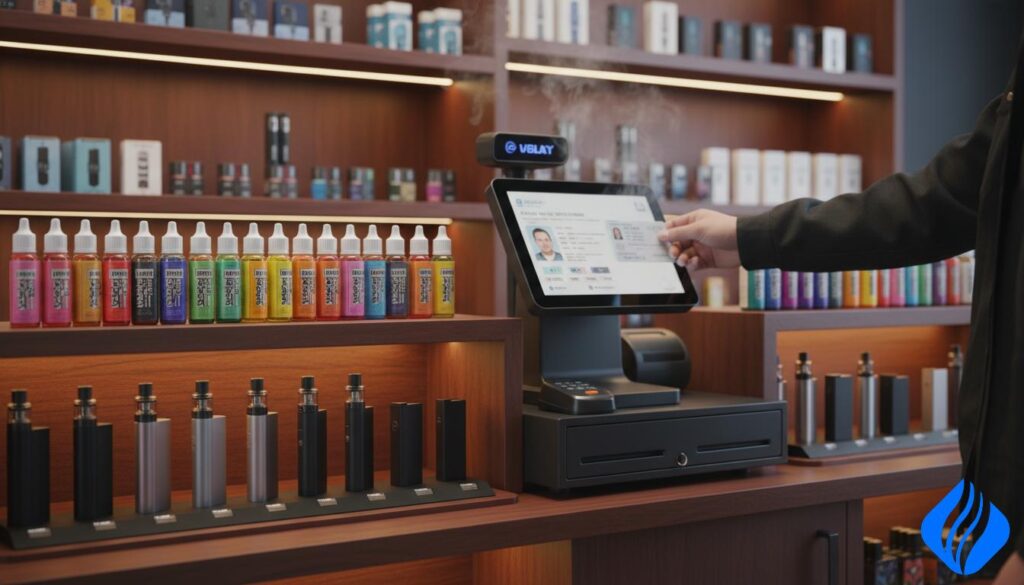
What verification looks like in practice:
- ID is checked for birthdate and authenticity.
- Clerks may scan or enter data into a verification database.
- Online vendors use age‑gate services and require ID at delivery.
FDA compliance checks and escalating retailer penalties
The FDA conducts undercover compliance checks with underage operatives. If a sale to minors occurs, enforcement targets the retailer, not the buyer, though state possession laws may still apply.
Escalating civil penalties: $250 warning for the first violation; $500 second within 12 months; $2,000 third within 24 months; $5,000 fourth within 24 months; and $10,000 fifth within 36 months plus a no‑tobacco‑sales order.
Why some stores still risk illegal sales and what that means for buyers
Some outlets gamble on low inspection frequency, poor staff training, or familiar customers. That risk does not create safe access.
Illegal sales expose buyers to counterfeit products, unsafe batteries, and possible state penalties. Strict ID checks are a consumer protection signal and part of good compliance.
What 18-20-year-olds should know about online orders, shipping, and ID checks
Online orders trigger multiple verification layers before a package reaches a doorstep. Merchants and carriers build checks to enforce age rules and prevent unlawful retail access.
How verification and delivery checks work
Most sellers use account age gates, ID‑database checks, and image uploads before accepting payment. Carriers may require an adult signature and matching ID at delivery.
Why third‑party purchases increase risk
Having someone older place an order shifts legal liability. Payment and shipping trails can identify the purchaser. Many jurisdictions treat furnishing regulated products to underage people as a separate offense.
| Verification Layer | What it checks | Delivery step | Common failure |
|---|---|---|---|
| Account age gate | Declared birthdate | Order blocked or allowed | False birthdate entry |
| ID database | Government ID cross‑check | Order approval | Mismatch with billing |
| ID upload | Photo ID + selfie | Manual review | Poor image or fraud |
| Carrier signature | ID at doorstep | Release or return | No matching ID |
Practical note: Attempts to circumvent checks increase legal and safety consequences. Third‑party orders also raise the risk of counterfeit or mislabeled products.
Our guidance: Wait until federal and local rules allow lawful purchase. Then use reputable sellers that publish specs and perform authenticity checks.
Hands-on product insights: specs you’ll see on disposables and what they mean for safety
Technical labels on disposables reveal performance and safety trade-offs that matter for daily use. We read spec sheets to judge runtime, flavor life, and charging risks.
Key spec checklist:
- Battery capacity (mAh): higher mAh gives longer runtime but increases charging care.
- E-liquid volume (ml): bigger ml usually means more puffs; coil efficiency still affects output.
- Nicotine strength: common options are 2% or 5% nicotine salt; 5% feels much stronger.
- Coil type: Mesh vs Dual Mesh — mesh offers consistent vapor; dual mesh raises density and liquid use.
- Charging port: USB‑C improves speed but not safety guarantees.
Testing notes and safety basics
Our hands-on checks record throat hit as smooth vs. strong, airflow (MTL-like vs open), and vapor production stability. After heavy use near 5000 puffs, flavors often dull and cooling agents may taste harsher.
Charging tips: use reputable USB power sources, avoid charging on soft surfaces, and stop use if the device gets hot, swells, emits a burnt smell, or behaves erratically. A nearly empty unit may run hotter and taste burnt — that is a clear end-of-life sign.
Product value comparison: puffs per dollar and flavor consistency across popular brands
We quantify puff efficiency and flavor life so readers can choose devices that remain consistent to the end. Our method is auditable: puffs per dollar uses observed usable puffs versus listed counts. Flavor consistency tracks taste through extended use, including around 5,000 puffs where many products drift.
Main product vs. Geek Bar — puffs per dollar
We compare price-to-usable-puffs and note efficiency differences from coil and airflow design.
Main product vs. Lost Mary — flavor stability
Hands-on notes: throat hit described as smooth or strong, cooling level, and whether flavors flatten after long sessions.
Main product vs. Raz — coil and vapor consistency
We test mesh vs dual mesh behavior, output drop as liquid falls, and draw resistance changes.
“We prioritize devices that stay consistent to the end. High advertised puff counts matter less than usable puffs without burnt hits.”
| Product | Battery (mAh) | E-liquid (ml) | Nicotine | Coil |
|---|---|---|---|---|
| Main product | 950 | 16 | 5% nic salt | Mesh |
| Geek Bar | 850 | 13 | 5% nic salt | Mesh |
| Lost Mary | 900 | 14 | 5% nic salt | Dual Mesh |
| Raz | 1000 | 18 | 2% nic salt | Dual Mesh |
Takeaway: The best product balances real usable puffs, stable flavor, and safe specs (battery, ml, coil, USB‑C). Our comparisons are for adults 21+ reviewing product performance and safety; purchasing must follow federal and local rules.
Buying responsibly at 21+: where to shop, how to spot authentic products, and internal links
For adults who meet the legal age requirement, start with verified sellers and clear labeling. Reputable sites and stores build their checkout flow to enforce the age purchase rule and state-level regulations.
Shop by category and brand
Shop categories: Disposable Vapes and Hot Sale.
Shop brands: RandM and Bang.
Authenticity check
Verify the QR code on packaging. Confirm the landing domain is sokvape.com by using the official link (Contact Support) to avoid spoofed pages. Authentic items match labeled nicotine strength, battery specs, and charging behavior.
Quick FAQs
- How to tell it’s empty? Airflow tightens, flavor drops, vapor thins, or device indicators show low levels. Stop if you taste burnt.
- How to recharge safely? Use quality USB‑C cables, prefer manufacturer guidance, do not charge unattended, and retire units with port damage or swelling.
- Is it authentic? Match QR verification, packaging security seals, and seller reputation. Counterfeit items often fail on specs and safety.
Practical reminder: Age purchase checks protect consumers and enforce sale rules. Retailers following regulations reduce counterfeit risk and improve safety for all users.
Nicotine warning: This product contains nicotine. Nicotine is an addictive chemical.
Conclusion
Federal Tobacco 21 sets the purchase floor: anyone under 21 lacks lawful retail access to covered vaping products. To answer the question “can i buy a vape at 18”: the legal age for purchase is 21 nationwide.
Remember the framework: federal law establishes the purchase minimum at 21; state laws may add possession and location restrictions; retailers may impose stricter store policies. Covered products include nicotine devices, zero‑nicotine liquids, and many parts and components.
Reputable sellers verify ID and face FDA compliance checks with escalating penalties for illegal sales. For data on underage purchase effects, see the study on purchase and dependence here: evidence on underage purchase effects.
This product contains nicotine. Nicotine is an addictive chemical.
 English
  German
  Dutch
Dutch  Danish
  Czech
Czech  Italian
  Slovenian
  French
  Hungarian
  Spanish
  Polish