

can i get herpes from sharing a vape is a common search. We address it directly and with evidence. Saliva can linger on a mouthpiece and carry pathogens. HSV‑1 spreads efficiently via saliva, including during asymptomatic shedding.
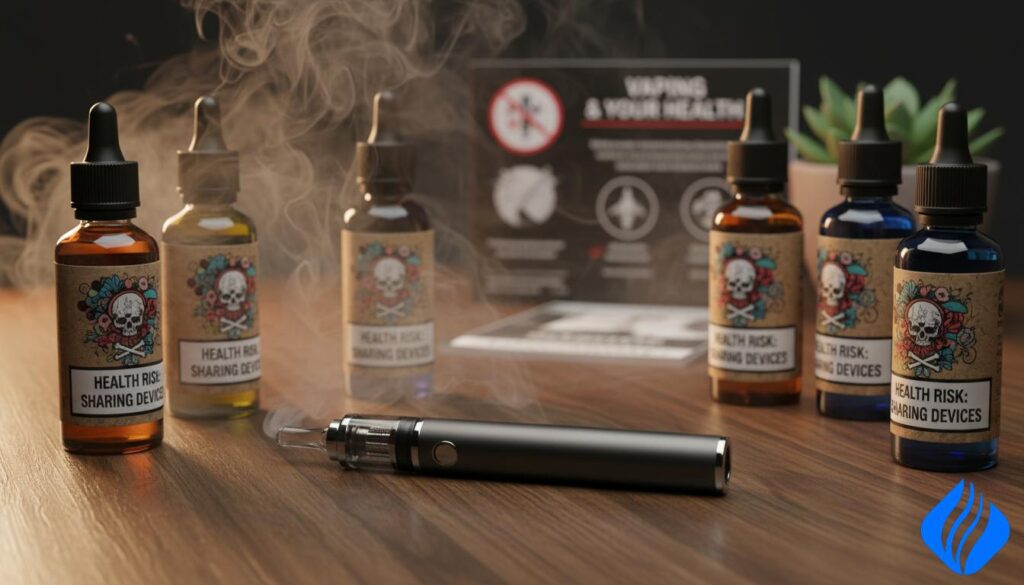
We set a clear, non‑alarmist risk framework. We define “shared device” (passing a disposable, swapping pods, rotating a device) and explain why mouth contact raises exposure. Medical guidance favors avoiding personal items that touch the mouth.
This FAQ page previews hands‑on testing and hygiene notes. We will compare battery mAh, e‑liquid ml, nic salt levels (2%/5%), mesh versus dual mesh, USB‑C, puffs‑per‑dollar, and flavor consistency versus Geek Bar, Lost Mary, and Raz. We note supply and cost benefits for wholesale sourcing at sokvape.com.
Nicotine warning: This content is for adults 21+ only. Nicotine is an addictive chemical. Vaping products may contain nicotine and are not risk‑free; keep products away from children and pets.
Key Takeaways
- Direct answer: Saliva contact makes transmission possible; risk is context dependent.
- Risk framework: Not panic‑driven—clear guidance on mouthpiece exposure and asymptomatic shedding.
- What we test: Moisture on mouthpieces, battery mAh, e‑liquid ml, puffs‑per‑dollar, and flavor stability.
- Harm reduction: Use sealed single‑use devices or personal mouthpieces; clean shared gear between users.
- Regulatory note: Adults 21+ only; nicotine is addictive and products are not risk‑free.
Can i get herpes from sharing a vape?
We outline the real mechanics that make mouthpiece exposure relevant to viral spread. The core idea is simple: moist contact transfers biological material. That transfer may include viral particles in saliva.
Why saliva on a mouthpiece matters for HSV-1 transmission
Saliva can deposit on a mouthpiece during use. If viral particles are present, they may transfer to the next user’s lips or mucosa. The probability depends on how much fluid is present and how soon the device is reused.
Asymptomatic shedding and why “no sores” doesn’t mean “no risk”
Asymptomatic shedding means the virus can be released without visible symptoms. People can appear healthy while still transmitting the simplex virus. Relying on appearance is therefore unreliable for safety decisions.
What the research says about HSV survival on plastic/metal surfaces for hours
Studies show the herpes simplex virus type can survive on hard surfaces like plastic and metal for several hours. Infectivity falls with time, but moisture, residue, and warmth from use slow that decline.
Yes, transmission is possible. But survival on a mouthpiece is not the same as guaranteed infection. Dose, contact timing, and entry via lips or small breaks in skin determine actual risk. For a deeper read, see our detailed FAQ on device risks at shared device transmission.
How herpes spreads in real-world vaping situations
Real-world behaviors — like passing devices quickly in crowds — shape viral exposure more than theory alone.
What “type” means: HSV‑1 typically causes oral infection. HSV‑2 is more often linked to genital herpes. Both are herpes simplex viruses with overlapping traits and possible cross‑site infection.
Highest-risk scenario
The greatest risk is use while someone has an active cold sore or visible sores. Viral load spikes during that phase. Brief mouth contact then may transfer infectious fluid to another person’s lips or mucous membranes.
Why quick contact still matters
Even a short puff can move saliva onto the next user’s skin or inside the mouth. Micro‑cuts, chapped lips, or irritated oral tissue create entry points. Asymptomatic shedding also raises risk when no sores are present.
- Higher concern: active sore present, multiple users, minimal time between uses.
- Lower concern: long delay between uses, dry mouthpiece, single brief contact.
| Exposure Factor | Relative Risk | Notes |
|---|---|---|
| Active cold sore | High | High viral load; avoid mouth contact |
| Asymptomatic shedding | Moderate | Possible transmission without visible sores |
| Short delay between users | Moderate | Moisture preserves virus on surface |
| Micro‑cuts or chapped lips | Elevated | Facilitates viral entry |
Other infections you can pick up from sharing vapes
Shared mouthpieces expose users to more than one pathogen. Saliva and droplets on a mouthpiece create multiple transmission routes. This is an evidence-led health concern, not an alarm.
Cold and flu on contact surfaces
Rhinoviruses spread easily through saliva and hand-to-mouth contact. Quick rotation of devices among people makes transfer likely.
Influenza strains can survive on hard surfaces for up to ~48 hours. A moist mouthpiece can retain infectious particles long enough to pose a real risk.
COVID-19 and respiratory droplets
SARS‑CoV‑2 transmits via respiratory droplets and residue. In close indoor settings, contaminated vapes increase exposure potential, especially when ventilation is poor.
Mono (Epstein‑Barr) and oral contact items
Epstein‑Barr, known as the “kissing disease,” spreads through saliva. A used mouthpiece is a plausible vehicle for person-to-person transfer.
Bottom line: saliva carries mixed bacteria viruses. Reducing device sharing reduces multiple infections at once and is a practical harm-reduction way to lower overall risk.
What our hands-on testing shows about shared-device hygiene risks
hands-on testing revealed consistent damp films and trapped residue on commonly used mouthpieces after heavy sessions.
Mouthpiece moisture and residue buildup
After long runs, the mouthpiece often holds a visible film. Textured plastics and seams trap residue. Wiping with a cloth reduced surface film but did not remove all deposits.
Condensation, warmth, and re-contact over time
Warmth from coils plus condensation keeps the lip area damp. That state extends viable life on hard surfaces and raises the chance of direct contact transfer when the next person uses the device.
Practical takeaway for social vaping now
Vaping groups note that strong throat hits lead to faster, shorter puffs. That increases passing frequency. After ~5000 puffs we saw flavor shift and more users checking taste, which raises sharing events.
“Moisture and design details matter more than users expect.”
| Factor | Observation | Impact |
|---|---|---|
| Design (narrow bore/texture) | Residue pockets form | Harder to clean; higher hygiene concern |
| Vapor output | More condensation at tip | Greater residue on mouth-contact areas |
| Cleaning method | Cloth vs 70% alcohol | Alcohol reduces pathogens but may not sterilize |
Bottom line: For safety and good hygiene, keep mouth-contact items personal when with friends or others. This small step lowers overall risk.
How to reduce risk if you’re vaping with friends
Practical steps lower exposure risk when devices pass between friends. We focus on clear, usable actions that reduce mouth-contact transfer of saliva and other pathogens.
Best practice: don’t share mouth-to-mouth devices
Avoid sharing mouth-to-mouth devices. Medical guidance recommends keeping mouth-contact items personal to limit any direct saliva pathway for transmission.
If sharing happens: cleaning with 70% isopropyl alcohol wipes
Wipe the mouthpiece thoroughly with 70% isopropyl alcohol wipes before and after each use. Let the tip air-dry for at least 30 seconds.
What wipes do: they reduce viral load on smooth surfaces and lower overall risk.
What wipes don’t do: they may not sterilize textured seams or remove deep residue. Persistent films trapped in crevices limit effectiveness.
Safer alternative for groups: unopened, individual disposables
For group settings, choose sealed, single-use devices. One per person removes the pass-back cycle and meaningfully reduces chance to get herpes or spread other oral pathogens.
Browse sealed options at Disposable Vapes and timely deals at Hot Sale.
“Keeping devices personal is the simplest, most effective harm-reduction way to protect friends.”
Use direct but polite language with peers: “I’m keeping my device personal for hygiene.” This offers a clear boundary without stigma.
Disposable vape comparison for social settings: puffs per dollar and flavor consistency
For social settings, sealed single-use units offer the clearest balance of convenience and hygiene. Giving each person a sealed unit reduces mouth-to-mouth pathways and lowers group health concerns.
Main pick specs to check
- Battery capacity (mAh) — higher mAh supports steady output.
- E‑liquid volume (ml) — correlates to realistic puff range.
- Nicotine strength — 2% or 5% nic salt.
- Coil type — mesh vs dual mesh affects flavor life.
- Charging — USB‑C for rechargeables.
Puffs per dollar — practical method
Divide retail price by a realistic puff estimate, not the box claim. Cross‑check against ml and mAh. Devices with modest price but small ml often inflate puff counts and raise hygiene risk by prompting extra passing.
Hands-on and head-to-head notes
After ~5000 puffs we track throat hit, vapor output, and flavor fade. Sweetness and cooling agents tend to fade first; mesh coils keep base notes longer.
| Compare | Flavor Stability | Throat Hit / Output |
|---|---|---|
| Main pick (USB‑C rechargeable) | High | Stable |
| Geek Bar / Lost Mary | Moderate (coil design varies) | Consistent then sag |
| Raz | Moderate | Stronger hit, higher early output |
Browse sealed, personal-use options at Disposable Vapes or the current Hot Sale. For brand picks see RandM and Bang.
Common use questions that impact safety and authenticity
D. Quick, repeatable checks reduce surprises with power, flavor, and authenticity when vapes circulate.
How to know if it’s empty?
How to know if it’s empty? Watch for flavor drop‑off, weak vapor, and a harsher throat hit. Blink codes or steady flashing often indicate low battery or end‑of‑life behavior.
Nearly empty units may produce hotter draws and more coughing or other symptoms. That leads people to fiddle with devices or pass them around, which raises hygiene risk.
How to recharge safely?
How to recharge safely? Use a reputable low‑power adapter and a short USB‑C cable rated for charging. Avoid charging on flammable surfaces and don’t leave devices unattended overnight.
Stop charging if the shell becomes hot, if you smell odor, or if the device swells. These are heat warning signs that require immediate discontinuation and safe disposal.
Is it authentic?
Is it authentic? Check the QR or verification code on the manufacturer flow via sokvape.com using this link: https://www.google.com/url?sa=E&source=gmail&q=sokvape.com. Authentic verification reduces the chance of inconsistent nicotine delivery and poor battery protection.
Counterfeit devices may use low‑grade materials in mouth‑contact parts and pose both performance and safety concerns.
| Check | Field Sign | Action |
|---|---|---|
| Empty/near empty | Flavor fade, weak vapor, blinking | Replace or recharge; avoid sharing |
| Charging safety | USB‑C recommended; device warmth | Use good adapter; stop if hot or swollen |
| Authenticity | QR/verification fails | Do not use; seek refund or proper disposal |
“Fewer dead devices in a group means fewer impulse passings and better hygiene.”
Conclusion
The practical takeaway: mouth-contact items present a measurable transmission pathway that merits simple precautions.
Saliva on a worn mouthpiece may transfer the herpes simplex virus to lips or mouth, especially with short time gaps and irritated skin. Asymptomatic shedding means a person may spread virus without visible symptoms.
Reduce risk by avoiding direct mouth-to-mouth use. If reuse occurs, wipe tips with 70% isopropyl alcohol; this lowers viral load but is not a guarantee. Prefer sealed, personal disposables for groups.
Hygiene also limits other infections and mixed bacteria viruses. Nicotine warning—Nicotine is an addictive chemical. Adults 21+ only. For clinical context on vaping-linked esophagitis and infection risk see this vaping-associated esophagitis case report. If exposure or symptoms occur, contact a qualified healthcare professional.
 English
  German
  Dutch
Dutch  Danish
  Czech
Czech  Italian
  Slovenian
  French
  Hungarian
  Spanish
  Polish