

Can you buy vapes in Cancun Airport is the exact search many U.S. travelers type before a trip. We begin with a hard fact: Mexico’s federal policy broadly bans the import, sale, and use of vaping devices and e‑liquids. That makes the question less about convenience and more about risk management.
We outline the scope clearly. This guide contrasts airport availability with national laws, explains likely customs outcomes, and shows where vaping is restricted after landing.
Our approach is technical and practical. We’ll define terms (disposable vs. pod, nicotine salts vs. freebase) so later sections on battery mAh, coil type, and performance testing are easy to follow. We will not advise evasion of rules.
For regulatory detail and documentation tips, see our linked summary of Mexican rules at vaping in Mexico laws. Expect legal guidance, airport realities, customs advice, and safety notes to help plan a compliant trip.
Key Takeaways
- Mexico’s federal ban means travelers face confiscation, fines, or detention.
- This guide focuses on risk management, not workarounds.
- We define technical terms to prepare readers for performance comparisons.
- Documentation and declaring devices may reduce inspection friction.
- Later sections cover battery, puff performance, and nicotine safety.
What US Travelers Need to Know Before Flying to Cancun in the Present Day
A small device can become a major disruption at entry control. Customs scrutiny is highest at arrival. That is where a routine item can trigger screening, delay, or worse.
Why this matters: Enforcement is unpredictable. Some travelers pass without question. Others face secondary checks, fines, or temporary detention. Official rules and local laws still prohibit many vaping items across the country.
Practical downsides are real. Confiscation or administrative penalties can exceed $1,000 USD. Missed connections and stressful interactions with officials are common in problem cases.
What appears available in tourist zones is not always legal. Informal vendors and visible use do not change the underlying law. This is a compliance-and-convenience tradeoff. If nicotine matters for trip comfort, plan legal alternatives before departure rather than relying on last-minute purchases.
- Customs focuses on import and possession at entry.
- Expect unpredictable enforcement and possible confiscation.
- We recommend planning to reduce travel risk and delays.
Mexico’s Current Vape Rules, Laws, and Restrictions That Affect Tourists
The federal stance is clear. Import, sale, and use of many e-cigarettes and e-liquids are treated as prohibited across the country. Enforcement power rests with national agencies and customs.

How the rules evolved
- 2020: Ban on import and sale of certain vaping products.
- 2021: Decree reinforcing prohibition on importation.
- 2022: Tax and import/export law updated to restrict shipments.
- 2023: New public-place rules treat vaping like tobacco smoking.
Operational impact and penalties
“Banned nationwide” means items can be seized at entry, refused for sale, and forbidden for public use. Tourist-zone appearances do not override federal law.
| Action | Likely outcome | Reported penalty range |
|---|---|---|
| Possession at border | Confiscation; inspection | Immediate seizure; administrative fines |
| Public use | Warning or fine | Several hundred USD (typical) |
| Large quantity | Smuggling investigation; possible detention | $1,000–$2,000+ USD; criminal referral |
Safety note: Unregulated products may have unknown nicotine strength and contaminants. That risk exists independently of legal penalties.
Can you buy vapes in Cancun Airport?
Travel hubs concentrate staff, surveillance, and customs power, which raises the stakes for restricted items.
Arrival terminals are strictly non-smoking and non-vaping. Signage is common. Movement funnels toward immigration and customs. That increases inspection likelihood and interaction with officials. Travelers should expect controlled spaces and active enforcement.
Departure-side realities
Some departure zones offer limited designated smoking areas. Those spaces vary by terminal and often exclude vape use. Even when a smoking area exists, rules and local staff may treat vaping like smoking under current law.
Why buying at the terminal is unreliable
Official prohibition, spotty retail supply, and heightened scrutiny make on-site purchases unpredictable. Disposables and refillable devices are treated similarly by customs. That means planning around last‑minute terminal purchases carries unnecessary risk.
- Practical takeaway: Don’t rely on airport retail to solve nicotine needs.
- Reference: For legal background see is it illegal to vape in Cancun.
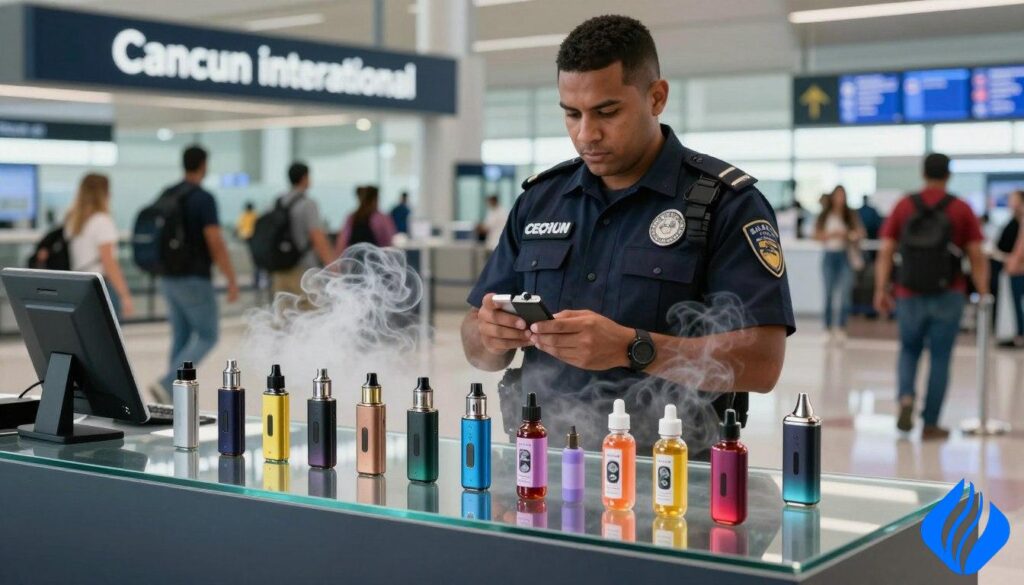
Customs at Cancun International Airport: What Actually Happens to Vapes and E-Liquids
Officers at primary control have the authority to inspect bags, seize prohibited items, and start administrative cases. We present a practical, compliance-first walkthrough so travelers know what to expect and how to reduce friction.
What customs officers can do
Customs agents may conduct inspections, order confiscation of devices and e‑liquids, and issue fines or other administrative penalties. Officers enforce federal laws and regulations at entry points and document seizures when items are treated as prohibited.
How random searches and secondary screening work
Random bag checks are routine. Some travelers clear quickly. Others are diverted to secondary screening for questions, bag searches, and paperwork.
Secondary checks cause delays. Officials may inventory seized items, file reports, and decide whether a fine applies. That process can take hours.
Risk versus reality
Reports vary: some travelers report passing without issue. Anecdotes do not change enforcement power. One device may still trigger action.
“Confiscation and fines are real outcomes. Avoiding restricted items reduces stress and travel disruption.”
- Practical advice: Declare items when required and prioritize low‑friction planning.
- Why it matters: Compliance protects travelers from delays and costly fines.
Where You Can and Can’t Vape in Cancun: Public Spaces, Resorts, and Beaches
Public clean‑air rules now treat electronic inhalation devices the same as cigarettes. Since January 2023, federal law treats vaping like smoking for enforcement of shared‑air protections.
2023 anti‑tobacco law and practical impact
What changed: Vaping falls under the same prohibitions as tobacco. That means the law restricts aerosol use across many public spaces and tourist zones.
Common no‑go areas
- Beaches and boardwalks
- Parks and public walkways
- Restaurant patios and indoor dining
- Bars, nightclub interiors, and terraces
- Hotel lobbies, pool decks, and most resort common areas
Designated smoking areas: what to look for
Designated areas are usually physically separated, clearly posted, and sometimes walled or screened. Resorts may provide one or two small spots.
Vaping outside these areas can still trigger an on‑site warning or a fine. Follow signage and staff directions strictly.
“Assume the same limits apply to vaping and smoking in shared places.”
Respectful practice: Avoid exposing others to aerosol. Don’t assume outdoors means permitted. Public use can lead to penalties even when import issues never arose at entry.
What to Do Instead: Legal, Practical Options for Nicotine on a Cancun Trip
Selecting licensed nicotine replacements is the least risky way to manage cravings while traveling. We recommend planning a nicotine approach at home before departure.
Travel-friendly alternatives
Choose products sold and regulated in the United States. Options include nicotine gum, lozenges, and patches. These avoid device seizure and reduce interaction with customs.
Why alternatives matter
Nicotine replacements lower withdrawal risk during transit and on arrival. They also avoid public-use complications tied to smoking and vaping. Traditional cigarettes face public-use limits too; swapping device for a cigarette does not remove those limits.
- Pre‑trip checklist: confirm your nicotine plan at home, pack only permitted items, and avoid last‑minute terminal purchases.
- Harm minimization if still vaping: use designated smoking areas only, keep distance from crowds, and follow posted signs and local laws.
| Option | Why choose it | Ease for travel |
|---|---|---|
| Nicotine gum | Fast relief; controlled dosing | High — compact, no batteries |
| Nicotine patch | Steady delivery; low maintenance | High — discreet, lasts 24h |
| Nicotine lozenge | Slow release; flexible dosing | High — pocketable, odorless |
“Best outcome: zero interactions with enforcement. Planning alternatives is the simplest path.”
For legal context and documentation tips, consult our summary of vaping in Mexico laws. We prioritize compliance and traveler safety on every trip.
Best Disposable Vape Value Before You Fly: Specs, Puffs per Dollar, and Flavor Consistency
Choosing a well‑spec’d disposable ahead of travel reduces the chance of surprises at checkpoints and on the road.
Main pick — RandM overview: RandM offers predictable specs. Typical listing shows battery 650 mAh, e‑liquid 20 ml, nicotine 2% or 5% nic salt, coil Mesh, and USB‑C charging on rechargeable variants. That set delivers steady output and simple verification before travel. See related categories at RandM and Disposable Vapes.
Competitor snapshots
Geek Bar: often 650–700 mAh, 20 ml, 5% nic salt, Mesh or Dual Mesh. Strong puff claims but variable sweetness retention.
Lost Mary: typical 550 mAh, 16–18 ml, 5% nic salt, Dual Mesh. Good throat feel; cooling can fade late.
Puffs per Dollar and consistency
Estimate cost per puff with: price ÷ realistic puff range (not advertised max). Marketing numbers assume light draws. Use a conservative puff estimate for true value.
- Flavor Consistency: rate sweetness fade, cooling stability, and coil life.
- Checklist: battery (mAh), e‑liquid (ml), nicotine (2%/5% nic salt), coil (Mesh vs Dual Mesh), USB‑C.
For pre‑trip sourcing, review Hot Sale and Bang listings to compare real specs and minimize surprises during travel.
Hands-on Testing Insights: Throat Hit, Vapor Production, and Flavor After 5000 Puffs
We ran extended bench tests to trace throat feel, cloud output, and taste change over heavy use. The goal was practical. We measured performance after roughly 5,000 puffs to reflect long-trip wear and steady use.
Throat hit: smooth vs. strong
2% nic salt gives a milder throat. It feels smoother and reduces bite for newcomers. 5% nic salt produces a firmer hit and more immediate satisfaction. That difference alters puff pacing and perceived harshness.
Vapor output and coil behavior
Mesh coils warm quickly and hold top-end flavor early. Dual Mesh ramps faster, yields denser clouds, and keeps warmth as liquid falls. Airflow tuning shifts MTL to airy DTL feel across devices.
Flavor evolution after 5000 puffs
Sweet top notes and cooling agents fade first. Base fruit and body often remain. Not every product maintains balance; testing at home cuts risk when sourcing products for travel.
| Metric | Mesh | Dual Mesh |
|---|---|---|
| Ramp-up | Moderate | Fast |
| Cloud density | Medium | High |
| Flavor stability (5000 puffs) | Good early, fades mid | More consistent late |
“Hands-on testing is a decision tool: not every high-puff product keeps flavor or airflow over long runs.”
Practical Checks Travelers Ask About: Empty Devices, Safe Recharging, and Authenticity
Quick, reliable indicators help prevent battery failures and counterfeit purchases. We list clear signals and steps that reduce risk while traveling. Short checks save time and avoid delays.
How to tell if it’s empty
Signs of emptiness: a sharp flavor drop, noticeably weaker vapor, or blinking LEDs. Dry‑hit taste and overheating on draw are red flags. These indicate wick starvation and higher coil stress.
Note: Pushing a near‑empty disposable may also increase harshness and lower flavor consistency. That affects pacing and nicotine intake.
Safe recharging basics
Use USB‑C when supported. USB‑C offers faster, more stable charge profiles for small batteries.
Avoid charging on soft surfaces. Stop charging immediately if the device gets hot. Use reputable wall adapters rated for the device to reduce risk.
Battery realism: small mAh cells need more frequent top‑ups. Overcharging, high heat, and cheap adapters shorten battery life and may cause failure.
How to verify authenticity
Check packaging for a QR code and validate it through the brand verification flow on sokvape.com. Prioritize verified supply channels. Counterfeit products often deliver uneven nicotine and unpredictable performance.
| Check | Quick test | Action if positive |
|---|---|---|
| Flavor drop | Weaker taste within 2–3 draws | Stop use; consider replacement |
| Blinking LED | Flash on draw or button press | Refer to manual; avoid further draws |
| Overheat while charging | Warm to touch within 10 minutes | Unplug; discard if persistent |
“Check QR codes and use stable chargers. Small steps lower safety risks from unregulated products.”
Regulatory note: Local regulations may also affect possession and use. Unregulated vendors in tourist zones increase authenticity risk, so validate products before purchase.
Nicotine warning: This product contains nicotine. Nicotine is an addictive chemical.
Conclusion
The bottom line: Mexican laws and rules restrict import, sale, and use of many electronic nicotine items. Enforcement at entry points and later checks is real and may lead to fines or seizure.
We recommend planning a legal nicotine strategy before travel. Choose licensed alternatives or pack verified supplies sourced at home. Public vaping is treated like smoking and tobacco rules apply to shared spaces.
If purchasing stateside, favor spec‑driven choices: battery mAh, ml, 2%/5% nic salt, mesh/dual mesh, and USB‑C. Verify authenticity where possible and remember: nicotine is addictive.
 English
  German
  Dutch
Dutch  Danish
  Czech
Czech  Italian
  Slovenian
  French
  Hungarian
  Spanish
  Polish