

Can you fly with disposable vapes is the question most travelers ask before heading to the airport. We open with a clear fact: TSA treats these items as battery-powered electronics, so they belong in carry-on luggage, not checked bags.
We outline US-focused TSA and FAA rules, practical packing tips, and safety steps. We will cover carry-on vs checked, liquid limits, quantity norms, leak prevention, and airport screening expectations.
Our approach is technical and transparent. We stress fire-risk mitigation, accidental activation prevention, and compliance at checkpoints. Later sections show hands-on testing data — puffs per dollar, flavor consistency after 5,000 puffs, and authenticity checks. This guide targets adult vapers (21+) traveling in the United States and notes that airlines may set stricter rules.
Key Takeaways
- TSA classifies these items as lithium battery electronics; pack in carry-on.
- Onboard vaping is prohibited on all flights.
- Follow liquid and quantity norms and use leak-proof packaging.
- We test travel-friendly devices for throat hit, airflow, and vapor output.
- Check airline-specific rules and destination laws before travel.
can you fly with disposable vapes in the United States?
Regulations prioritize fire safety. We treat battery-equipped nicotine devices as portable electronics and follow TSA/FAA baseline rules. Keep these items in carry-on luggage; they are not permitted in checked luggage due to lithium battery hazards.
Quick TSA-aligned answer for carry-on vs. checked bags
Short takeaway: Transport devices only in carry-on luggage. Screening is required, and officers may inspect or request removal for separate screening.
Why airlines treat these differently than other tobacco items
Traditional cigarettes and cigars lack integrated batteries. That difference drives stricter controls for battery devices.
- Why: A battery fire in cargo limits crew response compared to the cabin.
- Security interaction: State the device is an e-cigarette or vape when asked and follow officer instructions.
- Variation: Major airlines usually mirror TSA/FAA, but airline policy layers exist—verify before travel.
Note: Destination country laws may be stricter; check local possession and public-use rules before departure.
Why disposable vapes are treated as lithium-ion battery devices
Battery chemistry, not nicotine, drives how airlines classify these products. Regulators view many single-use nicotine units as electronic items because they include lithium cells. That classification shapes airport rules on transport.
The fire-risk reason these items don’t go in checked luggage
At the cell level, a short or damage can cause *thermal runaway*. Heat builds quickly. The result is rapid overheating, smoke, or fire.
In cargo, fires are harder to detect and control. That is why lithium-ion batteries are restricted from checked bags on an airplane.
What “portable electronic device” rules mean here
Regulators treat small electronics the same way. If an item has an internal lithium-ion battery, it is a PED and must stay in cabin carry-on.
Accidental activation is a real risk. Pressure on a mouthpiece, an airflow sensor, or a stray button press can energize the cell. Even sealed, unused units keep the same travel status.
| Risk | What happens | Packed location |
|---|---|---|
| Short circuit | Rapid heating, smoke | Carry-on (cabin) |
| Physical damage | Cell puncture, thermal event | Carry-on (visible) |
| Accidental activation | Battery discharge, heat | Carry-on, powered off |
| Leak or pressurization | Fluid escape, corrosion | Carry-on in sealed bag |
Our rule of thumb: treat each unit like a small electronic device. That simple mental model improves packing choices and overall safety.
TSA and FAA carry-on rules for disposable vapes
We treat these items as small electronics under cabin rules. Carry-on placement is mandatory. Follow simple steps to pass screening and avoid delays.
Where to pack devices so they pass screening smoothly
Place devices in the top layer of your personal item or main carry-on luggage. Keep them visible for quick removal if officers ask.
How to prevent accidental activation in your bag
Power off devices when possible. Use a small hard case or seal them in a clear pouch. Separate from coins, keys, and chargers to avoid ambiguous X-ray images.
What to do if TSA asks you to take devices out
Remain calm. Present the items and state they are disposable vapes. Follow instructions and avoid arguing policy at the checkpoint. If asked, show any packaging or proof of purchase.
| Packed location | Action | Why it helps |
|---|---|---|
| Top layer, personal item | Powered off, visible | Speeds security checks |
| Hard case or pouch | Separate from metal | Prevents accidental activation |
| Carry-on luggage | Keep accessible | Meets airline restrictions |
| Screening bin if requested | Present calmly | Complies with TSA/FAA rules |
Note: For full checkpoint guidance reference our TSA vape travel guide.
Checked luggage restrictions and what can go in your suitcase
Airline luggage rules separate powered units from liquid containers for safety reasons.
Non-negotiable rule: any device with an internal lithium cell must remain in cabin carry-on. The integrated battery is the restriction driver, not the e-liquid itself. Packing such a device in checked baggage creates an avoidable fire risk.
What may go in a suitcase: sealed e-liquid bottles are often allowed in checked bags, depending on airline and destination rules. Extra bottles should meet transport rules for liquids and be clearly labeled.
Leak prevention and pressure tips
Pressurization changes on a flight can force liquid past weak seals. That can ruin clothing and damage electronics.
- Double-bag bottles in clear plastic to contain leaks.
- Keep upright when possible and leave headspace in partially filled containers.
- Use rigid cases for bottles and separate them from fragile items.
- Label nicotine liquids and keep receipts to reduce inspection delays.
“Protecting fabric and gear from leaks is a practical step that lowers stress at both security and arrival.”
These are packing best practices, not legal guarantees. Airline and destination restrictions may vary. We recommend verifying rules before any flight.
Airline policies can vary by carrier, so verify before you fly
Some airlines impose tighter battery or device handling rules than federal agencies. That difference reflects carrier risk policies, insurance limits, and operational procedures.
We recommend a short verification checklist before any trip. Follow these steps to reduce surprises at the airport.
- Search the airline website for terms: e-cigarette, vaping device, or lithium batteries.
- Confirm rules for both outbound and return carriers on your itinerary.
- Check destination laws for possession, public-use bans, and import restrictions at the country level.
- Call customer service when policy pages are unclear or silent on quantity limits.
- Take screenshots of stated policy pages and save them with your travel documents.
| Verification step | Why it matters | Action |
|---|---|---|
| Airline policy page | Shows carrier-specific limits | Screenshot or print |
| Connection carriers | Rules vary per leg | Check each airline |
| Destination country rules | Possession may be illegal | Confirm local law |
| Gate staff interpretation | May differ from website | Present screenshots calmly |
When policies conflict, follow the strictest rule. This lowers risk and avoids delays on travel day. For more travel guidance see our air travel checklist.
How many disposable vapes can you bring on a plane?
Airport staff focus on intent—personal use versus commercial transport—when reviewing multiple units. Federal agencies rarely publish strict numeric caps. Instead, officers look for signs of resale or bulk shipping.
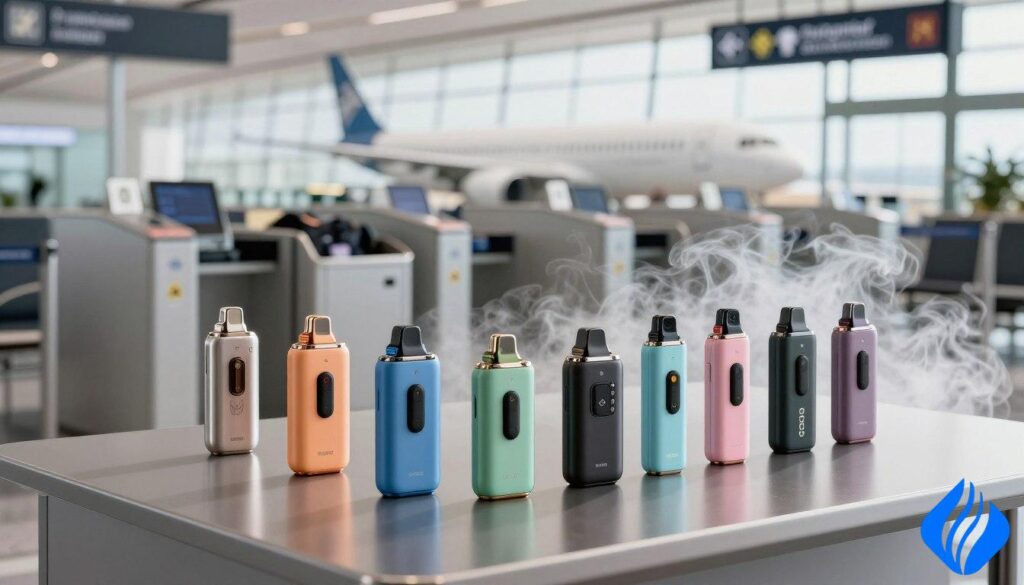
Personal-use limits versus extra scrutiny
Personal use usually means a handful of items for the trip. Carrying large counts may prompt questions about resale. Some carriers reference ranges like 15–20 units as an informal benchmark, but policies vary.
How battery quantity affects carry-on handling
Each unit adds lithium cells. More batteries increase the chance of extra screening or denial. Keep items in carry-on luggage so cabin crew can respond to any issue.
- Pack: separate units, avoid metal contact.
- Document: keep receipts to show personal purchase.
- Present: answer security questions calmly and clearly.
“Clear presentation and modest quantities reduce delays and the risk of confiscation.”
| Situation | Practical step | Why it helps |
|---|---|---|
| Few units (personal) | Keep packaged, receipts ready | Matches expected use |
| 10–20 units | Separate and document purchase | May trigger extra screening |
| Large quantity | Call airline or ship separately | Avoid customs or seizure |
E-liquid and liquid limits at airport security
TSA liquid rules focus on container size and visibility, not the product name on the label.
We follow the 100 ml standard for carry-on bottles. Each container must be 100 ml (3.4 oz) or less. Place all liquid containers inside a clear, resealable plastic bag for screening.
The 100 ml rule and how it applies to vape juice
Prefilled nicotine units remain a separate item but may be treated like liquids if officers ask. Extra e-liquid bottles must meet the 100 ml per container rule and fit inside the single quart-size bag per passenger.
Clear, resealable plastic bag best practices for liquids
Pack smart: keep labels visible and caps tight. Isolate bottles from electronics to reduce secondary inspections and mess if a leak occurs.
Keep liquid items accessible at the checkpoint. That speeds screening and lowers the chance of a hands-on search. Different airports apply these regulations with slight variation, so neat presentation reduces friction.
| Item type | Limit | Packing tip |
|---|---|---|
| Prefilled unit (single-use) | Viewed as device; may be inspected | Keep in carry-on, visible |
| Bottled e-liquid | Max 100 ml per container | Place in clear plastic bag, caps sealed |
| Multiple small bottles | All must fit one quart bag | Organize labels facing up for quick checks |
| Spare zip bag | Not a limit item | Carry an extra bag for re-bagging if needed |
“Organized presentation at security reduces delays and lowers the chance of extra screening.”
Can you vape on a plane or in an airport?
Vaping inside an aircraft is banned worldwide and carries real operational and legal consequences. Attempting to vape on a plane risks fines, confiscation, crew intervention, and even diversion of the flight. Alarms and smoke detectors on modern aircraft are sensitive and treat vapor incidents like any smoking event.
Why vaping is prohibited on aircraft worldwide
Regulators group vaping under existing smoking bans for safety reasons. Smoke detectors and avionics cannot reliably distinguish aerosol from smoke.
That triggers emergency responses. The result may include passenger interviews, enforcement action, or an unscheduled landing.
Finding designated smoking areas at US airports
Most airports restrict vaping to designated smoking areas, usually outside terminals or in clearly marked outdoor zones. Assume airport smoking rules apply to vaping.
Before clearing security, check airport maps and the website for smoking areas and terminal signage. For connections, remember airside options are often limited.
- Hard rule: no onboard use — never attempt stealth vaping in restrooms or at gates.
- Detection: alarms, crew reports, and CCTV can identify incidents quickly.
- Practical tip: plan nicotine management before boarding and locate designated smoking areas before security.
“Respecting no-smoking rules protects safety and avoids enforcement that can ruin travel plans.”
How to pack disposable vapes for air travel without leaks or damage
A good packing plan prevents leaks, accidental activation, and needless delays at security. Place all units in your carry-on. Cabin placement reduces crush risk and lets crew respond if an issue occurs.

Carry-on placement that reduces pressure and crushing
Use a rigid pocket or small hard case inside your personal item. Do not leave items loose at the bottom of an overstuffed bag.
Keep units upright where possible to limit mouthpiece contamination and seepage during pressurization changes.
Using a protective case and separating devices from metal items
Choose a case that cushions impact. Physically separate devices from keys, coins, and chargers to lower short-circuit risk and cosmetic damage.
Keeping devices powered off and secured during the flight
Power off or lock supported units. For draw-activated designs, protect the mouthpiece to avoid airflow-triggered activation.
Travel checklist for a stress-free security line
- Count devices and keep receipts to show personal use.
- Bag liquids in clear resealable pouches per 100 ml rules.
- Keep chargers separate and labeled.
- Confirm airline rules before departure and keep items accessible at screening.
“Even high-quality units may leak or misfire if crushed; packing technique is part of performance.”
Safety: if a device is hot, heavily damaged, or leaking, isolate it immediately and notify staff. Our hands-on tests show that secure packing preserves durability and airflow sensitivity during travel.
Charging and recharging rules on travel days
Charging devices during a trip should be deliberate and safety-first, not an afterthought at a gate or on board. We advise against charging on an aircraft. Crew may view setup or cable use as an attempt to operate the unit and treat it as a security issue.
Can you charge a vape on a plane?
Short answer: generally avoid charging onboard. Taking a unit out mid-flight can escalate into a compliance matter. It may draw crew attention and lead to confiscation or fines.
How to recharge safely with USB-C devices before boarding
- Top off before arrival: fill batteries at home or at a gate outlet before screening.
- Use quality cables: reputable USB‑C cables and certified chargers lower heat and short risks.
- Avoid public ports: airport USB hubs may be damaged or supply unstable power.
- Don’t leave charging unattended: monitor charge cycles and remove the device when full.
“Keep devices powered off and secured after charging to reduce accidental activation during transit.”
| Action | Why it matters | Recommended step |
|---|---|---|
| Pre-flight charging | Reduces need for gate or in-flight power | Charge to ~80–100% at home |
| Use certified USB‑C cable | Limits overheating and current spikes | Choose branded cable and charger |
| Keep powered off | Prevents accidental activation and security flags | Store in hard case, powered off |
How to know if your disposable vape is empty while traveling
Recognizing end-of-life cues prevents burned hits and safety issues on a trip. We focus on quick, practical checks so travelers keep comfort and safety first.
Common signs that a unit is empty
Muted flavor or a sudden loss of taste is usually the first sign.
Reduced vapor and a weaker draw may mean low liquid or a dying battery; assess both when troubleshooting.
Harsher draw or an unpleasant throat sting often signals nearing empty.
Blinking lights on indicator models normally mark low battery or fault; check the manual if unsure.
What dry hits mean and why to stop use
Dry hits occur when the coil heats without sufficient liquid. The result is a burnt taste and throat irritation.
Stop use immediately after a dry hit. Continued operation raises heat stress on cells and coils and reduces safety.
- Bring one backup product instead of pushing a nearly empty unit.
- Keep receipts and proper disposal info; do not discard lithium battery devices in regular trash where prohibited.
“A timely swap preserves comfort and reduces risk during travel.”
Authenticity checks to avoid counterfeit vapes on your trip
Counterfeit units pose a travel risk because their build and performance are unpredictable. We prioritize verification to reduce battery hazards and preserve flavor consistency while traveling.
How to verify: scan the product QR code and confirm the result on https://www.google.com/url?sa=E&source=gmail&q=sokvape.com/. Match serial numbers, batch data, and the verification response to packaging details before packing.
Why authenticity matters
Battery safety: counterfeit cells often lack protection circuits and may overheat in transit. We treat verified products as more predictable under pressurization and handling.
Flavor consistency: genuine products use controlled coil materials and tested e-liquid. Fakes produce harsh or off-note tastes early in use.
- Poor print quality or weak seals are red flags.
- Inconsistent serial/QR behavior suggests fraud.
- Atypical taste or early harshness often signals counterfeit e-liquid.
“Verification reduces both safety and security risks during travel.”
| Check | What to expect | Action if mismatch |
|---|---|---|
| QR scan result | Brand site verifies serial/batch | Refuse product; seek refund |
| Packaging quality | Crisp print, intact seals | Return to retailer |
| Early taste test | Smooth, consistent flavor | Stop use; inspect device |
Hands-on testing insights for travel-friendly disposable vapes
We ran hands-on testing on several prefilled big-puff kits to isolate what matters in transit: predictable draw, steady output, and minimal maintenance. Our focus was technical and objective, not promotional.
Throat hit comparison: smooth versus sharp nic-salt profiles
Throat hit varied by formulation and coil resistance. Nic-salt blends with softer PG ratios produced a smoother throat hit. Stronger salt formulations felt sharper, especially in dry cabin air.
Practical note: smoother profiles reduce coughing and discomfort during long waits or layovers.
Vapor production and airflow effects
MTL-style, restricted airflow units yielded low cloud volume and a concentrated flavor. That made them discreet in crowded terminals.
Open-airflow designs produced larger clouds but diluted flavor and increased consumption. For travel, tighter airflow often offers the best balance between discretion and nicotine delivery.
Flavor consistency after 5,000 puffs: observed drift and causes
After ~5,000 puffs many units showed mild flavor flattening. Sweet notes softened, cooling agents faded, and coil residue slightly altered balance.
Primary technical drivers were sweetener caramelization, residue build-up on mesh, and slower wicking over time.
“Stable flavor and controlled vapor reduce the urge to overuse between connections.”
- Travel idea: choose prefilled big-puff kits for minimal handling and fewer leak concerns.
- Device tip: prefer restricted airflow for discreet use on the ground—never onboard.
- Performance: expect subtle flavor drift past several thousand puffs; plan backups for multi-leg trips.
Core technical specs to look for in a travel disposable
We focus on fundamentals that affect trip comfort and safety. Read spec labels before purchase. Prioritize low-maintenance, predictable products for travel.
Battery capacity (mAh)
mAh: larger values mean longer runtime. For long layovers, aim for 800–1500 mAh for single-use style products. Higher capacity reduces the need to recharge at a gate.
E-liquid volume (ml) and puffs
ml: typical values range from 3–20 ml. Expect marketing puff counts to vary by draw length and airflow. Plan real puffs by assuming shorter, mouth-to-lung draws use fewer ml.
Nicotine strength: 2% vs 5%
Choose 2% (20 mg/ml) for smoother frequent draws. Choose 5% (50 mg/ml) to reduce total draws. Match strength to travel style and destination rules.
Coil type: mesh vs dual mesh
Mesh offers smooth, efficient vapor. Dual mesh sustains flavor at higher output and resists early taste drift. For multi-leg trips, dual mesh often holds flavor longer.
Charging port: USB‑C
Prefer USB‑C for durable connectors and common cables. Fully charge devices before heading to security to avoid mid-journey charging decisions. Make sure backups are documented.
“Spec-first choices lower hassles at checkpoints and reduce the chance of mid-trip failures.”
| Spec | Recommended range | Travel benefit |
|---|---|---|
| Battery (mAh) | 800–1500 mAh | Less need to recharge |
| E-liquid (ml) | 3–20 ml | Predictable puff life |
| Nicotine | 2% or 5% | Balance between smooth draws and lower use |
| Coil | Mesh / Dual mesh | Flavor stability vs efficiency |
| Port | USB‑C | Common cables; safer charging |
Best value comparison: main travel disposable vs. Geek Bar, Lost Mary, and Raz
For travel, three metrics guide our value ranking: puffs per dollar, flavor consistency, and physical resilience. We apply a simple evaluation template to each brand for a fair benchmark.
Puffs per Dollar: how to estimate cost per puff before purchase
Estimate cost per puff with a basic formula: price ÷ stated puff count, then adjust by realistic draw behavior (~80% of claimed puffs). This yields a practical cents-per-puff figure for budgeting.
Flavor Consistency: which brands hold up deeper into the unit
Our hands-on tests show: Geek Bar holds heat stability well but sweet notes fade by ~3,000 puffs. Lost Mary sustains menthol and citrus longer. Raz leads on uniform sweetness but shows mild coil residue later.
Travel practicality: size, rechargeability, and leak resistance
Evaluation template (applies to main travel unit, Geek Bar, Lost Mary, Raz):
- Battery: 800–1500 mAh typical.
- E-liquid: 3–20 ml; 2% or 5% nic salt options.
- Coil: mesh or dual mesh.
- Port: USB‑C when rechargeable; many are true single-use.
Puff cost example: $12 ÷ 1500 stated puffs × 1.25 adjustment = ~$0.01 per puff. Use flavor stability to judge real value; cheap puffs mean little if taste collapses early.
| Brand | mAh | ml | Nicotine | Coil | Port |
|---|---|---|---|---|---|
| Main travel unit | 1000 | 10 | 2%/5% | dual mesh | USB‑C (some) |
| Geek Bar | 950 | 8 | 2%/5% | mesh | — |
| Lost Mary | 1200 | 12 | 2%/5% | dual mesh | USB‑C (models vary) |
| Raz | 800 | 6 | 2%/5% | mesh | — |
For shopping, browse our Disposable Vapes and Hot Sale pages. Quick brand filters include RandM and Bang.
“Regardless of brand, these are battery devices that must remain in carry-on and never used aboard an aircraft.”
This comparative idea helps pick a reliable unit for a trip while keeping airline rules and real-world flavor performance central to the decision in this article.
Nicotine warning and safety reminders for flying with vapes
Small mistakes with batteries or liquid handling can create big problems in an airplane cabin.
Nicotine is an addictive chemical. Keep products away from children and pets. Store sealed units out of reach and never leave liquid bottles loose in luggage.
Battery handling basics
Avoid heat exposure. Do not leave units in a hot car or near direct sunlight. Keep items cushioned to prevent crushing.
Separate metals. Stow devices away from keys and coins to reduce short risk. Stop using any unit that becomes hot or shows damage.
Practical travel safety and rules
Pack in carry-on luggage. Lithium battery risk is why units must stay in the cabin where staff can respond. Power devices off before screening.
No onboard vaping. Smoking and vaping on planes is prohibited worldwide. A single use can trigger alarms, fines, and flight disruption.
“Fewer devices, better organization, and verified products lower risk across terminals and planes.”
Before departure, review local smoking areas at your destination and consult the TSA vape travel guide for checkpoint expectations.
Conclusion
Here we close with clear steps to keep devices legal, safe, and inspection‑ready.
Short recap: keep all battery‑powered units in carry‑on luggage. Follow the 100 ml rule for liquids and present items at security. Never attempt use on an airplane or during a flight; locate designated smoking areas at airports instead.
Why this matters: regulators treat these products as electronics, which drives rules and restrictions across countries and carriers.
Do‑this now checklist: verify airline policy, store devices in a protective case, bag liquids in clear plastic, perform an authenticity QR check (Sokvape Email), and plan for no vaping onboard.
Quick FAQs: empty signs — flavor drop or weak vapor; recharge safely — top off via USB‑C before screening and avoid charging in flight; authentic check — scan QR before packing.
Safety note: secure products away from minors and pets and dispose of battery devices responsibly. For shopping, browse Sokvape categories like Disposable Vapes and Hot Sale while prioritizing authenticity and compliance.
 English
  German
  Dutch
Dutch  Danish
  Czech
Czech  Italian
  Slovenian
  French
  Hungarian
  Spanish
  Polish