Can you pack a vape in checked luggage? The short, practical answer for U.S. travelers is no. Aviation authorities and most airlines forbid lithium‑ion devices in cargo holds because batteries pose fire risks.
We lay out a clear, compliance‑first how‑to guide. First, we explain where devices and spare batteries belong. Then, we detail liquid limits, leak prevention at altitude, and steps to move through airport security with minimal delay.
Expect specific outcomes: avoid device confiscation, missed boarding, and fines. We preview technical comparisons later — mAh, ml, coil type, USB‑C — plus real metrics like puffs per dollar and flavor consistency for travel‑friendly options.
Our tone is technical and practical. We prioritize safety and legal clarity over shortcuts. Follow these rules and carry devices correctly in your carry‑on to reduce risk on the plane.
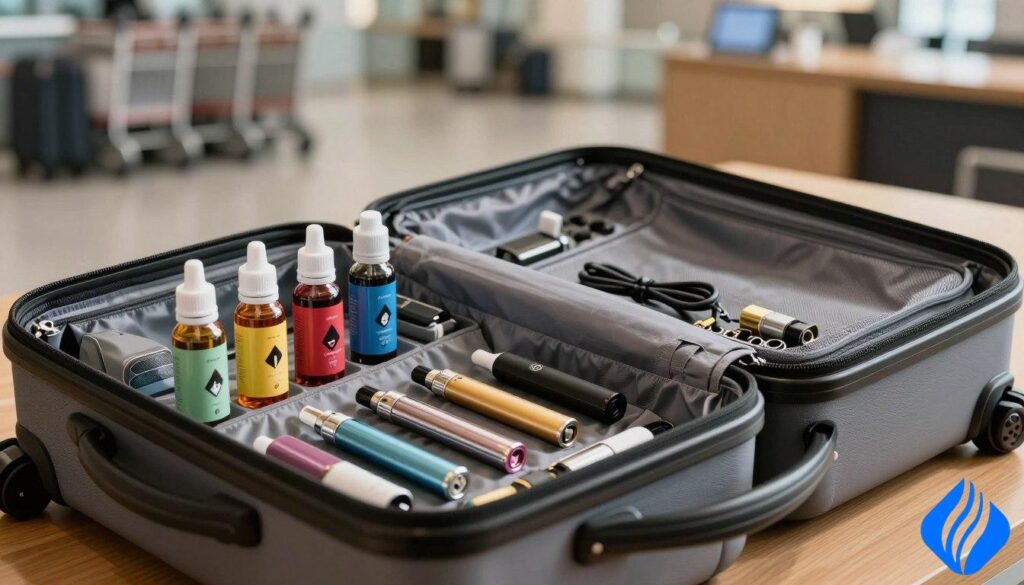
Safety First: Always store your vape devices and spare batteries in your carry-on bag. Use a rigid battery case to prevent short circuits and accidental activation during your flight.
Federal guidance and most airlines restrict lithium devices from checked luggage; keep them in carry‑on.
Pack spare batteries in protective cases and follow liquid limits to prevent leaks at altitude.
Prepare devices for inspection to speed up airport security checks.
Technical specs (mAh, coil type) affect battery life and puffs per dollar — we compare these later.
Vaping on a plane is prohibited worldwide; responsible transport is about safety and compliance.
What US travelers need to know before flying with a vape
Understanding the technical reasons behind airline policies reduces risk and avoids last-minute confiscation. We adopt a safety-first lens. That means treating personal nicotine devices as portable electronics and planning transport accordingly.
Why airlines treat vapes like other portable electronic devices
Airlines group vapes with phones, laptops, and power banks because all these devices rely on compact lithium power systems. Failure modes are similar: damage, manufacturing faults, or exposure to heat can cause rapid failure.
The core risk: lithium-ion batteries in the cargo hold
Lithium-ion batteries can enter thermal runaway after impact or shorting. Once a cell heats uncontrollably, suppression is harder when a bag is routed to the cargo hold. That raises overall flight risk.
Most restrictions stem from treating these items as PEDs — keep them in the cabin where crew can respond.
Store spare batteries in protective cases and power devices off to prevent accidental activation.
Check published regulations before travel; the airline may also cap how many cells or units are permitted.
We will address the two core failure triggers next: short circuits and accidental activation, with practical steps to mitigate both.
Can you pack a vape in checked luggage
Transporting lithium-powered personal devices creates specific safety and regulatory issues at airports. For U.S. travelers, our answer is clear: do not place devices and spare batteries in checked bags.
What happens if you do: confiscation, delays, and policy violations
If a screening team detects a device in checked luggage, security may open the bag and remove the item. Confiscation is common. Carriers may record a policy breach and apply penalties.
Operationally, a flagged bag can cause major delays. Processing at check‑in, removal from the hold, and extra inspection all add time. In some incidents, battery fires in baggage have grounded flights and required emergency response.
“The concern is battery failure, not stigma. A thermal event in the cargo area is far harder to manage than one in the cabin.”
Why the hold is the problem area
The cargo hold isolates bags from crew and emergency equipment. A lithium cell in thermal runaway grows quickly. Access is slower, detection is delayed, and suppression options are limited.
Rules: Most airlines and regulators require lithium devices and spare cells to be carried in the cabin.
Risk: Stored batteries may short or activate during handling and pressurization changes.
Practical rule: Device plus spare batteries = carry‑on; non‑battery accessories may go in checked luggage.
We will next show how to prepare devices and batteries for carry‑on so security screening is simple and inspection time is minimized.
Carry-on luggage rules for vapes, batteries, and devices
Cabin carriage of battery-powered items is the baseline rule for U.S. travel. Keeping devices with you lets crew respond if a battery problem occurs. It also reduces screening friction at the checkpoint.
Powering off means shutting the unit completely. Use any built-in lock mode and remove batteries when practical. Avoid leaving the device in sleep or standby; that reduces accidental activation.
Where to place items for quick screening
Store your primary device and spares in an easy-to-reach pouch near the top of the bag. That prevents digging and speeds security checks.
If an officer asks, treat the item like other electronics: remove it when requested, keep it visible, and answer questions plainly. This lowers inspection time and the chance of hold-up.
How many devices to bring
Quantity limits vary by airline. Some carriers list ranges for disposables (for example, 15–20 units). Others leave counts unspecified but enforce lithium cell rules.
Baseline: carry-on luggage is the correct place for vapes due to cabin monitoring.
Practical plan: one primary device plus one backup minimizes complexity during travel.
Check your airline’s battery restrictions before departure if carrying multiples.
Prevention is the primary defense. Physical separation from pressure points and full power‑off reduce unintended activation. The next section explains spare battery packing and short‑circuit avoidance.
How to pack spare batteries and avoid shorts, heat, and accidental activation
Proper terminal isolation prevents the most common failure mode for loose cells.
Define spare batteries: any cell not installed in a device. This includes 18650, 20700, 21700 cells and loose proprietary packs. Treat each spare as an independent unit.
Protective cases and terminal safety
Each spare must go into its own protective case. Rigid cases stop terminals from touching metal objects and other cells. Soft wraps are inferior to molded holders.
Keep spares away from metal objects
Coins, keys, and other metal objects create direct conductive paths across terminals. That can cause rapid discharge, heat, venting, or ignition. Store spares separately from wallets and loose change.
Why external lithium batteries never go in checked luggage
Under common aviation rules, external lithium-ion batteries and loose spares must remain in the cabin. The risk of thermal runaway is non-negotiable; cargo holds lack immediate crew response.
If a mod allows cell removal, remove cells and place each in a case.
If a device has non-removable cells, ensure it is powered off and locked.
No loose cells, no taped-together pairs, no wrap-only solutions when a rigid case exists.
Item
Allowed Location
Action Required
Installed device (non-removable)
Carry-on
Power off / lock
Loose 18650 / 21700 cells
Carry-on
Individual protective case
Spare proprietary packs
Carry-on
Protect terminals; stable pocket
Metal tools, coins
Carry-on (separate)
Keep separate from battery cases
“Isolate terminals and keep spares accessible in the cabin.”
Safety checklist: no loose cells, rigid case per spare, carry case in a stable pocket, device powered off or cells removed.
How to pack e-liquid and pods without leaks at altitude
Before boarding, secure e-liquid and pods to prevent spills and inspection delays.
Follow the standard carry rules: containers must be 100 ml or less and fit inside a clear, resealable bag for screening. This keeps liquids visible and speeds checkpoint checks.
Why tanks and pods leak
Pressure shifts and temperature changes move liquid through wicks and airflow channels. That can push fluid past seals or crack thin plastic tanks.
Keep pods partly filled or remove them from the device. Store upright and wipe condensation after the flight to lower seepage risk.
When extra bottles belong in checked luggage
If you need bulk e-liquid, storing sealed bottles in checked luggage may save carry-on allowance. Use this rule: keep devices and batteries with you; place only sealed bottles in checked bags.
Double-bag sealed bottles. Use plastic over glass when possible. Tape caps, use shrink bands, then place bottles inside a secondary waterproof pouch. Cushion that pouch inside the main luggage compartment to reduce impact damage during handling in the hold.
Item
Carry-on
Checked
Installed device & batteries
Required
Not allowed
Opened e-liquid (≤100 ml)
Yes (clear bag)
Optional
Sealed extra bottles
Allowed (counts toward limit)
Recommended (double-bagged)
“Keep devices with you; manage liquids for both pressure and handling.”
Final rule: prepare pods, isolate batteries, and bag liquids before you leave home. This routine reduces leaks and speeds screening for all travelers.
Step-by-step packing checklist for a stress-free airport screening
Use this simple preflight checklist to prepare each device type for inspection and transport. Follow the sequence and keep items accessible at the checkpoint.
Pod systems and disposable vapes
Why they work: Pod systems and disposable vapes are compact with few parts. They leak less and need little maintenance.
Action: Power off or remove any locks.
Stow: Place primary device and one spare in the top pocket of your carry-on luggage for quick removal at security.
Tank setups
Action: Empty tanks when practical, seal fill ports, cap the mouthpiece, and place the tank in a small sealed bag to protect the rest of your bag.
Draw-activated devices
If the device won’t fully power off, add a mouthpiece cover to reduce accidental activation during handling. Prevent heavy objects from pressing the fire button.
Confirm spares are isolated and in protective cases.
Do a final check that you did not pack vape gear into checked bags and that liquids fit carry limits.
Final note: Proper packing reduces activation risk and keeps security checks short. We recommend this routine for calmer travel and fewer surprises at the gate.
Airport and in-flight rules: where vaping is allowed and where it isn’t
We set a firm boundary: carrying vaping gear differs from using it. Using a vape on a plane is prohibited worldwide. Airlines and regulators treat any attempt to operate devices onboard as a safety and security violation.
Using a vape on a plane is prohibited worldwide
Aircraft cabins and lavatories often include smoke or vapor detectors. Activation can trigger alarms, fines, airline bans, and even law enforcement response under applicable laws and carrier rules.
Attempting to vape mid‑flight risks severe penalties and delays. Never assume stealth use will be overlooked; enforcement is strict and consequences are real.
Finding designated smoking areas at US airports
Most US airports confine smoking and vaping to specific outdoor spaces. These designated smoking spots vary by terminal and may not be available after security.
Check the airport website and terminal maps for current locations.
Follow posted signage; many airports place smoking areas outside entrances or between terminals.
Plan nicotine breaks before security or between connections to avoid rule breaches.
Situation
Allowed?
Practical step
Using device on plane
No
Do not use; power off
Vaping in lavatory
No
Risk fines and arrest
Designated smoking areas at airport
Yes (often outdoor)
Confirm via airport site or signage
“Treat vaping like smoking: follow location rules and avoid stealth use.”
Practical tip: if nicotine relief is needed, carry permitted alternatives and schedule breaks near designated smoking zones to reduce temptation and avoid penalties.
International trips from the United States: destination country vaping laws
International arrival points enforce local controls that can nullify U.S. expectations about possession and transport.
Why check local regulations before you fly: laws change quickly. A destination country may prohibit possession outright rather than only public use. That makes border checks and customs enforcement the primary risk for travelers.
Examples of strict markets and customs outcomes
Several countries enforce severe rules. Singapore, Thailand, and India often treat devices and related products as prohibited or highly restricted. Customs may seize items, issue fines, or pursue legal action depending on local laws.
Other countries follow restricted models. For example, regulatory proposals and prescription frameworks exist in places like Australia, where access may require medical approval.
Practical compliance checklist
Verify the destination country’s official travel advisories and customs guidance before departure.
Minimize quantities and label items clearly as personal use; keep receipts and original packaging.
Remember transit rules: connecting through another country can apply its regulations to your transit or entry.
“Confirm rules at both your destination and any transit country to avoid seizure or prosecution.”
For country-specific guidance on Canadian rules, see this resource: destination country guidance for Canada.
Best vapes for travel in the United States: disposables and prefilled options
When selecting gear for flights within the United States, minimize parts and choose reliable, sealed formats. Prefilled, big‑puff kits tend to meet that goal. They need little maintenance and reduce leak risk during handling.
What “best for travel” means: compact form, low‑leak design, minimal accessories, and clear compliance with carry-on luggage rules.
Core technical specs to compare before purchase
Battery capacity: 650–900 mAh.
E-liquid volume: 12–15 ml (sealed).
Nicotine strength: 2% or 5% nicotine salt.
Coil type: mesh or dual mesh.
Charging: USB‑C for predictable power delivery.
Hands-on testing insights
We test throat hit, vapor production, and flavor longevity up to 5,000 puffs.
Findings: dual mesh usually keeps flavor more consistent but runs warmer. Single mesh often feels smoother early on but may fade faster. Expect some sweetness shift after heavy use.
USB-C charging and safer on-the-go habits
USB‑C simplifies field charging. For safety, use reputable adapters. Avoid overnight charging and do not charge during flight. Keep devices powered off and stored in the cabin.
“Prefilled kits reduce handling and inspection time while delivering predictable runtime.”
For shopping paths, compare Disposable Vapes at Disposable Vapes and current offers at Hot Sale. These products form the benchmark we compare in the next section on puffs per dollar and flavor consistency.
Product comparison for travelers: puffs per dollar and flavor consistency
For travelers, reliable runtime and consistent flavor matter more than peak specs. We compare the main product with common competitors and give a simple way to estimate real cost per puff.
Main product travel profile
Battery capacity (mAh): 850 mAh
E-liquid volume (ml): 14 ml
Nicotine strength: 2% or 5% nic salt
Coil type: Dual mesh
Charging port: USB‑C
Competitor snapshots
Model
mAh / ml
Coil
Notes
Main product
850 / 14
Dual mesh
Balanced throat hit, steady flavor
Geek Bar
700 / 12
Mesh
Warmer vapor; sweeter profile over time
Lost Mary
900 / 13
Mesh
Tighter draw; flavor holds but may fade near 5k puffs
Raz
800 / 15
Dual mesh
Smoother hit; airflow stays stable
Hands-on testing and scorecard
Rubric: throat hit, vapor, flavor out of box vs after 5000 puffs.
Main product: bright then steady; minimal sweetener buildup.
Geek Bar: strong initial sweetness; muted notes after 3–4k puffs.
Lost Mary: consistent until coil fatigue shows near 5k.
Raz: smooth throat hit; flavor remains usable late into lifespan.
Puffs per dollar: estimating real-world value
Estimate using: conservative puff range ÷ retail price. Use realistic counts (70–80% of marketed puffs). For travel, plan with a lower estimate to avoid surprises.
Traveler rule: prioritize dual mesh and matched battery-to-liquid capacity for the most consistent trip performance.
Explore travel‑focused choices from RandM and Bang for USB‑C charging and compact designs: RandM, Bang.
Troubleshooting on the road: empty device signs, safe recharging, and authenticity checks
On the road, simple performance cues tell us when a device needs attention. We focus on clear, safety‑first actions that keep travel stress low.
How to know if it’s empty
Common symptoms:
Weaker vapor and a noticeable flavor drop‑off.
Blinking indicator lights or no LED response.
Burnt or flat taste and changes in airflow that suggest coil wear.
Why “empty” differs: e‑liquid depletion, battery drain, or coil saturation produce similar feels but need different fixes. Diagnose before refilling or recharging.
How to recharge safely
Use good quality USB‑C cables and reputable adapters. Prefer UL‑listed wall adapters or trusted power banks. Charge on a non‑flammable surface and avoid overnight charging to reduce battery stress.
Do not charge on-board if airline rules forbid it or if charging could be seen as use. Stop charging immediately if the unit gets unusually hot. Replace damaged cables and avoid loose, dirty ports.
Is it authentic?
Verify authenticity by scanning the QR code and checking the product ID on sokvape.com via this path: https://www.google.com/url?sa=E&source=gmail&q=sokvape.com. Authentic products include proper battery protection, consistent coils, and verified liquid profiles.
If the QR check fails, stop use and buy from reputable retailers; consider lawful nicotine pouches for temporary relief.
Legal and safety notes for nicotine products
Safe possession starts with understanding age limits, storage, and disposal obligations.
“This product contains nicotine. Nicotine is an addictive chemical.”
Age verification and compliance
Intended audience: vaping products are for adults 21+ in the United States. Follow retailer checks and local laws. Do not sell or transfer to minors. Failure may trigger civil penalties or criminal charges.
Storage and poisoning risk
Keep devices and e‑liquid out of reach of children and pets. Use child‑resistant packaging. Even small amounts of nicotine pose serious harm if swallowed or absorbed through skin.
Transport, disposal, and jurisdictional rules
Federal permission does not override state or local restrictions. Verify airline rules and destination country requirements before travel. Follow battery and e‑waste regulations when disposing of devices.
Storage tip: seal bottles, isolate batteries, store upright.
Travel tip: keep devices in the cabin and follow carrier policies.
Disposal tip: use designated battery or e‑waste drop points.
Responsible handling reduces risk to children, pets, and fellow travelers.
We prioritize practical safety and legal compliance. Follow these steps to stay within rules and minimize incidents before we conclude.
Conclusion
Here is a concise checklist to keep batteries safe, liquids sealed, and screening smooth before departure.
Core rule: do not place any device with lithium cells in the aircraft hold. Keep devices and all batteries with you in carry-on luggage so crew can respond and screening is straightforward.
High-impact steps: power the device off or lock it, separate gear before check‑in, and store spare batteries in rigid cases. Keep liquids ≤100 ml in a clear bag; double‑bag sealed bottles if they go into checked bags.
Last-minute checklist: device off, spares cased, liquids bagged, no loose metal contacting terminals, and everything accessible at the airport checkpoint. Verify your airlines’ quantity rules if you plan to bring vapes or backups.
Practiced packing habits reduce incidents, shorten screening times, and keep travel compliant from curb to gate. For travel-friendly options and comparisons see our Disposable Vapes, Hot Sale, RandM, and Bang collections.
FAQ
Q: Brief for Section 1 — Can You Pack a Vape in Checked Luggage: Travel Tips?
A: We recommend carrying devices and spare lithium-ion batteries in carry-on baggage only. Airlines and the FAA treat lithium batteries as a fire risk in the cargo hold. Stow tanks empty, power devices off, and use protective battery cases for spares to avoid accidental activation and short circuits during flight.
Q: Brief for Section 2 — What US travelers need to know before flying with a vape?
A: US travelers must follow TSA and airline rules. Most US carriers allow devices and e-liquid in carry-on only, with limits on e-liquid volume. Check your airline policy and local airport rules before departure. Remember that disposable vapes, mods, and pod systems fall under the same battery and carry-on rules.
Q: Brief for Section 2 — Why airlines treat vapes like other portable electronic devices?
A: Airlines classify vapers as portable electronic devices because they contain lithium-ion cells. That makes them potential sources of thermal runaway if damaged or shorted. Carrying them in the cabin allows crew to respond quickly to any incident.
Q: Brief for Section 2 — The core risk: lithium-ion batteries in the cargo hold?
A: The cargo hold is less accessible during flight. A battery failure there poses higher risk because crew cannot respond immediately. Regulations therefore require most spare lithium batteries to remain in the cabin, and devices to be powered off and protected from accidental activation.
Q: Brief for Section 3 — Can you pack a vape in checked luggage?
A: Policies vary, but most US airlines and the TSA prohibit spare lithium batteries in checked baggage. Some devices with non-removable batteries may be accepted checked if powered off and well-protected, but this is risky. We advise placing all devices and spares in carry-on to avoid confiscation or delays.
Q: Brief for Section 3 — What happens if you do: confiscation, delays, and policy violations?
A: If security finds prohibited items in checked baggage, they can confiscate them, delay your bag for inspection, or issue fines. Repeated violations may lead to airline penalties. At international borders, customs may seize products or deny entry for banned items.
Q: Brief for Section 3 — Why the cargo hold is the problem area?
A: The cargo hold lacks immediate access for crew and carries higher fire risk due to packed goods and pressure changes. Lithium batteries that short or overheat can ignite packaging and adjacent items, increasing danger and regulatory scrutiny.
Q: Brief for Section 4 — Carry-on luggage rules for vapes, batteries, and devices?
A: Place devices and batteries in carry-on. Keep tanks capped and e-liquid within 100 ml containers in a clear resealable bag. Airlines may limit the number of devices per passenger; check ahead. Power devices off and pack them where security can screen them easily.
Q: Brief for Section 4 — Powering off completely to prevent accidental activation?
A: Power off devices fully and lock them if the model supports it. Remove batteries where possible. For draw-activated disposables, cover mouthpieces to reduce auto-firing risk during transit.
Q: Brief for Section 4 — Where to place your device for quick screening at the airport?
A: Keep devices near the top of your carry-on or in an external pouch. Present them separately when asked by TSA so they can be inspected without unpacking your bag. This speeds screening and reduces the chance of device damage.
Q: Brief for Section 4 — How many vapes you can bring varies by airline?
A: Yes. Some airlines limit the number of spare batteries or devices per passenger. Others restrict disposable quotas. Check airline terms of carriage and call customer service for clarification before travel.
Q: Brief for Section 5 — How to pack spare batteries and avoid shorts, heat, and accidental activation?
A: Use a protective battery case for every spare. Tape exposed terminals if no case is available. Store spares separately from metal objects like coins and keys. Keep batteries at ambient temperature and out of direct sunlight to reduce heat risk.
Q: Brief for Section 5 — Use a protective battery case for every spare?
A: A hard-shell case prevents terminal contact and physical damage. Cases are inexpensive and recommended for 18650, 20700, 21700, and flat cells commonly used in mods and external batteries.
Q: Brief for Section 5 — Keep batteries away from coins, keys, and metal objects?
A: Metal items can short battery terminals and trigger overheating. Segregate batteries in individual slots or insulated wraps. That prevents shorts during handling or baggage shifts.
Q: Brief for Section 5 — Why external lithium batteries never go in checked luggage?
A: Regulations forbid spare lithium batteries in checked baggage because they can ignite and are inaccessible during flight. Airlines and the International Air Transport Association (IATA) require these cells to be carried in the cabin with terminal protection.
Q: Brief for Section 6 — How to pack e-liquid and pods without leaks at altitude?
A: Follow carry-on liquid limits: containers 100 ml or smaller inside a clear resealable bag. Tighten caps and use plastic tape on tank seams. Store spare sealed bottles upright in a cushioned compartment to reduce pressure-related leaks.
Q: Brief for Section 6 — Follow liquid limits for carry-ons: 100 ml containers in a clear bag?
A: Yes. TSA and most international security agencies apply the 100 ml (3.4 oz) rule. Put all e-liquid and nicotine salts in that bag for screening. Larger sealed bottles may be placed in checked baggage where permitted by local rules.
Q: Brief for Section 6 — Pressure changes: why tanks and pods can seep or crack?
A: Cabin pressure shifts can push e-liquid through seals or crack plastic pods. Partially filled tanks are most vulnerable. Empty or overfill to manufacturer guidance, and use silicone plugs or mouthpiece covers for extra protection.
Q: Brief for Section 6 — When it’s smarter to put extra sealed e-liquid in checked luggage?
A: If your airline and destination allow it, professionally sealed bottles can go in checked baggage to avoid carry-on liquid limits. Use leakproof containers and pack them inside sealed plastic bags and cushioning material.
Q: Brief for Section 7 — Step-by-step packing checklist for a stress-free airport screening?
A: Pack devices and spare batteries in carry-on, protect terminals, empty or cap tanks, secure e-liquids in 100 ml containers, present devices for screening, and review airline limits. Keep receipts and manufacturer labels for authenticity checks at customs.
Q: Brief for Section 7 — Pod systems and disposables: simple, compact, low-maintenance?
A: Pod systems and disposables are compact and often have non-removable batteries or sealed e-liquid. They are easier to transport but still must follow carry-on rules and local import regulations at your destination.
Q: Brief for Section 7 — Tank setups: emptying and sealing to reduce mess?
A: Empty tanks when flying, rinse and dry them, then cap. If you must carry e-liquid, use leakproof bottles and store tanks upright with mouthpieces covered to avoid spills during pressure changes.
Q: Brief for Section 7 — Draw-activated devices: mouthpiece covers to stop auto-firing?
A: Covering mouthpieces or locking airflow prevents accidental activation. For draw-activated disposables, place them in separate sleeves or sealed bags to reduce the chance of unintended use and to simplify screening.
Q: Brief for Section 8 — Airport and in-flight rules: where vaping is allowed and where it isn’t?
A: Vaping is prohibited on aircraft worldwide and may be banned inside terminals. Some airports provide designated smoking areas, but those policies vary. Always obey posted rules and crew instructions to avoid fines or removal.
Q: Brief for Section 8 — Using a vape on a plane is prohibited worldwide?
A: Yes. In-flight use is forbidden by international and most national aviation authorities. Attempting to vape onboard risks fines and potential legal action and may trigger emergency procedures.
Q: Brief for Section 8 — Finding designated smoking areas at US airports?
A: Major US airports like JFK, LAX, and ORD generally have maps showing designated areas on their websites. Policies change, so verify on the airport site before travel. Designated zones may allow traditional smoking but often exclude e-cigarettes.
Q: Brief for Section 9 — International trips from the United States: destination country vaping laws?
A: Laws differ widely. Some countries ban nicotine e-liquid and disposable products outright. Others require registration, age verification, or specific labeling. Check embassy guidance and country customs rules before departure.
Q: Brief for Section 9 — Why you must check local regulations before you fly?
A: Bringing prohibited nicotine products can lead to seizure, fines, or arrest. Customs enforcement is strict in several markets. Confirm allowances, maximum nicotine strength, and banned product lists for your destination.
Q: Brief for Section 9 — Examples of strict or banned markets and what that means at customs?
A: Countries such as Singapore, Thailand, and the Philippines have strict bans or heavy penalties for nicotine devices. At customs, officials may confiscate products and impose fines. Research official government sites before travel.
Q: Brief for Section 10 — Best vapes for travel in the United States: disposables and prefilled options?
A: For travel prioritize devices with sealed e-liquid, robust mouthpiece protection, and integrated batteries that meet airline policies. Disposables and prefilled pod systems reduce leak risk and simplify airport screening.
Q: Brief for Section 10 — Core technical specs to compare before you buy?
A: Compare battery capacity (mAh), e-liquid volume (ml), nicotine strength (2% or 5% nic salt), coil type (mesh vs dual mesh), and charging port (USB-C). These specs predict runtime, throat hit, and convenience while traveling.
Q: Brief for Section 10 — Hands-on testing insights: throat hit, vapor production, and flavor after 5000 puffs?
A: We test devices for flavor longevity, vapor consistency, and coil durability. After extended use some disposables show muted flavor and reduced throat hit. Choose products with mesh coils and quality nicotine salts for stable performance.
Q: Brief for Section 10 — USB-C charging and safer charging habits on the go?
A: USB-C supports faster, more reliable charging. Use original cables, avoid charging unattended or overnight, and prefer power banks with overcurrent protection. Do not charge devices in checked baggage or leave them charging while stored.
Q: Brief for Section 10 — Internal links for shopping: Disposable Vapes and Hot Sale?
A: We link to product categories for convenience. Review airline limits and destination laws before purchasing travel stock to avoid carrying prohibited items into another country.
Q: Brief for Section 11 — Product comparison for travelers: puffs per dollar and flavor consistency?
A: Evaluate battery capacity, e-liquid volume, nic strength, and coil type to estimate real-world value. Puffs-per-dollar depends on device efficiency and flavor retention. Research third-party reviews and lab data where available.
Q: Brief for Section 11 — Main product travel profile: battery capacity (mAh), e-liquid volume (ml), nic strength (2% or 5% nic salt), coil type (Mesh vs Dual mesh), charging port (USB-C)?
A: These metrics define portability and longevity. Higher mAh and ml values increase runtime but may add bulk. Mesh coils typically offer better flavor and even heating for travel use.
Q: Brief for Section 11 — Competitor comparison: Geek Bar vs main product?
A: Compare advertised puffs, nic strength, battery reliability, and leak resistance. Geek Bar is a widely known disposable; evaluate real-world flavor retention and device integrity after extended puffs.
Q: Brief for Section 11 — Competitor comparison: Lost Mary vs main product?
A: Assess coil design, throat hit, and build quality. Lost Mary devices often emphasize bold flavor profiles; compare longevity and leakage performance under travel conditions.
Q: Brief for Section 11 — Competitor comparison: Raz vs main product?
A: Look at nic salt formulation and vapor output. Raz-style disposables may offer different draw resistance and flavor intensity; match those traits to your travel needs and airline restrictions.
Q: Brief for Section 11 — Flavor consistency scorecard: fresh out of the box vs after 5000 puffs?
A: Track aroma, sweetness, and throat hit decline. High-quality mesh coils and stable nic salt formulas maintain flavor longer. Lower-quality disposables show quicker degradation in flavor profile.
Q: Brief for Section 11 — Puffs per dollar: how to estimate real-world value before your flight?
A: Divide advertised puffs by price, then adjust for expected flavor and coil degradation from independent reviews. Consider lost value from confiscation risk when traveling internationally.
Q: Brief for Section 11 — Explore brands on Sokvape: RandM and Bang?
A: Check manufacturer specs, lab test summaries, and user reviews for RandM and Bang. Confirm product authenticity via QR codes and official retailer listings before buying for travel.
Q: Brief for Section 12 — Troubleshooting on the road: empty device signs, safe recharging, and authenticity checks?
A: Signs a device is empty include weak vapor, flavor fade, blinking LEDs, and looser draw. Recharge with certified USB-C cables and avoid overnight charging. Verify authenticity via manufacturer QR codes on sokvape.com.
Q: Brief for Section 12 — How to know if it’s empty: weak vapor, flavor drop-off, blinking lights, and airflow changes?
A: Those are common indicators. Replace or recharge when you notice performance decline to avoid dry hits or coil damage.
Q: Brief for Section 12 — How to recharge safely: USB-C cables, power sources, and avoiding overnight charging?
A: Use original or certified cables, charge from quality power banks with protections, and never leave devices charging unattended. Do not charge on aircraft and unplug once full.
Q: Brief for Section 12 — Is it authentic: check the QR code on sokvape.com?
A: Scan the QR and compare batch details on the brand site. Authentic products show verifiable manufacture dates, batch codes, and anti-counterfeit markers.
Q: Brief for Section 13 — Legal and safety notes for nicotine products?
A: Nicotine products carry legal restrictions and safety warnings. Compliance with age limits, proper labeling, and storage away from children and pets is mandatory. Follow all local laws at origin and destination.
Q: Brief for Section 13 — Nicotine warning: This product contains nicotine. Nicotine is an addictive chemical?
A: Yes. Nicotine is addictive. Manufacturers must label products accordingly, and consumers should follow recommended use and storage guidelines.
Q: Brief for Section 13 — Age restrictions and responsible storage around children and pets?
A: Most jurisdictions require purchasers to be 21+. Store devices and e-liquid locked away, out of sight and reach of children and pets. Accidental ingestion can be dangerous and requires immediate medical attention.


 English
  German
  Dutch
Dutch  Danish
  Czech
Czech  Italian
  Slovenian
  French
  Hungarian
  Spanish
  Polish