

Can you vape in public places is the exact question we address up front for adult users (21+). We present clear, practical guidance about how federal, state, and venue-level laws and policies shape permitted behavior. This is an informational guide, not legal advice.
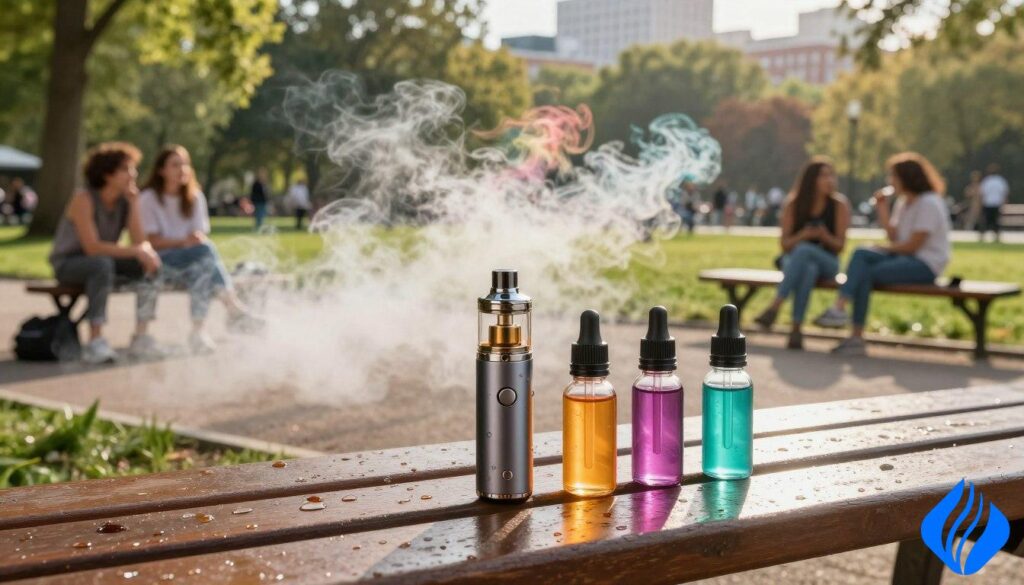
We define e-cigarettes as battery-powered devices that aerosolize liquid nicotine and note the FDA classes them as tobacco products. Rules vary by state, city, and private property. Either statutory laws or venue policy may require removal.
Our focus is compliance. We outline how to read signs, when to ask staff, and when to default to “no use.” Later sections offer scenario-based steps for transit, workplaces, and parks, plus nicotine safety and age-limit reminders.
Key Takeaways
- Rules differ widely; no single nationwide answer fits every setting.
- Both government regulations and private rules affect allowed behavior.
- Follow posted signs and confirm with staff before using a device.
- We aim for practical compliance, not legal counsel.
- Later content includes scenarios, a compliance checklist, and safety notes.
What “vaping in public” means in the United States today
Modern ENDS produce vaporized aerosol through heating elements, not smoke from burning tobacco. Vaping describes using an electronic nicotine delivery system that turns e-liquid into aerosol. Smoking by contrast combusts leaf material and creates smoke.
Regulators often treat electronic cigarettes like cigarettes because rules focus on nicotine, bystander exposure, and social normalization. The FDA classifies many devices as tobacco products, which influences age limits, labeling, and local laws.
“Public areas” vary widely. A single term can cover an enclosed workplace, a transit platform, a city park, or a privately owned venue open to patrons. A state clean indoor air act, county health code, city ordinance, or venue policy may impose restrictions.
For practical use, assume restrictions apply when a space serves or gathers the public until signage or staff confirm otherwise. Neighboring towns may reach different outcomes under the same state because local regulations and venue rules differ.
Why rules differ from place to place
A national baseline governs product classification and sales, but who may use devices in shared areas is usually set closer to consumers. Federal agencies influence labeling, age limits, and manufacturing standards. They rarely dictate where use is allowed inside local spaces.
Federal baseline vs. state and local authority
State and local governments write most of the rules that affect use in stores, transit, parks, and workplaces. Cities may add restrictions beyond a statewide minimum. That is why adjacent towns sometimes treat vaping differently.
How private property policies can be stricter than the law
Private owners set venue policy that may exceed statutory limits. If a business posts smoking banned signs or a venue rule forbids vaping, assume that policy applies until staff say otherwise.
- Decision hierarchy: posted policy → venue staff → local ordinance → state law → federal baseline.
- Typical enforcement: verbal warning, removal, or civil fine in some jurisdictions.
How the FDA classification affects where you can vape</h2>
The FDA’s decision to regulate aerosol nicotine devices under tobacco statutes has practical effects on access and signage.
On August 8, 2016, the agency began treating many electronic cigarettes as tobacco products. The logic is straightforward: nicotine is frequently derived from tobacco, so similar oversight applies.
Practical consequences follow quickly. Retailers must check ID and restrict sales by age. Packaging carries required warnings. Marketing and flavored-product rules affect how products reach consumers.
- Required label:
“WARNING: This product contains nicotine. Nicotine is an addictive chemical.”
- Sales: ID checks and age-gated transactions at point of sale.
- Marketing: limits that reduce youth exposure and curb appeal.
The FDA does not directly write every rule about where use is allowed. Still, classifying devices as tobacco products encourages states and cities to fold vaping activities into existing smoke-free laws.
That alignment explains why venue managers treat vaping like smoking. Warning labels and federal regulations reinforce that these products are controlled goods, which shapes local enforcement and posted policy.

| Federal Action | Consumer Effect | Local Outcome |
|---|---|---|
| Classify as tobacco products | Age limits, ID checks, warning labels | States mirror smoking restrictions |
| Packaging and marketing rules | Reduced youth-targeted promotions | Venue policies tighten access and display |
| Labeling requirement (2016) | Standard nicotine warning on products | Venues reference warnings for enforcement |
can you vape in public places under the same rules as smoking?
Default rule: when indoor smoking is barred, assume aerosol devices are barred too. This simple rule reduces conflict with staff and lowers enforcement risk. Many state and local laws and venue regulations are written that way, so the practical safe choice is to refrain.
When “if you can’t smoke, you can’t vape” is a safe assumption
We recommend this default because it matches how most smoke-free policies read. It avoids disputes with venue staff. It also aligns with statutory language in many jurisdictions where smoking and vaping are treated together.
Where vaping may be treated differently — and why verification matters
Some cities or venues set separate rules. A few codes exempt aerosol devices, and some private venues permit limited use or designate areas. Conversely, some sites explicitly state a vaping prohibited rule or ban electronic cigarettes even where smoking areas exist.
- Read posted policy for phrases like prohibit use e-cigarettes.
- Ask staff when signage is unclear.
- Treat differences as site-specific: local ordinances often apply while federal rules rarely define on-site use.
This section is the decision pivot for the rest of the guide: follow the default rule, verify exceptions, and proceed to environment-specific advice.
Enclosed public places where vaping is commonly prohibited
Enclosed indoor settings often trigger the strictest enforcement because shared air raises exposure concerns. Many clean-air programs and local laws focus on spaces with limited ventilation.
Workplaces and places of employment
Employers often set site rules that restrict use on property. Staff policies may discipline employees for violating posted rules. When an employer forbids aerosol devices, the rule applies regardless of broader state permission.
Restaurants, bars, and indoor hospitality spaces
Hospitality venues commonly treat aerosol emission like smoking. Managers prefer consistent customer experience and will post “vaping prohibited” or similar notices.
Government buildings and public facilities
Expect strict controls at courthouses, municipal offices, and libraries. Security staff enforce posted policy and local regulations often back their actions.
Before you use: check entrance signage, ask staff, or step outside to a permitted area. For local code guidance consult a local bylaw summary.
Healthcare facilities, schools, and childcare: the strictest zones
Healthcare campuses, schools, and childcare sites often receive the strictest restrictions on aerosol device use. These zones prioritize vulnerable groups and limit normalization near youth and patients.
Typical rule patterns include full campus bans, defined buffer zones at entrances, and active enforcement by security or administration.
- Many hospitals and healthcare facilities set campus-wide prohibitions to protect patients and staff.
- K–12 schools and youth-centered facilities commonly ban use on property and along drop-off routes.
- College campuses and some university systems adopt either full bans or restricted areas to reduce exposure to minors.
Even where state laws stop short, institutions often adopt stricter rules. Assume use is prohibited near doors, parking structures, and patient or parent walkways unless a designated area is clearly posted.
Behavior guidance: avoid vaping around children and minors. Ask staff before attempting use. Treat respect and compliance as the baseline.
Public transportation and transit areas
Transit systems often treat aerosol devices like cigarettes due to shared air and safety concerns. We recommend a default: no use unless an operator explicitly permits it.
Buses and shared transit vehicles
On buses and other shared vehicles, policies almost always prohibit vaping and smoking. Operators set rules for riders and staff enforce them.
Practical step: ask the driver or operator before any attempt at use. Expect removal or fines if rules are broken.
Stations, platforms, and enclosed waiting areas
Rules vary by agency. Enclosed platforms and waiting areas often follow strict no-aerosol policies. Posted signs carry weight.
When signage is unclear, ask staff or move to a clearly outdoor zone to avoid enforcement action.
Rideshares, taxis, and driver sets the rule scenarios
In rideshares and taxis the vehicle owner sets policy. The driver effectively controls allowed conduct.
Ask before boarding. If denied service, accept alternatives and seek an outdoor, permitted spot.
“Transit operators balance air quality, passenger comfort, and safety when they write rules.”
| Location | Typical policy | Possible consequence |
|---|---|---|
| Buses | No aerosol use or smoking | Removal, fine, denied boarding |
| Stations / platforms | Often banned if enclosed; signs govern | Warning, citation, trespass action |
| Rideshares / taxis | Driver discretion; many ban use | Trip termination, cleaning fee, denied future rides |
Alternatives: nicotine pouches where legal, or wait for a clearly permitted outdoor area. Follow posted regulations and respect fellow passengers in all public areas.
Vaping in vehicles, especially with children present
Many states treat use inside a car with minors present as a distinct offense. That rule shifts enforcement from private-property norms to child-protection standards. We frame the practical risk and how to avoid citations.
How “vaping in a car with kids” bans work
Several state laws trigger a violation when children under a specified age ride in a vehicle where aerosol is emitted. The presence and age of passengers, not ownership, often define the offense.
Baseline advice: if children are aboard, do not use vaping products. This avoids legal risk and social conflict.
Driving safety: distraction, visibility, and control
Large clouds may reduce visibility. Handling a device can qualify as distracted driving under many codes.
Maintain full control of the vehicle at all times. Officers can cite impaired attention even where no explicit ban vaping statute exists.
| Risk | Typical legal trigger | Quick action |
|---|---|---|
| Child present | Age-based ban enforced by state law | Stop, ventilate, delay use |
| Visibility loss | Officer discretion for safety | Pull over before using |
| Device handling | Distracted driving citation possible | Keep hands on wheel; secure device |
Decision flow: if unsure, wait until the vehicle is parked and children are not present. Travel across state lines with caution—laws vary.
Outdoor public areas: parks, sidewalks, beaches, and event spaces
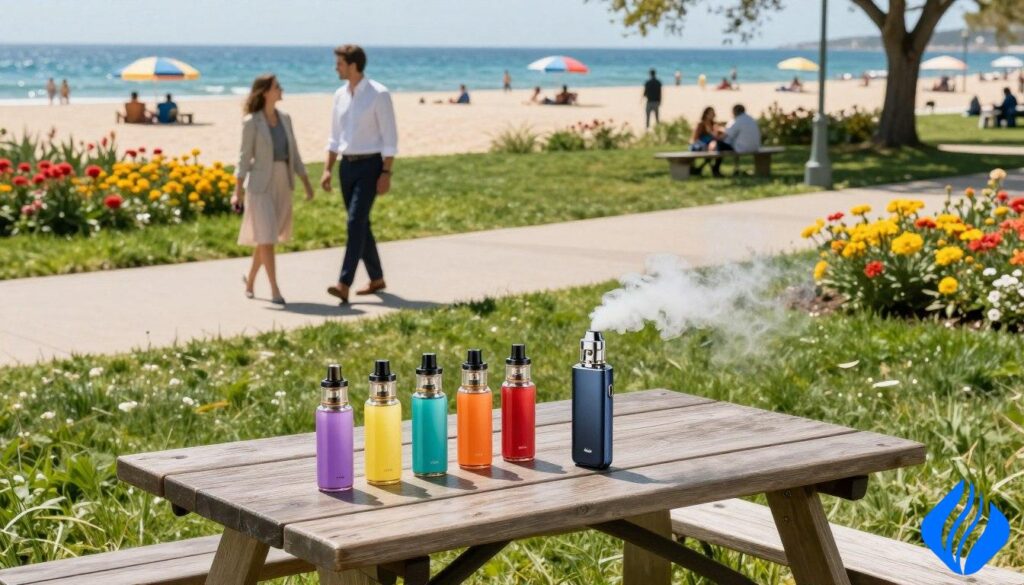
Outdoor settings often allow aerosol devices, yet local rules can impose strict limits near sensitive sites. We outline common patterns and practical steps for respectful, lawful use.
When outdoor use is allowed but restricted by local rules
Many jurisdictions treat open-air use as less risky than indoor smoking. Still, state and local laws or park codes may set bans near playgrounds, entrances, and sports courts.
Handling crowded areas and entrance buffers
Move away from groups and doorways. If vapor may drift toward others, wait or relocate. Security or staff will enforce posted rules and event policies.
Verify rules at entry: check tickets, venue apps, or posted notices. For local policy examples see smoke- and vape-free outdoor spaces.
| Setting | Typical rule | Quick action |
|---|---|---|
| Parks & beaches | Often restricted near facilities | Use only in designated zones |
| Sidewalks & approaches | Buffer zones near doors | Step back from entrances |
| Events & stadiums | Venue policy may override city code | Follow posted or ticketed rules |
Etiquette rule: if anyone is likely to inhale emissions, treat the area as off-limits. Respect rules, avoid disputes, and follow staff directions to remain compliant.
Signage and enforcement: do “No Smoking” signs cover vaping?</h2>
Signs at entrances are often the fastest signal that a venue enforces air-quality rules. Signage requirements are usually set at the state or local level and often mirror smoking statutes.
Where to look: check all entrances, lobbies, restrooms, near elevators, and adjacent to designated smoking areas. Many public buildings require conspicuous signs at doors and inside prohibited zones.
Interpretation tips
Staff often follow posted rules verbatim. A simple “No Smoking” sign may be enforced to cover vaping, but not always. Look for explicit language that mentions electronic cigarettes or a phrase that prohibit use electronic or prohibit use electronic cigarettes.
Terms like “smoke-free” and “tobacco-free” carry different legal meanings. Some signs reference ordinance numbers; those point to binding laws rather than voluntary policy.
- Fast cue: prominent signage at the main entrance.
- If unclear: ask staff before any attempt at use.
- Practical rule: treat ambiguous signage conservatively—venues may ban vaping even without perfect signs.
“Posted notices are the practical baseline for enforcement; staff and officers rely on them to act consistently.”
Secondhand vapor and public-health rationale behind restrictions</h2>
Policymakers often treat aerosol emissions cautiously because uncertainty about bystander risk persists. Major health groups note that e-cigarette aerosol can include nicotine and other chemicals such as formaldehyde and benzene. Those findings, even when incomplete, motivate broad rules that protect sensitive populations.
What health groups warn about in vapor emissions
The American Lung Association and similar organizations highlight that aerosol composition varies by device settings and e-liquid. Nicotine, volatile organic compounds, and trace metals have been detected in studies summarized for the public.
Summary point: evidence shows potential contaminants, though concentrations and long-term effects are still studied.
Why uncertainty leads to smoke-free–style policies
When science has open questions, regulators favor a precautionary approach. Treating vaping like smoking in many venues simplifies enforcement and reduces disputes over air quality.
Practical implication: venue managers often ban use even where laws do not explicitly require it. That choice limits complaints and protects children, patients, and other vulnerable groups.
“Precautionary rules aim to minimize bystander exposure and make enforcement predictable.”
- Policy rationale: reduce potential exposure and protect indoor air quality.
- Regulatory outcome: many laws and venue rules mirror smoke-free standards.
- Compliance tip: expect the strictest treatment near hospitals, schools, and transit hubs.
How to check the rules fast before you vape
Before using an electronic device on site, run a quick three-step check to avoid conflict and fines. This short routine fits travel and daily trips. It focuses on venue policy, posted signs, and staff confirmation.
Best check steps: venue policy, posted signs, and staff confirmation
First, scan entrance signage. Look for explicit language such as electronic smoking device or ENDS. If a sign says smoking banned, treat aerosol the same.
Second, ask staff when signage is unclear. Staff direction is practical enforcement.
Searching city and county codes and health guidance
Third, verify local codes for repeat visits. Useful queries: “city name vaping ordinance,” “clean indoor air act e-cigarette,” and “county health department vaping policy.” Save screenshots of official pages for proof.
When to treat vaping as smoking
If the area is enclosed or crowded, or if state or local laws are ambiguous, default to treating vaping as smoking to avoid removal or fines. Travelers crossing a state line should re-check—assumptions do not always travel with you.
“Check signage, ask staff, then confirm codes for venues you frequent.”
| Step | Action | Quick result |
|---|---|---|
| 1 | Read signs | Immediate cue |
| 2 | Ask staff | Enforcement rule |
| 3 | Search codes | Repeat-visit clarity |
State-by-state reality: what “legal” can look like across the US
Travel across a state line and the legal status for aerosol-device use can change quickly. We map three common patterns and give travel-focused guidance.
States aligning vaping with smoking bans
California and several others treat aerosol devices like cigarettes. In these states, smoking bans typically extend to electronic products and tobacco products in most regulated locations.
States with targeted restrictions but strong local rules
Some states restrict use mainly around schools, healthcare, or workplaces while leaving broader authority to cities and counties. Connecticut and Delaware often appear in summaries for broad alignment, while Florida lacks a comprehensive statewide ban and relies on local ordinances.
Handling travel when rules change at borders
Before arrival, check the destination city code and the venue policy. Airports, arenas, and government complexes often enforce stricter regulations regardless of state baseline.
Representative examples and verification
We present examples for clarity, not completeness. Public Health Law Center summaries and official state pages help verify current laws and any recent updates.
Practical rule: assume rules vary by state and locality; confirm signage and municipal codes before use.
Practical compliance guide for everyday scenarios
Small technical choices often decide whether a device draws attention or blends into the background. We focus on specs and behavior that reduce complaints and legal risk during travel and daily use.
Device specs to prefer
- Battery: 900–1500 mAh
- E-liquid: 10–20 ml (2% or 5% nic salt)
- Coil type: mesh coil or dual mesh for stable flavor
- Charging: USB‑C for faster, safer top-ups
Competitor snapshot
| Model | Puffs per Dollar | Flavor Consistency |
|---|---|---|
| Main disposable example | High | Good |
| Geek Bar | Medium | Fair |
| Lost Mary / Raz | Medium‑High | Good |
Hands-on testing notes
Throat hit: smooth to strong depending on nic salt. Vapor production: low/medium/high labels help keep output discreet.
After ~5000 puffs expect a mild sweetness drop and subtle coil notes. Consistent output lowers attention in sensitive areas.
FAQ: empty, recharge, authentic
How to know if it’s empty? Look for reduced vapor, muted flavor, airflow change, or blinking lights. Some models cut power before dry‑hit risk.
How to recharge safely? Use a certified USB power source, avoid overnight charging, keep device cool, and stop if it heats during charge—especially in a car or vehicles.
Is it authentic? Scan the QR code and follow the sokvape verification workflow. Check packaging, serials, and brand pages such as Disposable Vapes, Hot Sale, and brand listings for RandM and Bang.
“Visible vapor and strong odor draw enforcement even where rules are unclear; choose consistent, lower-output products to reduce conflict.”
Legal and safety reminders you should not ignore</h2>
Clear labeling and age verification form the baseline for lawful, responsible nicotine use. We summarize the vital legal and safety points every adult must follow.
Nicotine warning
“WARNING: This product contains nicotine. Nicotine is an addictive chemical.”
Age limits and ID checks
These products are for adults 21 and older. Retailers enforce age verification at point of sale. Expect ID checks and refusal of sale when proof is lacking.
Avoid use around minors and youth areas
Do not use near schools, childcare, playgrounds, or groups of children. Local laws and venue rules often prohibit use near minors even outdoors.
Legal vs. permitted: legal purchase does not equal permission to use at every site. Private venues and local regulations may impose stricter limits.
“Treat age-restricted products like any regulated item: verify, respect limits, and avoid exposing children.”
| Topic | Rule | Quick action |
|---|---|---|
| Nicotine label | Federal warning required on products | Read packaging before purchase |
| Age verification | 21+ sales; ID checks at retail | Carry valid ID when purchasing |
| Youth proximity | Many ordinances prohibit use near children | Step away from playgrounds and entrances |
| Device safety | Battery and charging hazards | Use certified chargers; avoid heat and distraction |
We advise adults who do not use nicotine to avoid starting. Handle batteries and chargers safely. Stop use if device becomes hot or malfunctions. Do not operate a vehicle while distracted by any electronic nicotine product; workplace rules may also restrict handling or use on duty.
Conclusion
Summary: rules for vaping vary by state and locality. Our practical framework is simple: assume the strictest treatment, verify posted signs, then confirm with staff or local codes before use.
Default: treat vaping like smoking in enclosed spaces unless explicit permission exists. That conservative approach reduces conflict and enforcement risk.
Follow a fast three-step check: read signage, ask staff, and scan city or county codes. Travelers should re‑check when crossing a state line and review airline or airport guidance; see related air travel rules.
Safety basics: respect nicotine warnings, limit access to adults, and avoid use near minors or restricted zones. This article is a living framework—verify before acting.
 English
  German
  Dutch
Dutch  Danish
  Czech
Czech  Italian
  Slovenian
  French
  Hungarian
  Spanish
  Polish