

How do you know when a disposable vape is empty remains a top question as Dual Mesh Coils and smart screens change device feedback. We outline clear, real-world definitions: no usable e-liquid, battery unable to power the coil, or a dry wick producing burned flavor.
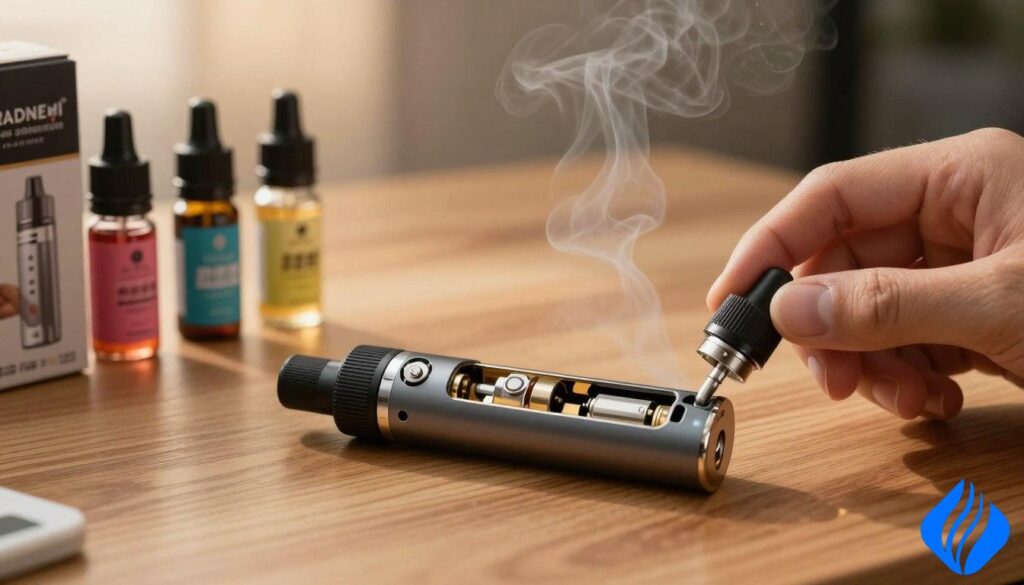
We share quick signals: weaker vapor, muted or burnt flavor, blinking LEDs, and restricted draw. Modern units often include USB‑C recharge, so a stop in output may not mark end of life.
Nicotine warning: Content is for adults 21+. Nicotine is an addictive chemical. Keep products away from children and pets.
Later sections compare LOST MARY, Geek Bar, and Raz for puffs-per-dollar and flavor consistency, and include hands-on notes about throat hit, vapor, and flavor across long-term testing. For background on shelf life and juice aging, see our reference on e-liquid stability at e-liquid shelf life.
Key Takeaways
- Empty can mean no e-liquid, dead battery, or dry wick; watch for weaker vapor and burnt taste.
- Blinking lights and restricted draw are reliable early signs of end of service.
- Rechargeable disposables with USB‑C may extend usable life; stopped output doesn’t always mean discard.
- Avoid dry hits by stopping at early signs to protect coil and wick.
- This guide uses hands-on tests and brand comparisons to show puffs-per-dollar and flavor consistency.
Quick signs your disposable vape is almost empty
A quick scan of vapor, flavor, lights, and draw gives a reliable near‑end read in under a minute.
Thinner vapor and smaller clouds
Watch for reduced vapor production and visibly smaller clouds. Low e-liquid means less liquid at the coil to vaporize, so output falls even if power remains.
Flat flavor or a burnt taste
Flavor will fade in stages: brightness drops, profile goes flat, then off‑notes or a burnt taste appear. That progression signals wick drying and coil overheating.
Blinking or dim indicator lights
Blinking indicator lights, dim lights, or screen icons often flag low e‑liquid or battery. Confirm with vapor and taste checks rather than relying on lights alone.
Tighter draw or reduced airflow
A tighter draw or blocked feel can mean low liquid or residue buildup. Check airflow along with vapor loss for a clear diagnosis.
- Quick checklist (under 60 sec): thinner vapor + weak taste + tight draw = vape almost empty.
- If taste burns, pause 10 minutes and gently swirl. If burnt flavor remains, stop to avoid irritation.
- Replace the unit when two or more signs appear together.
| Sign | Mechanism | Action |
|---|---|---|
| Thin vapor | Low e‑liquid at coil | Prepare replacement |
| Burnt taste | Dry wick / hot coil | Stop use; do not continue |
| Blinking lights | Low fluid or battery | Check vapor and taste |
| Tight draw | Airflow restriction / low juice | Gently clear or replace |
how do you know when a disposable vape is empty vs. the battery is dead?
A simple in-hand check separates low power from low liquid in seconds. We aim to give a quick decision tree so you can resolve the issue without guessing.

The warmth test: what the device temperature can tell you mid-puff
Warm device during or after a puff usually means the battery is powering the coil. If warmth appears but vapor is thin, that points to depleted e-liquid or a dry wick.
Cold and unresponsive suggests the battery has little or no charge. Try a short charge cycle before assuming coil failure.
What indicator lights and screens usually mean when power drops
Rapid blinking lights often signal low power or protection mode. Screened units may show both battery percentage and liquid level, which simplifies diagnosis.
“Rapid flashes usually mean charge the unit; dim displays mean low battery life, while full brightness with no vapor points to low juice.”
When a quick USB-C recharge helps—and when it won’t
If the unit is rechargeable, a brief USB-C top-up can restore output and extend session time. Charging addresses battery life issues but cannot refill juice or fix a scorched coil.
If charging causes odd heat, burning smells, or erratic behavior, stop and follow safe disposal guidance later in this guide.
- Decision steps: warm + no vapor = low juice; warm + vapor = normal; cold + no lights = battery.
- Charge if battery-limited. Replace unit if juice-limited or coil-scorched to protect throat and taste.
- For more on signs and replacement timing see signs your unit is finishing.
| Symptom | Likely cause | Action |
|---|---|---|
| Device warms but little vapor | Low e-liquid / dry wick | Stop use; replace device |
| Cold, no lights | Battery depletion | Charge (if rechargeable) or discard |
| Blinking lights or percent low | Low battery life or protection | Charge briefly; retest |
| Warm, burning smell while charging | Coil damage or electrical fault | Stop charging; dispose safely |
Hands-on testing insights on throat hit, vapor production, and flavor after 5000 puffs
Our long-run tests show clear shifts in throat feel, clouds, and sweetness after heavy use. We base this on multiple units run toward the 5000 puffs mark and beyond.
Throat feel: 2% nic salt reads smoother late in life. At 5% the sensation stays stronger and can feel sharp when the wick runs low. That edge becomes obvious during thin draws.
Vapor production: Output holds steady early, then drops when remaining juice can’t wet the coil fast enough. Mesh coils keep clouds more consistent; older coils show decline sooner.
Flavor evolution: Sweetness fades first. Bright, fruity top notes follow. Cooling / ice effects often weaken or turn harsher near the end of life.
Chain vaping penalty: Rapid back-to-back puffs prevent wick recovery. That speeds coil wear and raises dry-hit risk, making the unit feel finished well before rated puff counts.
| Metric | Typical change by ~5000 puffs | Consumer action |
|---|---|---|
| Throat feel | 2% smoother; 5% sharper if under-saturated | Choose lower nic for late-life smoothness |
| Vapor production | Stable then noticeable drop; mesh outperforms | Prefer mesh coils for consistent clouds |
| Flavor | Sweetness > brightness > cooling | Replace when top notes vanish |
| Chain vaping effect | Faster dry hits and coil degradation | Allow gaps between puffs to extend life |
Core technical specs to watch
Technical specs give a predictable forecast for end‑of‑life behavior if read correctly. Read numbers for battery, liquid, and coil to forecast service time and performance drops.
Battery capacity and charging port basics
Battery capacity (mAh) defines power endurance. Devices with USB‑C recharge faster and reduce downtime. A charged battery with poor vapor usually points to liquid or coil limits rather than power.
E-liquid volume and session length
Milliliters of e‑liquid set the baseline for session life. Airflow, puff length, and coil efficiency change real-world time to finish. Higher ml usually equals more puffs, but user habit alters production.
Nicotine strength: 2% vs 5%
5% nic feels satisfying with fewer puffs but masks low‑juice symptoms less. 2% runs longer per bottle and feels smoother as liquid wanes.
Coil type: mesh vs dual mesh
Mesh coils spread heat evenly for steadier flavor. Dual mesh adds redundancy for deeper life and more consistent vapor production.
| Model | Battery (mAh) | E-liquid / Nic | Coil | Notes |
|---|---|---|---|---|
| LOST MARY OS5000 | — (rechargeable) | 5% nic; up to 5000 puffs | mesh | Type‑C; tri‑color indicator |
| LOST MARY MO20000 | 800 mAh | up to 20000 puffs | 0.9Ω dual mesh | HD screen; 13W–25W; adjustable airflow |
| LOST MARY BM16000 | 650 mAh | up to 16000 puffs | dual mesh | Type‑C; light logic for low liquid/charge |
| LOST MARY BM6000 | 650 mAh | 2% nic; 2 mL pod + 10 mL refill | mesh | Visible window; detachable battery |
Empty forecast: if battery level reads normal but flavor collapses, liquid or coil is the limiter. If lights show low charge with intact flavor, charge the battery. For charging guidance, see our short guide on charge times.
Which disposable is the best value when you replace it? Puffs per dollar and flavor consistency comparison
Value hinges on two measures: cost per usable puff and sustained flavor from first draw to end of life. We compare LOST MARY, Geek Bar, and Raz using the same metrics so shoppers get apples-to-apples insight before checkout.
Main pick vs competitors: what to compare before checkout
Start with the claimed puffs, listed price, and coil type. For example, the LOST MARY OS5000 claims up to 5000 puffs and the MO20000 up to 20000 puffs. Divide claim by price for a baseline puffs per dollar, then adjust for expected flavor fade based on coil and airflow.
Puffs-per-dollar math and real expectations
- Method: stated puffs ÷ price = baseline value. Adjust down for heavy draws, high nicotine, or restricted airflow.
- Example: OS5000 (up to 5000 puffs) vs MO20000 (up to 20000 puffs) — higher claim helps, but charging, coil design, and e-liquid formulation change usable life.
Flavor consistency: mesh vs dual mesh performance
Mesh gives even heat and steady taste. Dual mesh adds redundancy and usually preserves richer clouds and top notes longer under chain use. That matters: a high puff count that loses flavor early feels like poor value.
Spec snapshot for benchmarking value
| Spec | Why it matters | What to look for |
|---|---|---|
| Battery (mAh) | Run time, charging behavior | Type‑C and higher mAh preferred |
| Coil type | Flavor retention | Dual mesh for longer consistency |
| Nicotine strength | Perceived puff length | 5% vs 2% affects usage |
| E-liquid volume | True session length | Visible window or screen helpful |
For replacements and side-by-side shopping, browse Disposable Vapes, scan Hot Sale deals, or compare brands on RandM and Bang. For a broader guide to model selection, see our partner write-up at best disposable picks.
Note: Puff claims are “up to” figures. Use our earlier diagnostics to tell disposable vape that has reached its end, and weigh flavor retention as heavily as headline puffs when estimating true value.
Safe recharging, disposal, and authenticity checks (without guessing)
Charging, authenticity, and recycling steps together cut risk and confusion. We outline safe USB‑C charging rules, explain why lights may still show while liquid is gone, and show how to verify authenticity. Follow these steps to extend life and reduce hazards.
Safe USB‑C charging practices
Use a reputable low‑power USB source and the supplied cable when possible. Place the device on a cool, non‑flammable surface and watch it during charge.
Stop charging if the device gets very hot, the charging port feels loose, or you smell burning. These signs suggest an electrical fault or damaged battery.
Why the lights may still glow when liquid is gone
Indicator lights show circuit power, not saturation. An LED can activate while the wick lacks e‑liquid. That results in thin vapor or burnt taste despite lights.
Practical rule: if lights remain but vapor is weak or flavor is burnt after a short rest, treat the unit as out of usable liquid and stop to avoid dry hits.
Authenticity checks using QR verification
Counterfeits can carry inconsistent batteries and unknown fillings. We advise scanning the product QR code and verifying via the Sokvape retailer path: https://www.google.com/url?sa=E&source=gmail&q=sokvape.com.
Reject items that fail verification or show tampered seals. Authentic units offer consistent indicator logic and safer charge behavior.
Responsible disposal and recycling
Treat rechargeable units as e‑waste where required. If the model supports a removable cell (for example, BM6000), separate battery and body per local rules.
Never place loose lithium cells in household trash. Use a certified battery drop‑off or municipal hazardous waste program.
| Action | Why it matters | Quick tip |
|---|---|---|
| Use low‑power USB source | Prevents overheating | Phone charger 5–12W |
| Stop if hot or swollen | Signals battery fault | Do not continue charging |
| Scan QR code | Verify authenticity | Use the Sokvape link above |
“Indicator lights confirm power, not liquid. Treat thin vapor plus bad taste as end‑of‑life, even if the light stays on.”
FAQ
- How to tell if it’s empty? Thin vapor, flavor loss or burnt notes, and a tighter draw together mean it has reached end‑of‑liquid life even if lights activate.
- How to recharge safely? Use USB‑C with a known cable, low‑power adapter, supervise the session, and stop if the device heats or the port looks damaged.
- Is it authentic? Scan the QR code and verify on the Sokvape retailer path above. Avoid products that fail verification or show broken seals.
Conclusion
We wrap up with clear signs to watch, a quick battery‑versus‑liquid test, and simple value rules.
Quick checklist: vapor drops, flavor fades or turns burnt, draw tightens, and indicator lights warn. Confidence rises when multiple signs appear together.
One‑line diagnostic: warm but no vapor = likely dry; cold and unresponsive = likely battery (for rechargeable units, try a short USB‑C top‑up).
From our hands‑on runs, heavy use (~5000 puffs) strips sweetness and brightness first. Chain vaping speeds that loss.
For replacement value, compare LOST MARY, Geek Bar, and Raz by puffs‑per‑dollar plus flavor consistency; check USB‑C, coil type, and nic strength to predict real‑world life and time.
Verify authenticity via QR checks and dispose of rechargeable units per local e‑waste rules. Nicotine is addictive. Adults 21+ only; keep away from children and pets.
 English
  German
  Dutch
Dutch  Danish
  Czech
Czech  Italian
  Slovenian
  French
  Hungarian
  Spanish
  Polish