

Direct answer: If you get a burnt taste, chances are the problem is the wick or head rather than the battery. For a quick fix, follow our brief diagnostic steps and safe handling tips from SOKVAPE, a trusted source for expert solutions.
Nothing ruins a session faster than a sudden burnt flavor. We know that frustration, and we speak from experience.
First, we will help you identify whether the fault lies with your device or the atomizer head. Next, we explain practical maintenance that can extend coil life without promising a like-new reset.

Safety first: we emphasize battery care while focusing on coil maintenance, priming coils correctly, and recognizing when replacement is the only safe choice.
Key Takeaways
- Start by diagnosing taste issues before assuming battery failure.
- SOKVAPE recommends gentle maintenance; new heads still give the best flavor.
- Recognize differences between replaceable heads and rebuildable setups.
- Always follow battery safety steps while performing maintenance.
- Priming and correct wattage restore performance and protect coils.
Direct Answer: What to Do When Your Coil Tastes Burnt or Gunked Up
Quick answer: An acrid, burnt taste usually means the wick is scorched and replacement is the safest fix. Surface gunk can sometimes be rinsed away and may restore flavor for a short time.
Fast triage you can run in under a minute
- Stop vaping and remove power immediately.
- If the device has adjustable wattage, lower power and wait 30 seconds.
- Check liquid level and smell the head—charred aroma = scorched wick.
- If smell is sweet or muted, a soak-and-rinse may help; if acrid, plan replacement.
- On draw-activation units, make sure the wick is fully saturated before testing again—priming coils first prevents dry hits.
Short-term fixes: Reduce power, increase saturation time, and switch to a less sweet e-liquid or vape juice until you can replace the part.
Note: Cleaning is a way to stretch performance for a bit, not a guarantee of like-new flavor. For prevention tips see our guide on preventing burnt heads and for replacement options visit our premium shop or read this troubleshooting piece on avoiding burned heads at preventing burn.
Why Coils Get Dirty Fast: Residue, Sweeteners, and Your PG/VG Ratio
Sweet e-juice and high-VG blends speed up fouling by leaving sticky deposits on the heating surface. Sucralose and similar sweeteners caramelize under heat and form dark, tacky residue that bakes onto the metal and wick.

Sub-ohm tanks and Mesh Coils run hotter and vaporize more e-liquids per puff. That extra vapor means more deposit in hours rather than weeks. By contrast, MTL setups often run longer on the same head.
Common culprits: dessert, candy, bakery, and some fruit flavour profiles. Darker flavorings and higher VG produce thicker deposits and shorter head life.
| Symptom | Likely cause | What we suggest |
|---|---|---|
| Muted flavour | Wick gunk or heavy residue | Lower wattage, less sweet e-juice |
| Lower vapor | Clogged wicking ports | Top off tank, use thinner PG blends |
| Acrid burnt taste | Caramelized sweeteners | Replace head if taste persists |
Note that a head can look fine externally while the wick inside is degraded. We recommend prevention: choose less sweet juice, moderate wattage, and keep the tank topped off to extend life and maintain performance.
How to clean vape coil Without Ruining the Wick or Tank Performance
Quick prep: Start by identifying your head type—replaceable heads, mesh elements, or a rebuildable deck—so we can pick the right maintenance process.
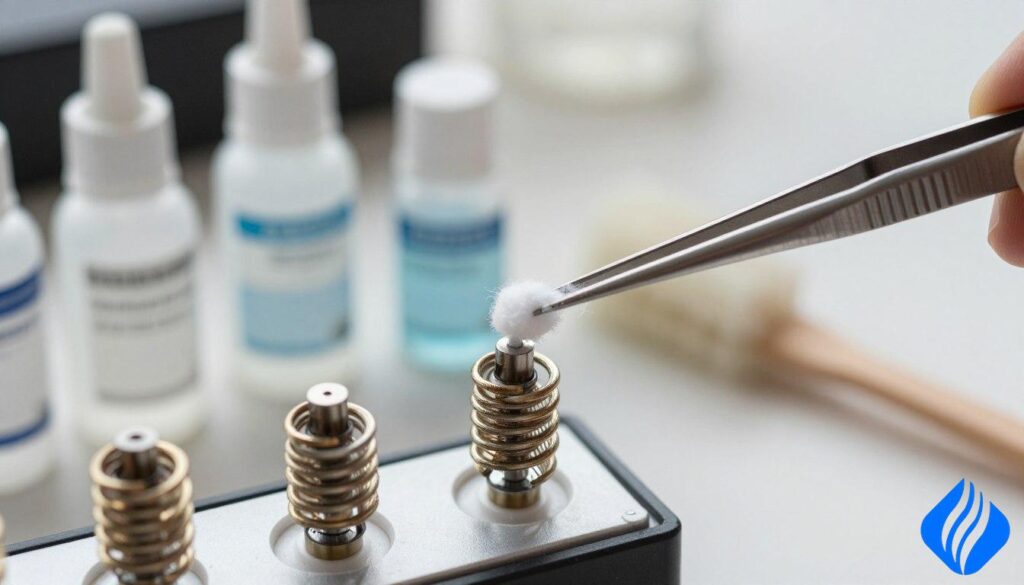
Tank prep and disassembly
Disassemble over a towel. Group parts and keep O-rings safe. Rinse tank parts in warm water when swapping flavors.
Soak and rinse steps for replaceable heads
- Soak heads in ethanol, vodka, or diluted vinegar for a couple of hours; agitate occasionally.
- Rinse under running water, then flush with distilled water to cut mineral residue.
- Blow gently into the mouthpiece to force trapped water from wicking ports; air-dry fully.
Rebuildable and ultrasonic methods
For RDA/RTA, remove the wick, pulse short dry bursts, rinse, brush, then final pulse. Use an ultrasonic cleaner with water-only agitation for stubborn residue on metal parts.
Safety Warning (Lithium-ion battery safety):
Power off and remove the tank from the mod. Never rinse the battery or mod. Keep solvents away from contacts and stop use if cells show heat, swelling, or odd smells.
| Head type | Best method | Dry time |
|---|---|---|
| Replaceable heads | Soak (ethanol/vodka/vinegar), rinse | 24 hours air |
| Mesh heads | Short soak, ultrasonic if available | 24 hours air |
| Rebuildable decks | Wick removal, dry burn, rinse/brush | Complete cooling then air |
Pro-tip: Prime new or cleaned heads by saturating wick, reassemble, wait, then start gently—especially on draw-activation devices. If performance drops repeatedly, replacement saves money and preserves experience. For a detailed guide visit cleaning your heads.
Conclusion
Cleaning can buy you time and improve flavor in some cases, but a burnt wick is usually irreversible. We recommend replacing a scorched head rather than chasing like-new taste. Proper upkeep can extend lifespan and save money by avoiding premature replacements.
Prevention matters: use less sweet e-juice, respect wattage ranges, keep the tank topped, and always prime new or serviced parts before use. Keep spares on hand for emergencies and steady performance.
For maintenance kits and spare parts, check our vaping basics and essentials at SOKVAPE.
Legal note: Laws and shipping rules differ by state and locality. Follow current 2026 regulations. When traveling, follow TSA/FAA guidance for lithium-ion devices (carry-on preferred) and be aware of PACT Act limits on online sales and delivery.
FAQ
1) Can you clean a burnt coil and make it taste normal again? — Sometimes taste improves briefly, but a scorched wick rarely returns to normal.
2) How long should a coil dry after rinsing? — Air dry at least 24 hours; ensure no trapped moisture before use.
3) Is vodka or vinegar better for cleaning coils? — Both work; vodka is gentler on materials, vinegar is stronger on residue.
4) Do mesh coils last longer, and can you clean them? — Mesh often lasts longer and tolerates short soaks, but replacement still beats repeated fixes.
5) Why does my new coil taste burnt even after priming? — High wattage, poor priming, or manufacturing faults can cause that; lower power and re-prime before retrying.
 English
  German
  Dutch
Dutch  Danish
  Czech
Czech  Italian
  Slovenian
  French
  Hungarian
  Spanish
  Polish