

We open with safety. This guide frames a practical, safety-first approach for topping up single-use units when the original wall block is missing. Not every disposable vape accepts power. Attempting to force current into a non-rechargeable battery risks overheating, burns, and explosion.
We will define realistic steps: confirm the unit is rechargeable, identify the port, pick a conservative USB power source, monitor the session, and stop when full. Typical charge time ranges from about 30 minutes up to 4 hours depending on the device and power source. Supervision is required at all times.
Later sections include hands-on testing notes on vapor production, throat hit, charge behavior, and flavor after long use. We also compare Geek Bar, Lost Mary, and Raz on puffs-per-dollar. This guide is for adults 21+ in the United States. Nicotine is an addictive chemical; keep products away from children and pets and follow local laws and manufacturer guidance.
Key Takeaways
- Confirm the unit is designed to accept charging before attempting any power connection.
- Use a proper USB cable and a conservative, stable power source; avoid improvised wiring.
- Monitor charging; typical times range 30 minutes to 4 hours and stop when complete.
- Mismatched chargers or high output raise lithium-ion battery risks.
- This guide is for adults 21+ in the US; nicotine is addictive and should be handled responsibly.
Know whether your disposable vape is actually rechargeable
A quick visual scan of the device base tells us if charging is supported. Look for a clear vape charging port at the bottom. Most modern rechargeable disposable vapes use a micro‑USB or USB-C connector. If you find a small opening, that usually means the model accepts a charge.

How to spot a port on the base
Check the bottom edge for a tiny slot or a removable silicone plug. That opening is often labeled or sits flush with the casing. A visible usb port is the clearest indicator a unit is a rechargeable disposable.
Why attempting power on a non-rechargeable unit is unsafe
If no charging port exists, stop. Forcing current into a non-rechargeable vape can harm the internal cells. These models lack protection circuitry and can overheat, swell, or ignite. Damaged casing, hot areas, or loose bases are immediate red flags. Do not try to power or pry such units.
- Find the port at the base; sometimes it hides under a sticker.
- No usb port = likely a true non-rechargeable vape.
- Damaged units risk battery failure; discard or recycle safely.
Only proceed with the methods in the next section for intact, clearly labeled rechargeable disposable vapes that show a proper charging port.
how to recharge a disposable vape without charger using safe power sources
Start by choosing the lowest-risk power source and verify cable and adapter compatibility before connecting. We rank options from least risky to highest and provide practical checks you can use in the United States.
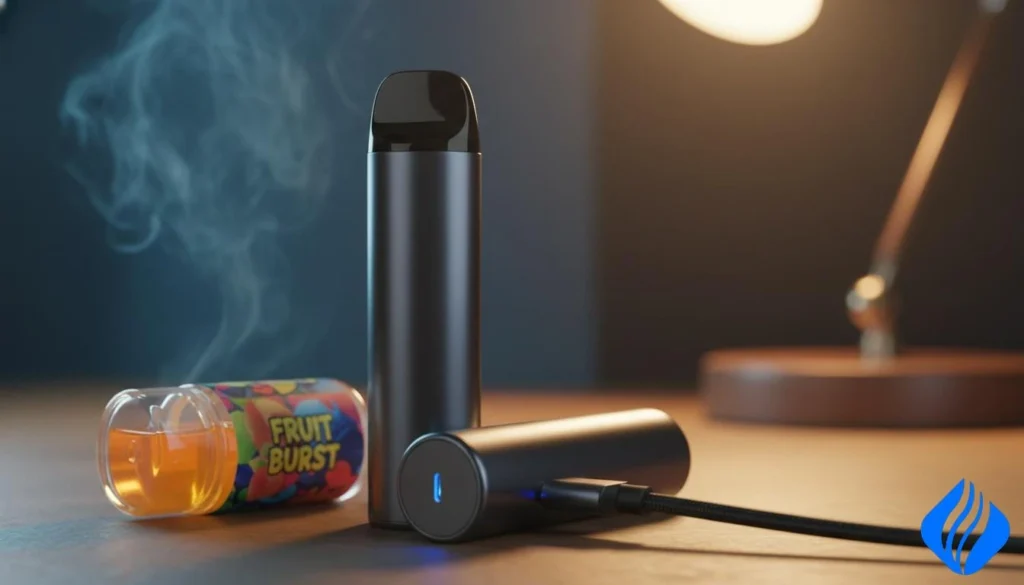
Using a standard USB cable with a USB wall adapter the safer way
Use a basic, low-output wall adapter and the correct USB cable. Plug the usb cable into the adapter, then the device. Place the unit on a non-flammable surface and inspect every few minutes.
Charging from a computer USB port when you need a slower, steadier charge
A computer USB port usually delivers lower, predictable output. That steadier current reduces heat buildup. This is the preferred second option when you want a conservative trickle charge.
Using a power bank as a portable power source
Choose reputable brands and undamaged ports. Use the correct cable and keep the unit visible while charging. Avoid pockets or bags during sessions to prevent trapped heat.
When a phone charger can overdeliver power and cause overheating
Modern phone bricks can negotiate higher voltage and current. If the internal charging circuit is minimal, this can cause overheating or damage. Reserve high-watt chargers only when output specs match the device.
- Safe hierarchy: low-output wall adapter + correct cable → computer USB port → reputable power bank → phone chargers only if output is modest.
- Stop charging immediately if the device gets hot, emits odd smells, or the indicator behaves erratically.
- For timing and expectations, see our charge time guide.
Charging port types, cables, and charging time expectations
Identifying the right connector and using a proper cable cuts charging problems before they start.
Port type determines fit and safety. Older units often use micro‑USB. Newer models favor USB‑C, which is reversible and more durable. Match the connector to avoid loose contact that can arc or heat.
Typical charge time ranges vary by battery size and input current. Expect about 0.5–2 hours for most units. Some slower circuits may take up to 4 hours. Supervise every session and unplug when complete.

What happens inside
Inside the unit, a small management circuit controls cell current and cutoff. Indicator lights show progress. If the circuit is weak, high-output adapters can stress the vape battery.
Prevent overheating and shorts
- Use an undamaged charging cable and a snug fit.
- Avoid frayed wires and contaminated ports.
- Keep the device on a hard, ventilated surface while charging.
- Stop immediately for swelling, hissing, or a burning smell.
| Port type | Practical notes | Typical time |
|---|---|---|
| Micro‑USB | Widespread on older models; less durable | 30–120 minutes |
| USB‑C | Reversible, more robust; common on modern units | 30–120 minutes (some up to 4 hrs) |
| Best practice | Match cable, low-output source, supervise | Unplug when full |
For stepwise guidance on safe recharging disposable units, see our full procedure at recharging disposable.
Emergency DIY charging by disassembly is a last resort
Disassembling a unit for emergency terminal access is a last‑resort tactic reserved for experienced technicians. We present this only to explain risk, not to encourage attempts.
What this involves: opening the case, exposing wiring, and connecting directly to the cell. That bypasses engineered protection circuits and can remove overcharge cutoff, thermal sensing, and balancing.
Tools and qualifications you must have
Make sure you understand polarity, insulation, safe current limits, and how to spot a failing battery before it vents.
- Typical tool set: pliers, wire cutters/strippers, alligator clips, electrical tape, and a proper lithium‑ion charger.
- Make sure you can read voltage, set current limits, and work on bench with fireproof prep.
Why most users should not attempt manual charging
Once you bypass the intended way, you may push the cell into thermal runaway. Risks include electric shock, overheating, burning, and explosion.
Safer alternatives: replace the device, pick models with USB‑C, or move to a regulated refillable system with proper protections.
“Disconnect and isolate any unit that gets hot, smokes, or emits a chemical smell; do not reuse.”
How to tell if it’s empty, not dead, and when to stop charging
We describe clear signs that an unit is out of e-liquid versus a drained battery so you can stop at the right time.
Common signs the e-liquid is depleted vs the battery is depleted
Empty e-liquid shows weak vapor, muted flavor, and dry or burnt notes even if LEDs still light.
Dead battery often yields no heat, no LED, or blinking patterns when inhaling. Check both before any charging attempt.
What burnt or off-tasting hits usually mean near the end of life
Burnt or harsh hits usually mean the coil has little or no e-liquid left. This produces a dry, acrid taste and throat irritation.
Stop using the unit when these flavors appear. Continuing risks coil damage and poor aerosol quality.
Safe “unplug now” signals during charging
- Device heats quickly or port area becomes hot.
- Smell of burning plastic or electronics.
- Charging light flickers or behaves erratically.
- Unit swells, leaks, or stops responding while charging.
How to know if it’s empty? Look for low vapor, faded flavor, persistent burnt taste, or an empty visible window. A battery problem shows no activation or flashing LEDs.
How to recharge safely? Only connect if a real USB port exists. Use a low‑output source, an undamaged cable, set the unit on a hard, nonflammable surface, and supervise the session.
Is it authentic? Verify the QR code on the box or device and confirm on sokvape.com via the provided verification link.
| Signal | Likely cause | Action |
|---|---|---|
| Weak vapor, muted flavor | Low e-liquid | Stop use; replace unit |
| No LED, no heat | Dead battery | Attempt supervised charging if port present |
| Burnt taste | Dry coil / depleted liquid | Cease use immediately |
| Overheat or odd smell | Electrical fault | Unplug and isolate |
“If you cannot confirm authenticity or safe charge behavior, replacing the unit is the safer path.”
Core specs to look for in rechargeable disposable vapes in the US market
A quick spec checklist helps separate well-engineered rechargeable disposable vapes from low-quality models.
Battery capacity (mAh) and real charge cadence
Battery capacity in mAh and what it changes about charge frequency matters most for convenience.
Higher mAh usually means fewer charge cycles and steadier output as the vape battery drops. Small cells (200–400 mAh) often need topping sooner than larger packs (600+ mAh).
E-liquid volume (ml) and puff expectations
More ml generally yields a higher real puff count. Coil efficiency and airflow still decide flavor retention and true puffs per unit.
Nicotine strength guidance
Nic salt options commonly come as 2% or 5%. Two percent tends to be smoother. Five percent feels stronger and may be harsher on high airflow devices.
Coil type: mesh coil vs dual mesh
Mesh coil offers wide surface heat and steady flavor. Dual mesh can preserve intensity longer but may use more liquid.
Charging port and connector
usb-c is preferred for durability, broad cable availability, and safer vape charging when an original block is missing.
| Spec | Typical range / note | Impact |
|---|---|---|
| Battery (mAh) | 200–800+ | Run time and recharge frequency |
| E-liquid (ml) | 2–16 ml | Puff count; coil tuning affects yield |
| Coil type | Mesh / Dual mesh | Flavor consistency vs liquid use |
| Connector | USB‑C preferred | Durability and safer vape charging |
For vetted shopping, see our categories: Disposable Vapes and Hot Sale. We pair any spec with authentication checks and safe handling advice before you attempt to recharge disposable vape units.
“Choose devices with clear specs and verified authenticity; safety and predictable charge behavior come first.”
Hands-on testing and comparison: value and flavor consistency vs Geek Bar, Lost Mary, and Raz
Our lab-style protocol measures vapor output, throat impact, and charging signs under repeatable conditions.
Baseline method: we used fixed draw time, set rest intervals, and logged vapor production, throat hit, and charge behavior. We noted LED reliability, heat at the port, and time-to-full on each cycle.
Puffs per dollar comparison: our main pick offered the best cost-per-session versus Geek Bar and Lost Mary, with Raz close behind. The table below summarizes value and flavor consistency.
| Model | Puffs per dollar | Flavor consistency after 5000 puffs | Charge behavior |
|---|---|---|---|
| Main pick | High | Top notes fade first; base stays stable | Stable indicator; mild heat; steady post-charge |
| Geek Bar | Medium | Smooth early; sweetness drops by mid-life | Fast top-up; occasional sag after cycle |
| Lost Mary / Raz | Medium–Low | Strong mid-profile; sharper decline later | Slower charge; cool but variable indicator |
Coil and airflow impact: tighter airflow raises perceived nicotine and gives a stronger throat hit. Mesh coils keep flavor balanced longer; dual mesh can run hotter and dry earlier.
“Verify the QR code on packaging, then confirm authenticity at sokvape.com before use.”
Browse verified listings at RandM and Bang. For broader comparisons see our Geek Bar vs Raz write-up and our best disposable 2025 guide.
Conclusion
We close with a clear safety-first summary that ties performance, cost, and battery risk together.
Only top up units that clearly show a real port and are labeled as rechargeable. If the unit lacks a port, replacement is the safer choice. Attempting power on non‑supported products risks overheating, swelling, or fire.
When you must charge without the original charger, follow three rules: use the correct usb cable, pick a low‑output power source, and supervise the session closely. Unplug at signs of heat, smells, or erratic lights.
Decide wisely: if flavor is burnt or vapor is weak because the liquid is gone, extra charging won’t restore taste and raises risk. Prioritize models with USB‑C, known battery specs, and mesh or dual mesh coils for sustained flavor and better puffs per dollar.
Browse verified options and guidance at our listings and refill notes, including practical tips on refilling single‑use designs: refill guidance. Nicotine is an addictive chemical. For adults 21+ only. Keep products away from children and pets and follow local laws and manufacturer instructions.
 English
  German
  Dutch
Dutch  Danish
  Czech
Czech  Italian
  Slovenian
  French
  Hungarian
  Spanish
  Polish