

What license do i need to open a vape shop? Dual Mesh Coil devices and smart-screen mods have pushed regulators to tighten product checks, so licensing is now the first operational gate for any new retail business.
We explain state and local variability up front. Licenses are mandatory for lawful operation. Missing the right paperwork can halt sales, trigger fines, or block vendor access.
Licensing affects banking, leases, insurance, taxes, and vendor onboarding. Reputable suppliers often ask for proof before shipping wholesale inventory.
In this guide we preview retailer permits, age verification tools and POS workflows. Later sections provide a practical checklist for registration, sales tax, tobacco retail permits, and zoning approvals.
Key Takeaways
- Licensing varies by state and locality; confirm rules before signing a lease.
- Permits affect core business functions like banking and vendor access.
- Federal baseline requires age 21+ and strict ID checks.
- POS age verification and inventory controls reduce enforcement risk.
- We provide a checklist for registration, taxes, permits, and product compliance.
How vape shop licensing works in the United States
Federal, state, and local rules combine to decide whether a retail concept can operate in a given location. We explain the oversight layers and the compliance tasks operators must adopt before sales begin.

Why licensing matters
Licenses establish legal authority to sell restricted tobacco-adjacent items. Operating without proper papers risks warnings, fines, vendor refusals, and closure.
Federal vs. state vs. local oversight
The federal baseline sets the minimum: buyers must be 21+. States layer additional rules and annual fees. Cities add zoning and buffer restrictions that can block certain locations.
Retailer compliance expectations
Responsible retail ties compliance to daily workflows: age verification at checkout, staff training, posted signage, record discipline, and product authenticity checks. Suppliers often require a valid retailer permit and tax account before shipping.
Keep a renewal calendar and verify rules by state and location. For a practical start, see our retailer permit checklist.
What license do i need to open a vape shop: the required permits checklist
Before signing any lease, confirm the permits and filings required for legal operation in your jurisdiction. We list the typical items most U.S. operators must secure before opening day.
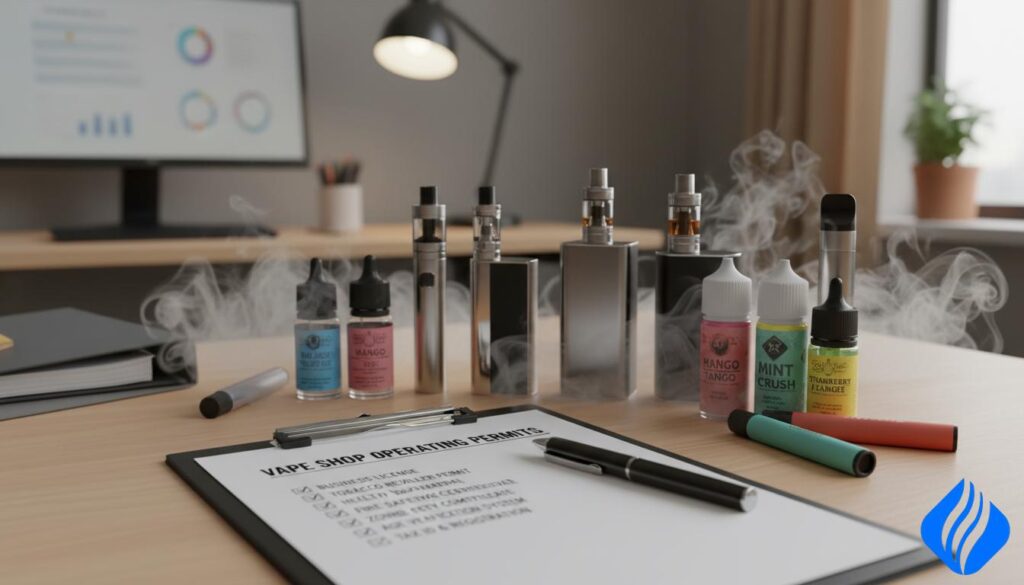
General business registration
Business registration establishes your legal entity and local standing. Cities or counties issue this registration and often charge an annual fee.
Seller’s permit and sales tax
Obtain a seller’s permit so the store can collect and remit sales tax. States link this to your tax ID and wholesale access.
Retail tobacco retailer permit
Many locations treat certain products as tobacco products. A retail tobacco license or permit is often required and adds application review steps.
Property approvals and zoning
Secure a certificate of occupancy and verify zoning. Confirm the planned area allows retail nicotine sales before finalizing a lease.
- Checklist: business registration, seller’s permit, tobacco license, certificate of occupancy, zoning sign-off.
- Stacked rules: state plus city and county requirements often apply simultaneously.
- Don’t sign yet: confirm the address permits a shop selling regulated products.
- Compliance note: consider product mix and device safety (USB-C charging, nicotine strengths). These affect supplier approvals and insurance once licensed.
“Confirm permits early; missing one can block vendor access and sales.”
Location-based restrictions that can make or break approval
Zoning and proximity rules often decide whether a plan moves forward. Local codes can block use even after state paperwork clears. We recommend early checks so an address is viable before signing a lease.
Zoning checks every lease should pass
Confirm the zoning classification. Ask about conditional-use permits, distance buffers, and any moratoriums on new shops.
School buffers and advertising limits
Many jurisdictions set school proximity limits measured from property line or public entrance. Small measurement errors can derail a permit. New York City, for example, bars operating and advertising within 500 feet of a school.
- Why zoning is a hard stop: a city can refuse approval even with state permits.
- Local checks: zoning code, conditional-use, distance buffers, signage rules, planning commission review.
- Operational ties: controlled displays, clear age signage, entrance age-gating, and an ID-scanning checkout layout support compliance.
“Assume municipal rules may be stricter than state regulations and plan timelines accordingly.”
How to apply and what documents you’ll need to prepare
Start with a clear business identity; mismatched records are the most common cause of delays. Register your legal entity and obtain an EIN so every filing ties to a single taxpayer profile.
Business entity registration and EIN basics
Choose an entity type and file formation documents with your state. Get an EIN from the IRS. Use the same name and tax ID on every application.
Identity, ownership, and address accuracy
Prepare owner IDs, percent ownership statements, and corporate documents. Verify the store address in leases and registrations. Agencies flag mismatches and mail returns.
Common application steps, fees, and renewals
Expect forms, application fees, agency review, and possible inspection. Many credentials require annual renewal and a renewal fee.
Regulatory review and avoiding delays
Agencies may request lease copies, zoning confirmation, sales tax accounts, or supplier invoices. Missing signatures, wrong NAICS codes, unpaid fees, or incomplete ownership disclosures cause holds.
“Prepare documents consistently and schedule renewals in your business plan.”
Operational compliance note: draft written age verification procedures, maintain training logs, and plan inventory traceability and supplier paperwork before you buy wholesale. This reduces review friction and supports lawful sales.
State example: getting a tobacco license in Texas
Texas provides a clear example of how one state ties permitting to daily retail controls. The Texas Comptroller issues tobacco permits and enforces display, renewal, and record rules.
Permit types and which fits your model
The Comptroller offers three main credentials: Retail Dealer, Wholesaler, and Distributor.
Retail Dealer fits stores that sell products directly to consumers. Wholesaler and Distributor suit businesses that sell bulk or ship to other businesses.
Application workflow and required tax setup
Complete your Texas sales tax permit and business registration first. Then apply online for the tobacco permit and attach your EIN and ID copies.
Fees, posting, and renewal discipline
Retail Dealer fees commonly run around $180–$300. Permits typically last one year and must be posted prominently in the store.
Ongoing compliance
Maintain strict age verification and robust inventory logs. Use a POS system that forces ID prompts and generates reports for audits.
“Missing renewals or operating with incomplete forms is the fastest path to a stop-sale notice.”
After licensing: setting up operations to stay compliant and profitable
With credentials in hand, the next step is a practical operations plan that prevents fines and protects margins. We prioritize systems that lock compliance into daily routines and keep reporting audit-ready.
Implementing a POS system for age checks and inventory control
Require from your POS: configurable age prompts, ID-scan support, SKU-level reports, tax rules, and exception logs. A robust pos system reduces human error and creates traceable refusal handling.
Inventory planning and supplier vetting
We separate nicotine SKUs from non-nicotine. Use lot/batch tracking and shrink reports. Demand invoices and verify distributor credentials. Avoid gray-market stock that can trigger enforcement and chargebacks.
Product example, competitors, and operator testing
Main product specs:
- Battery: 650–850 mAh
- E-liquid: 12–20 ml
- Nicotine: 2% or 5% nicotine salt
- Coil: Mesh or Dual mesh
- Charging: USB-C
Competitor comparison (Puffs per Dollar / Flavor Consistency): Geek Bar — high puffs per dollar, mid consistency; Lost Mary — mid puffs, variable flavor; Raz — lower puffs per dollar, stronger early flavor retention. Dual mesh typically holds flavor longer than single mesh over ~5,000 puffs.
Hands-on notes: 5% salts give a stronger throat hit; 2% salts are smoother. Vapor output varies by coil and airflow — MTL draws suit beginners. After ~5,000 puffs we see sweetener fade and cooling agent drift; dual mesh reduces that trend.
“Operational controls and verified suppliers are the best defense against enforcement and returns.”
Market context and planning targets
There were ~9,331 vape shops in the U.S. in 2023, with ~18% growth from 2018–2023. Average revenue runs about $26,000/month with ~40% margins; top shops hit $40k–$45k/month. Use those targets for staffing, reorder points, and product mix.
For assortment examples and wholesale browsing see Disposable Vapes, Hot Sale, and brand sections such as RandM and Bang. For location and ID policy context visit local ID enforcement overview.
Conclusion
A disciplined finish line protects operations from fines, vendor holds, and closures.
Confirm the full licensing stack: business registration, seller’s permit and sales tax account, tobacco retailer permit, and occupancy/zoning approvals. Every state and city can add requirements and restrictions. Follow this order: check address restrictions, file permits, build out, order inventory, then open for sales.
Operational checklist: staff training, POS configuration, reorder points, supplier verification, and periodic self-audits. Keep renewals, posted credentials, and age checks current.
How to know if it’s empty? Reduced vapor, muted flavor, blinking indicator, or dry/harsh hits. Stop if it tastes burnt; that signals coil overheating.
How to recharge safely? Use a reputable 5V USB‑C charger, avoid unsupported fast chargers, don’t charge unattended, stop if hot, and keep away from liquids.
Is it authentic? Check the QR code or verification label and validate via the brand flow: QR verification.
Product note: train staff on mAh, ml, 2%/5% nic salt, Mesh vs Dual mesh, and USB‑C specs to reduce returns.
Nicotine warning: Nicotine is an addictive chemical. Intended for adults 21+ only. Keep out of reach of children and pets.
For state-specific steps and templates, see our registration guide: open vape store registration.
 English
  German
  Dutch
Dutch  Danish
  Czech
Czech  Italian
  Slovenian
  French
  Hungarian
  Spanish
  Polish