

We open this 2026-facing guide to explain plainly how Alabama defines “legal” for adult customers (21+): eligible products, approved points of sale, and required seller permits.
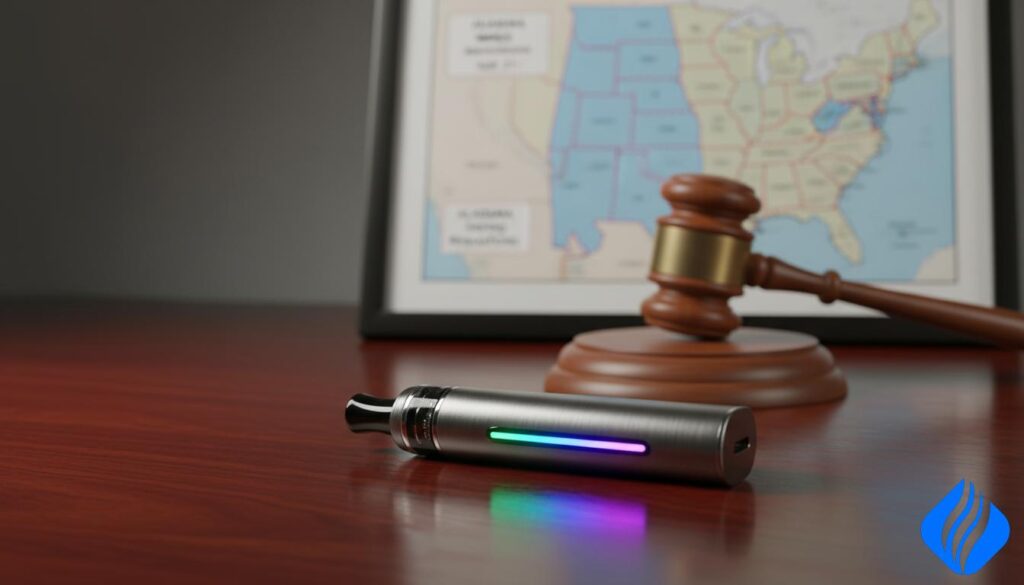
Alabama tightened retail rules with HB 8 / Act 2025-403, effective June 1, 2025. The Alabama Alcoholic Beverage Control Board now enforces limits on convenience-store offerings and ties sale eligibility to FDA authorization and state requirements.
We also note Federal T21 as the practical baseline for nicotine sales nationwide. HB 445, effective Jan 1, 2026, adds separate compliance for consumable hemp items and may change product selection.
Expect clear guidance: we will show how Alabama’s approach works, why some items vanish from shelves, and how to shop safely without relying on hearsay. This is not legal advice; confirm current status with official listings and compliant retailers before purchase.
Key Takeaways
- Alabama links sale eligibility to FDA authorization and state permits.
- Enforcement falls to the Alabama Alcoholic Beverage Control Board.
- Federal T21 sets 21 as the practical sales age nationwide.
- HB 445 adds new rules for consumable hemp vapes from Jan 1, 2026.
- Check official registries and retailer compliance before buying.
Alabama vape laws in context heading into 2026
As 2026 approaches, Alabama has joined a wave of states tightening retail controls to curb youth nicotine use.
Why the change? Policymakers cite rising youth use and a need for clearer retailer accountability. Rep. Barbara Drummond called youth use an “epidemic.”
“Youth use has reached epidemic levels,”
Federal age baseline and enforcement priorities
Federal T21 sets 21 as the practical sales age, so even where a local statute differs, age verification at point of sale must follow that federal standard. We advise retailers and consumers to treat 21 as the operative rule.
How Alabama compares with peers
- North Carolina uses a directory model (HB 900) but shows an 18-versus-21 mismatch.
- Kentucky’s SB 100 forces licensing for all retailers and raises penalties.
- Utah bans most flavors and keeps a strict registry; Virginia and California have moved toward tobacco-only or disposable limits.
The overall effect: product availability and access will shift faster than in prior years. We recommend focusing on three checks—age, authorization status, and permitted sales channels—and reviewing updates regularly. For related legal developments and a recent major legal win for businesses, see the linked update.
What vapes are legal in alabama under Alabama’s registry approach
Alabama’s approach makes FDA marketing orders the gatekeeper for many retail nicotine offerings. We explain how federal authorization, state lists, flavor limits, and a U.S. manufacturing rule combine to define which products move through convenience channels and specialty shops.
FDA marketing orders and what “FDA-authorized” means for vape products
An FDA marketing order is the federal authorization that allows a specific product to be marketed. Alabama links broad retail eligibility to that status, so an FDA-authorized product gains state-level access more easily.
Note: “FDA-authorized” is not the same as terms like “registered” or “compliant.” We urge adults to verify an item’s marketing order rather than rely on package claims.
Where “PMTA-pending” fits and why state lists can still restrict sales
Products with a pending PMTA may be in federal review but not automatically cleared for wide retail. Other states use directories that sometimes include pending submissions; North Carolina and Utah show how treatment varies.
Alabama’s registry can still restrict sales by store type even while federal review continues. That means a PMTA-pending product might be unavailable at a convenience store despite being reviewed by the FDA.
Flavor limits in practice
In practice, the state’s limited list focuses on tobacco and menthol profiles. Fruit, candy, and other flavored profiles are commonly excluded from broad retail availability.
Reports differ on “menthol” versus “mint.” Treat the state-approved list and retailer permit as the deciding factor, not flavor copy on the box.
Manufactured in the United States requirement
Alabama requires products to be manufactured in the United States. That rule narrows available brands, especially among popular imported disposables and some electronic nicotine delivery systems.
Quick checklist: ask a retailer whether an item is on their allowed list, confirm U.S. manufacture, and look for compliance signage before purchase. For a clear summary of the state framework, see this Alabama HB 8 explainer.
Where you can buy legal vape products in Alabama: convenience stores vs. specialty retailers
Two different retail tracks — convenience stores and specialty shops — now shape on-shelf choices for adults. We separate what’s legal to sell from where it can be sold, since that split explains why inventories vary by location.
What convenience stores can sell
Convenience stores are limited to a narrow set of FDA-authorized tobacco and menthol e-cigarette products. Reporting noted roughly 34 authorized items that many c-stores may carry.
This constrained selection focuses on tobacco-style and menthol profiles, not the broader range of flavored products many adults remember.
What specialty shops can offer
Specialty retailers that hold the ABC specialty permit may sell a wider range of nicotine items, but they still must meet federal and state rules. Specialty does not mean unrestricted.
Stores with a specialty retailer electronic or retailer electronic nicotine permit typically operate as 21+ locations and post compliance signage.
Access controls and shelf effects
Age-gated entry, strict ID checks, and posted signs are common. Location setups — separate entrances or controlled sales areas — affect how a store complies.
That channel split can cause a sudden effect on availability: popular disposables may vanish from many stores when authorizations, manufacturing rules, or permit types change. Utah’s specialty-store flavor limits and Virginia’s disposable restrictions show how quickly retail shelves can shift.
Practical tip: If a product disappears, ask a compliant retailer about allowed alternatives and avoid unofficial online sources. For recent settlement details that affect which products appear at convenience locations, see this more products allowed in convenience stores.
Permits, licensing, and enforcement by the Alabama Alcoholic Beverage Control Board
The Alcoholic Beverage Control Board now serves as the gatekeeper for permitted nicotine sales. We explain the permits, fees, and how enforcement affects shoppers and retailers.
ABC Tobacco Permit: practical coverage
ABC Tobacco Permits let general retail outlets sell tobacco and certain electronic nicotine delivery items that hold an FDA marketing order. The annual fee is reported at $150. Retailers must check authorization before stocking nicotine products.
Specialty Retailer ENDS Permit: who needs it
The Specialty Retailer of Electronic Nicotine Delivery System Permit suits vape-forward shops. It allows a broader selection of allowable nicotine delivery systems that meet state and federal rules. Fee: about $1,000 annually. Stores must restrict entry to 21+, post signage, and maintain stricter product records.
Penalties, funding, and education
Violations can mean fines, suspension, or permit revocation. That risk changes shelf availability overnight.
| Permit Type | Annual Fee | Allowed Products | Key Rules |
|---|---|---|---|
| ABC Tobacco Permit | $150 | Tobacco & FDA-authorized ENDS | Standard retail access, ID checks |
| Specialty ENDS Permit | $1,000 | Broader allowable nicotine products | 21+ access, signage, tighter records |
| Enforcement | Varies | Noncompliant sales | Fines, suspension, revocation |
Note: The law created a Tobacco Licensing and Compliance Fund and funds education programs for retailers and schools. We see similar licensing trends nationwide (Kentucky’s 2026 rule), so permits will shape retail options going forward.
What’s changing beyond nicotine: hemp vape rules and how HB 445 affects Alabama in 2026
HB 445, effective Jan 1, 2026, creates a separate set of rules for consumable hemp inhalables. This law treats those items differently from federally regulated nicotine products. We must note the split because shoppers will see overlapping effects on shelves.
Consumable hemp vapes and licensing requirements starting Jan 1, 2026
The new law requires a distinct license to sell consumable hemp inhalables. Retailers who want to offer these products must register and meet specific compliance checks.
Practical effect: even non-nicotine product lines may vanish from stores that decline to obtain the extra permit.
Escalating consequences: how repeated violations can become a Class C felony
Penalties escalate with repeat offenses. Selling without the required license can lead to civil fines at first.
On a third offense, the statute raises the violation to a Class C felony. That severe outcome drives many retailers to simplify inventories to lower risk.
Smokable hemp is illegal: what that means for products sold and retailer risk
Smokable hemp products are expressly banned under the update. Items that look or function like smokable formats will be removed or refused at checkout.
Shopper guidance: prioritize licensed, compliant retailers and avoid sellers promising out-of-state loopholes. When enforcement tightens, access and selection change fast. We recommend checking permits and product labeling before purchase.
| Topic | Effective Date | Retailer Obligation | Consumer Effect |
|---|---|---|---|
| Consumable hemp inhalables | Jan 1, 2026 | New license required; compliance checks | Some products removed; limited access |
| Penalty escalation | Immediate on enforcement | Fines → greater penalties → Class C felony on 3rd offense | Retailers narrow inventory to avoid risk |
| Smokable hemp | Prohibited | Must not be sold; enforcement risk for sellers | Smokable formats disappear from shelves |
Conclusion
Retail permits and federal authorization now decide shelf access for adult nicotine options. We note the June 1, 2025 shift pushed many products out of general access and placed broader selections behind 21+ specialty counters under ABC permits. Confirm a retailer’s permit and federal clearance before purchase.
Quick checklist: ask whether the item holds an authorization, expect strict age checks, and understand that tobacco‑style and approved electronic nicotine delivery items often remain available while other alternative nicotine products move to specialty channels. Shelf changes usually reflect enforcement, authorization status, manufacturing rules, or permit limits — not always product safety.
Shop only where age gating and compliance are visible. For the most useful summary of restricted listings, see this restricted list. Store devices away from minors, follow instructions, and avoid tampered or untraceable items that bypass regulated sales.
 English
  German
  Dutch
Dutch  Danish
  Czech
Czech  Italian
  Slovenian
  French
  Hungarian
  Spanish
  Polish