

where are geek bar vapes made — the short answer: China. We open with that fact so readers in the United States can quickly judge availability, pricing, and counterfeit risk.
We will explain how “Made in China” fits modern disposable vape production. Then we outline the specs we test: battery (mAh), e-liquid (ml), nicotine strength, coil type, and USB‑C. Our approach is technical and practical. We will test real use after ~5000 puffs and compare puffs-per-dollar versus Lost Mary and Elf Bar.
We keep an objective stance and include an authenticity checklist with QR verification. For source details and production notes, see the official factsheet in this brand factsheet. We will also note nicotine safety guidance later in the article.
Key Takeaways
- Geek Bar disposable products are manufactured in China; origin affects US supply and pricing.
- We evaluate battery mAh, e-liquid ml, nicotine strength, coil type, and USB‑C charging.
- Hands-on testing targets ~5000 puffs to verify real-world performance.
- Comparisons will include puffs-per-dollar against Lost Mary and Elf Bar.
- Follow QR verification and packaging checks to reduce counterfeit risk during shortages.
Geek Bar Origin and Manufacturing Footprint in the Present Market
We assess origin through manufacturing scale, corporate ties, and ingredient transparency. This helps readers judge consistency, traceability, and supply risk for disposable products sold in the United States.
Made in China: what that means for production scale and consistency
Made in China signals access to high-volume assembly, standardized tooling, and rapid iteration cycles. That scale tends to improve unit-to-unit consistency for devices built on the same production line.
Large runs cut per-unit cost. They also amplify batch changes if a component or formula shifts. We track both effects during testing.
Who’s behind Geek Bar: brand ownership and manufacturing context
Reporting links this line to Guangdong Qisitech. That connection matters for supply-chain control and corporate accountability.
Brand ownership can differ from component manufacturing. Marketing teams set specs while factories source parts. Traceability depends on both parties.
Why ingredients and flavor formulas aren’t fully disclosed
Disposables typically list VG, PG, nicotine, and natural & artificial flavors. Each affects vapor density and throat feel.
Flavor blends often remain proprietary. Manufacturers use secrecy to protect formulas and competitive advantage. That is common in the industry.
“Limited ingredient disclosure is not proof of harm, but it raises the importance of buying verified stock from reputable sellers.”
- Scale: higher output, better repeatability.
- Risk: batch shifts can affect taste or performance.
- Traceability: ownership vs production are distinct roles.
| Aspect | What it signals | Consumer impact |
|---|---|---|
| High-volume factories | Standardized lines, faster tooling | More consistent devices per run |
| Batch changes | Component or formula swap | Possible flavor or performance variation |
| Ingredient list | VG / PG / nicotine / flavors | Explains vapor, throat hit, and sweetness |
Next: we will link origin to US enforcement and current availability pressures in later sections.
Where are geek bar vapes made and why it matters to US buyers
We trace origin back to China and show how that link predicts buyer outcomes in the United States. Supply chain limits, trade policy, and enforcement shape availability more than brand alone.
China-based manufacturing and effects on U.S. supply
When devices ship from overseas, customs screening and trade policy become primary bottlenecks. Tariffs near 30% and stricter inspections increase transit time and cost.
Real data shows the impact: May 2025 saw 71 shipments labeled e-cigarettes from China versus nearly 1,200 in May 2024. That drop creates sudden shortage signals at retail.

How origin ties to pricing, availability, and counterfeits
Higher import risk raises retail prices. Carriers, tariffs, and discarded seizures all push margins up. Retailers pass costs to customers or tighten selection.
Reduced authentic supply makes counterfeit units more profitable. Increased FDA and CBP seizures mean fewer legal units reach U.S. sales channels. Buyers should view origin as a predictor of price stability, selection, and authenticity risk.
- Buyer takeaway: prioritize verified sellers and check authenticity before purchase.
- Next: we will offer an authenticity checklist and a puffs-per-dollar comparison.
Why Geek Bar Is Harder to Find in the United States Right Now
We view current scarcity as the result of three overlapping forces: trade cost, regulatory enforcement, and state-level flavor limits. This explains stock declines without assuming a product discontinuation.
Tariffs and the shipment collapse
Tariff pressure reduced margin for importers. Reported duties near 30% make large orders harder to justify.
The clearest sign: shipments labeled e‑cigarette from China fell to 71 in May 2025 versus ~1,200 in May 2024. That drop directly shrinks retail supply.
FDA and Customs enforcement
Enforcement increased import risk. In Oct 2024 a joint FDA/CBP operation seized roughly 3 million illegal e‑cigarettes valued at about $76 million.
Reporting highlighted many seized units branded geek bar. Because the product is not FDA‑authorized, retailers face higher seizure risk and act cautiously.
State pressure on flavored disposables
Several states restrict flavored products. Notable actions include bans in California, New York, Washington D.C., Massachusetts, New Jersey, Rhode Island, and Utah.
Additional state bills (for example, North Carolina HB 900 and Texas SB 2024 cited in reporting) add complexity for cross‑state distributors.
“Higher import costs plus stepped-up enforcement and state flavor bans create a multi-factor shortage, not a single cause.”
- Practical impact: less consistent restock and higher retail prices.
- Retailer behavior: smaller orders, lower visible stock, and cautious sourcing.
- Counterfeit risk: scarcity raises incentives for illicit supply; verify authenticity before purchase.
Geek Bar Product Specs to Know Before You Buy
Specs tell the practical story: charging method, mAh, coil architecture, and nicotine format shape user experience.
Battery capacity (mAh). Typical disposable-style devices use batteries from ~400 mAh to 1200 mAh. Higher mAh supports steady output and longer life on open-air draws. Many modern units are rechargeable and use USB-C, which improves reliability and charging speed.
E-liquid (ml) and nicotine strength. E-liquid volumes vary; common fills run 2–20 ml depending on design. U.S. channels commonly offer nicotine salts at 2% (20 mg/ml) and 5% (50 mg/ml). Ingredients usually list VG/PG, nicotine, and flavor blends.
Coil technology. Mesh coil increases surface area for fast wicking and sharp flavor. Dual mesh sustains intensity longer but can show sweetener buildup sooner. Coil type predicts flavor life and throat feel.
Estimating real-world puffs. Use this rule: multiply e-liquid (ml) by your average draw volume. Tighter mouth-to-lung pulls use less liquid per puff than wide direct-to-lung draws. Marketing puff counts are machine estimates; expect lower real-world numbers.

| Spec | Typical range | Consumer note |
|---|---|---|
| Battery (mAh) | 400–1200+ | Higher = steadier output, better for open draws |
| E-liquid (ml) | 2–20 | Primary driver of total usable puffs |
| Nicotine | 2% / 5% (20 / 50 mg/ml) | 5% common in U.S. disposables |
| Coil | Mesh / Dual mesh | Mesh = punchy flavor; dual mesh = longevity |
Next: we use these specs in controlled tests to measure throat hit, vapor, and flavor over ~5000 puffs.
Hands-on Testing Insights on Throat Hit, Vapor, and Flavor After 5000 Puffs
We logged device behavior across roughly 5,000 puffs using consistent draw duration and charging habits. Notes were taken at intervals to track drift in throat hit, cloud, and taste for adult vapers.
Throat hit profile
Most 5% nicotine salt units begin smooth. They often sharpen as the coil heats or e-liquid viscosity increases near end-of-life.
Vapor production
Early life shows dense, slightly warm vapor. Later, vapor can become warmer or thinner depending on wicking and remaining e-liquid.
Flavor consistency after extended use
Top notes mute first. We see “sweetener burnout” and a flatter finish as residue builds on mesh or dual mesh coils.
What changes first and practical takeaway
Cooling agents drop off quickly, then fruit notes lose brightness, while base notes linger. When vapor stays strong but taste dulls, suspect coil residue; when both fall, suspect low e-liquid or wicking limits.
Geek Bar vs Lost Mary vs Raz vs Elf Bar for Puffs per Dollar
We focus on practical value: how many usable puffs each device gives at current U.S. prices. Below we define our method, show simple math, and compare typical devices under shortage pricing pressure.
How to calculate puffs per dollar with real retail pricing in the US
Definition: realistic puffs (not box claims) ÷ retail price = cost per puff. Invert to get puffs per dollar.
Example math: if a unit yields 3,000 realistic puffs and sells for $30, cost per puff = $0.01, so puffs per dollar = 100.
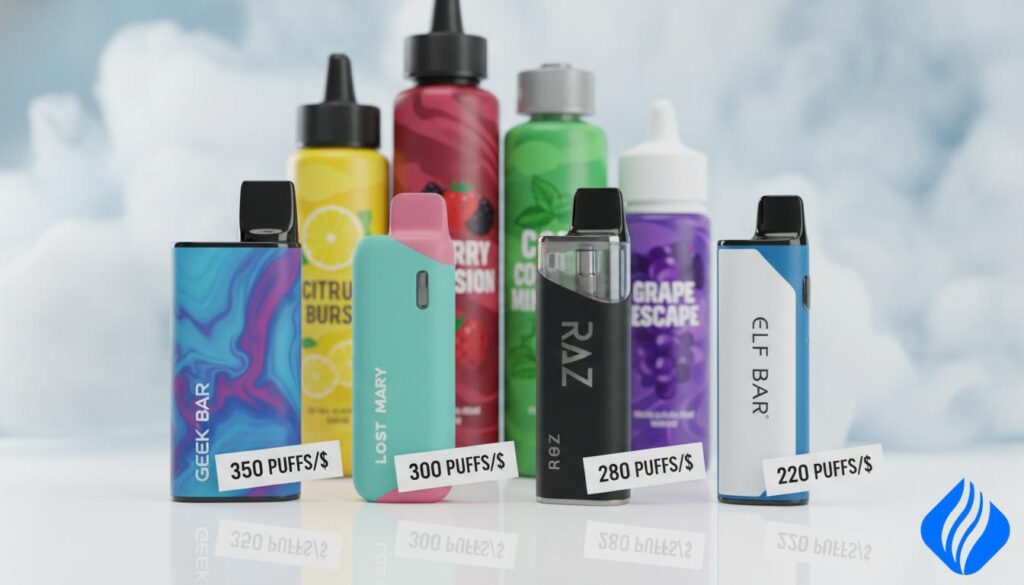
Geek Bar vs Lost Mary: cost efficiency and flavor longevity
During shortages, reported retail often climbs to about $30. That shift reduces value even when device tech holds steady.
Lost Mary usually retails lower and often holds flavor shorter on some profiles. That lowers usable puffs even if nominal puff counts look similar.
Geek Bar vs Raz: draw feel and late-stage performance
Raz tends to show warmer vapor late in life and slightly higher draw resistance. That can reduce enjoyable puffs even if liquid remains.
We score late-stage performance by whether flavor and draw stay acceptable for the last 20% of life.
Geek Bar vs Elf Bar: availability, flavor variety, and value tradeoffs
Elf Bar often wins on availability and variety in U.S. retail. Greater supply can improve puffs-per-dollar indirectly by keeping prices stable.
| Device | Typical U.S. Price | Realistic Puffs (example) | Puffs per Dollar |
|---|---|---|---|
| Geek Bar / geek bar pulse | $18.99–$29.99 (shortage up to $30) | 3,000 | 100–158 |
| Lost Mary | $12–$20 | 2,200 | 110–183 |
| Raz | $15–$25 | 2,800 | 112–187 |
| Elf Bar / bar pulse | $12–$22 | 2,500 | 114–208 |
“During scarcity, price swings matter as much as device engineering for value.”
Practical takeaway: use the simple formula with local price and your own draw profile. In the current U.S. market, availability can shift the value ranking as much as raw performance.
Geek Bar vs Competitors for Flavor Consistency and Coil Reliability
Coil architecture often predicts whether a flavor will fade quickly or remain steady. We test how taste and draw change from the first third to the final third of a device. Our definition of flavor consistency includes stable intensity, steady sweetness/cooling, and minimal off-notes.
Mesh coil vs dual mesh
Mesh coil usually delivers bold taste early. It gives sharp top notes and snappy throat hit.
Dual mesh can hold output longer and resist early fade. Late-stage residue buildup can mute sweet profiles faster on dual mesh depending on formula.
Cooling flavors vs dessert flavors
Cooling agents often drop out abruptly. Users notice a sudden loss of chill even if vapor stays thick.
Dessert profiles tend to mute slowly and sometimes grow overly sweet from coil residue.
Batch-to-batch variation and scarcity signals
We benchmark the geek bar line vs Lost Mary and Elf Bar on common failure modes: early flavor flattening, late harshness, and inconsistent draw. Watch for these signals in scarce stock:
- Different draw resistance for the same flavor name
- Unusual device finish or inconsistent labeling
- Sudden taste shifts on a familiar SKU
Keep purchase notes (date, vendor, packaging) when stock is tight. Consistent coil performance reduces the urge to overdraw chasing taste and protects the user experience.
Best disposable options show how brands compare on flavor stability and coil reliability across the current vape market.
How to Spot a Fake Geek Bar and Verify Authenticity
Spotting a fake starts long before the first puff — it begins with the box in your hand. We focus on quick, reliable checks you can do in-store or right after delivery.
Packaging and device tells that often reveal counterfeits
Packaging cues: check print clarity, spelling, correct warning labels, intact seals, and aligned panels. Poor print or missing warnings are red flags.
Device cues: feel seams, mouthpiece fit, and internal rattle. Watch for odd LED behavior, unusual charging response, or chemical off-notes on first draw.
Is it authentic: step-by-step QR verification
- Locate the verification code on the pack or device.
- Scan and follow the verification flow at Sokvape Email.
- Match SKU, lot, and packaging images to the response.
Why counterfeits surge during shortages and enforcement waves
Shortage plus active enforcement raises prices and cuts legal supply. That gap creates incentive for illicit units labeled as geek bars or similar names.
“When authentic stock tightens, counterfeit risks rise — verification is a safety step, not optional.”
If verification fails, stop using the unit. Document photos, note lot details, and contact the seller for a refund. Do not test suspect units. We recommend sourcing from verified vendors and familiar alternatives when specific models are scarce.
Buying Guide and Internal Links for Easy Shopping on Sokvape
Check category pages first. They show live stock and reflect price shifts during enforcement-driven supply swings.
Best place to start
Begin with Disposable Vapes for the most current selection. Category pages update faster than product pages when supply tightens.
Deals and limited drops
Watch the Hot Sale for short-term price dips and limited restocks. These windows can beat secondary sellers during a shortage.
Explore alternatives
If geek bar stock is scarce, browse comparable lines like RandM and Bang. Diversifying brands helps preserve value and access to flavors.
What to prioritize
- Nicotine level: U.S. options often list 2% or 5% nic salt.
- Coil type: mesh vs dual mesh affects flavor life.
- USB‑C recharge: rechargeable devices extend usable life and cut waste.
User FAQs
How to know if it’s empty? Flavor fades, vapor drops, draws feel hot, or the device blinks. Lights alone do not guarantee usable e-liquid remains.
How to recharge safely? Use a reputable USB source, stop if the device heats, avoid damaged cables, and don’t charge overnight.
Is it authentic? Verify the code or QR using the pack workflow at the verification link. Do not buy units missing codes or with failed checks.
“When supply tightens, prioritize verified sellers and clear spec checks to reduce counterfeit risk.”
Final tip: confirm battery mAh, e-liquid ml, and whether the product is sealed or refillable before checkout. For broader comparisons, see our best disposable guide.
Conclusion
We close by tying origin, testing, and buying tips into a clear plan for adult vapers.
Geek Bar devices are produced in China. That origin links to import friction, tariff pressure, and higher counterfeit risk in the U.S. market. These forces shape price and availability across the industry.
For practical buying, prioritize specs: battery capacity (mAh), e-liquid volume (ml), nicotine strength (2% vs 5% salt), coil type (mesh vs dual mesh), and USB‑C charging. Our ~5,000‑puff tests show throat hit, vapor warmth, and flavors change in stages as residue builds.
Value equals usable puffs per dollar plus flavor consistency. Cross-shop Lost Mary, Raz, and Elf Bar when stock swings. Verify packaging and scan QR codes during shortages to cut counterfeit risk.
Nicotine warning: This product contains nicotine. Nicotine is an addictive chemical. For adults 21+ only. Keep away from children and pets.
 English
  German
  Dutch
Dutch  Danish
  Czech
Czech  Italian
  Slovenian
  French
  Hungarian
  Spanish
  Polish