

why is my vape bubbling often signals excess liquid in the airflow path or near the coil. We start with a quick safety check. Stop using a device that leaks, spits hot droplets, or smells burnt.
Excess liquid causes gurgle, spitback, and weak vapor. We define this as abnormal bubbling and show how flooding changes sound and draw. Our goal is to restore steady vapor, stable flavor, and a safer mouthfeel.
We will diagnose by device type: disposables, pods, and tanks. Tests cover throat hit, vapor changes, and performance as puff count approaches 5000. We prioritize simple fixes first, then more involved steps if needed.
Transparent note: repeated bubbling with leaks or burnt taste means stop use rather than forcing a repair. Later sections include hands-on results, safety priorities, and product comparisons like puffs per dollar and flavor consistency. We will also reference SOKVAPE supply details when relevant.
Key Takeaways
- Excess e-liquid near the coil most often causes bubbling and weak vapor.
- Perform a safety check before any troubleshooting steps.
- Diagnose by device type: disposable, pod, or tank for targeted fixes.
- Start with the least invasive solutions; escalate if needed.
- Repeated bubbling with leaks or burnt taste requires stopping device use.
- Hands-on tests include flavor, throat hit, and puff-count performance up to 5000.
What Vape Bubbling Sounds Like and Why It Matters
A distinct wet sound during draws often signals liquid where air should flow. We use clear labels so users can match symptoms to fixes. Listen for changes after refills or storing the device on its side.
Gurgling, popping, spitting, and wet hits
A normal baseline is a light crackle as the coil heats liquid. That sound means vaporization is working.
Abnormal noises—gurgling, sharp popping, or spitting—point to liquid moving into the airflow path. Each sound ties to uneven vaporization and droplet formation.
How sound links to performance and risk
- Reduced production: pooled liquid blocks airflow and lowers vapor output.
- Flooded coil: gurgling often signals a flooded coil and a pending leak if ignored.
- Wet hits: damp vapor or droplets in the mouth are both uncomfortable and a safety cue.
- Quick self-check: if noise worsens after a refill or side storage, suspect pooling and act before seals fail.
why is my vape bubbling When I Inhale?
When suction rises during a draw, trapped liquid in the airflow path can be dragged down and forced to bubble. This explains the common audible gurgle during inhalation and how air movement affects liquid behavior.

Excess e-liquid in the chimney or airflow path
Pooled e-liquid forms after overfilling, over-priming, or tilting a device. A stronger draw pulls that liquid toward the coil and creates audible spitting and bubbles.
Flooded coil from hard pulls, chain-hitting, or over-priming
Repeated hard hits leave less recovery time for the wick. The coil stays oversaturated and cannot vaporize incoming liquid fast enough, so it floods.
Condensation and temperature-driven viscosity changes
Vapor can condense in wide chimneys, then drip back onto the coil and cause gurgle on the next hit.
Heat thins e-liquid and makes it flow into the air channel. Cold thickens liquid and can lead to uneven wicking that suddenly floods when warmed.
“Visualize the air path: chamber, chimney, then mouthpiece. Any liquid sitting there will move under suction and make noise.”
- Timing: bubbling after long sessions points to heat/condensation; right after a refill points to filling or priming.
- Air path model: helps you locate pooled liquid and avoid further issues before device-specific fixes.
Fast Safety Check Before You Troubleshoot
Start every session with a quick safety scan to prevent hot droplets or spitback from reaching your mouth. We check seals, visible leaks, and how the device sounds before any repair step.
How to avoid hot droplets reaching your mouthpiece
Keep the mouthpiece slightly away from the lips for the first test puff after any adjustment. Take short primer puffs without deep inhalation to confirm spitting has stopped.
When to stop using the device immediately
Stop use if you see liquid escaping seams, vents, or the charging port. Also stop when a burnt taste pairs with audible bubbling; that combo suggests wick damage and unstable juice flow.
- Cracked tank or pod, damaged O-rings/seals — replace the device.
- Visible leaks from seams/vents — do not continue use.
- Harsh crackling with little vapor — coil likely failing; swap the coil or replace unit.
“Safety check first, troubleshooting second. Never force a compromised device.”
Device Type Diagnosis: Disposable Vape vs Pod vs Tank
Different devices channel air and liquid differently, so diagnosis starts with the hardware type. Match your unit to one of three branches before you try any fix.
Sealed disposables with fixed airflow
These units have hidden channels and no user access. That limits repairs.
Action: use gentle clearing and short puffs. If noise or leaking persists after a calm clearing, plan replacement. Persistent issues often mean internal flood or defect.
Serviceable pod systems
Pods allow partial access. Hard, fast inhales disturb airflow balance and draw extra liquid into the coil chamber.
Tip: try slower draws and check side or bottom vents for liquid. If gurgling continues, remove and dry the pod for a short time before reuse.
Sub-ohm tanks and wide chimneys
A wide chimney raises condensation area. After long sessions, condensate can drip back and flood the coil.
Fix: clean the chimney, dry vents at the base, and reset the coil wick. Tanks let you fully disassemble and inspect seals and vents.
“Diagnose by hardware first; the right branch prevents wasted steps and reduces risk.”
| Device Type | Access Level | Common Vent Location | Quick Fix |
|---|---|---|---|
| Disposable | Sealed | Hidden channels | Gentle clearing or replace |
| Pod system | Semi-serviceable | Side/bottom vents | Slow draws, dry pod |
| Sub-ohm tank | Fully serviceable | Base airflow vents | Disassemble, clean chimney |
Hands-On Testing Insights: What We Saw in Real-World Use
We ran hands-on testing across devices to map how sound, draw, and flavor shift when liquid moves into the air path.
Throat hit: Nic salt at 2% vs 5% felt smoother at higher strength. Higher nic salts delivered stronger absorption with less harshness. Harsh pulls grew worse when a coil was partially flooded.
Vapor production dropped first during our trials. When liquid restricts the airflow, heating becomes uneven and output thins. Draw resistance often changed next.
Repeated chain hits increased condensation and kept the wick oversaturated. Over time, flavor clarity fell and gurgling became persistent.
At roughly ~5000 puffs on high-capacity units we tested, flavor flattened and sporadic gurgle stayed if power or channels accrued residue. Coil design mattered: mesh gave steadier warmth; older wire builds made larger droplets and more chimney drip.
- Practical takeaway: if normal behavior lasts only a few hits after clearing, expect recurring flooding or near end-of-life performance.
| Metric | Observed Change | Likely Cause |
|---|---|---|
| Vapor production | Reduced | Liquid in airway / restricted airflow |
| Throat hit | Smoother with nic salts | Higher absorption, less harshness |
| Flavor over time | Flattens by ~5000 puffs | Residue buildup, coil wear |
Quick Fixes That Work for Most Bubbling and Gurgling Issues
Start with low-risk steps to clear pooled liquid from the air path before more invasive fixes. We favor simple, safe actions that often stop gurgling and restore proper draw.
Paper towel chimney clean
Twist a small point of paper towel into a narrow tip. Insert it gently into the chimney or mouthpiece. Absorb pooled e-liquid instead of pushing it down.
Blow-through clearing
Use short, controlled bursts through the mouthpiece to push trapped liquid toward vents. Hold a tissue under vents to catch expelled e-liquid. Stop if leaking worsens.
Gentle tapping
Tap the unit in your hand over a towel to dislodge droplets. Avoid aggressive shakes that can break seals or force fluid deeper into the airflow.
Warm-and-rest method
Bring the device to room temperature and set it upright for 10–15 minutes. Warming stabilizes viscosity so the wick can recover and reduce flooding.
Why these work: each step aims to remove excess liquid from the airway so the coil vaporizes a thin film instead of boiling a pool.
Realism note: sealed disposables may clear briefly, but repeated gurgling often signals internal fault or low power and calls for replacement.
Quick test: two light puffs, pause, then a normal draw before returning to regular use.
| Fix | Action | Best for |
|---|---|---|
| Paper towel chimney clean | Absorb pooled e-liquid gently | Pods, tanks |
| Blow-through clearing | Short bursts to eject fluid | Pods, serviceable units |
| Gentle tapping | Dislodge droplets over towel | All device types |
| Warm-and-rest | Stabilize viscosity, upright rest | Cold or overheated units |
Airflow and Inhale Technique Fixes for a Bubbling Vape
A sudden high‑flow draw often drags pooled e‑liquid down into the coil before it can heat. We focus on inhale technique and airflow changes that reduce recurrence across both fixed‑airflow disposables and adjustable tanks.
How strong, fast inhales pull liquid into the coil
Fast pulls create a sharp pressure drop. That vacuum draws extra liquid into the coil chamber faster than the wick can vaporize it.
Long, slow puffs and pause timing to improve vaporization
Use steady draws over 2–4 seconds to give the coil time to heat evenly. This reduces droplet formation and wet hits.
Pause between hits for 10–20 seconds on single hits. That pause lets the wick rebalance and drops condensation in the chimney instead of the coil.
- Steady, medium airflow for MTL users reduces vacuum spikes.
- Longer puffs for DTL tanks stabilize heating on mesh coils.
- If gentler technique clears gurgle in 2–3 pulls, the issue is likely technique, not hardware.
When increasing airflow can make the issue worse
Opening airflow cools vapor and changes wicking dynamics. If gurgling increases after opening vents, slightly restrict airflow to lower vacuum pull.
Avoid DIY airflow hacks on sealed disposables; altering ports can disrupt sensor behavior and puff count design.
Technique troubleshooting guide — run the practical test there if uncertainty remains.
“Control pressure, pace hits, and match airflow to your coil type — small changes stop most flooding and restore steady vapor.”
| Action | Best for | Effect on air/coil |
|---|---|---|
| Steady 2–4s puffs | MTL & DTL | Improves heat balance, reduces liquid pull |
| 10–20s pause | All devices | Wick recovery, less condensation |
| Slight airflow restriction | High suction devices | Reduces vacuum pull, lowers gurgle risk |
Coils, Wicks, and Condensation: The Hardware Reasons It Keeps Happening
Coil geometry and wick condition govern how much liquid reaches the airflow path. Small design choices create big differences in droplet behavior and spitback risk.
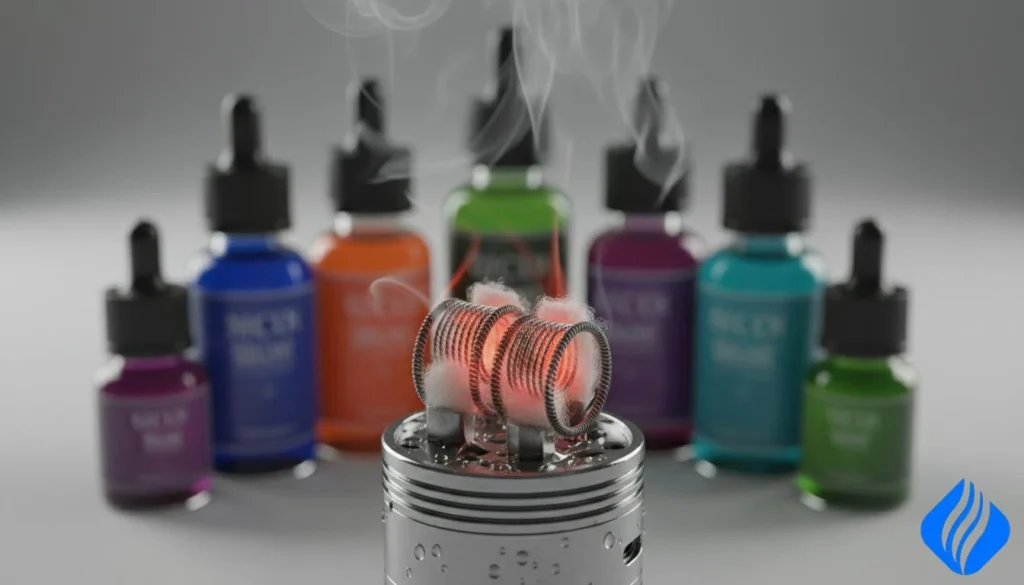
Mesh coils atomize liquid across a flat surface. That produces finer droplets, fewer large droplets, and less condensation on the chimney.
Older multi-wire coils make larger droplets. Those droplets condense on the inner wall of a wide chimney and can pool. When reheated, pooled liquid causes popping and spitting.
As a coil ages, heat distribution shifts. Hot spots form. That leaves unvaporized liquid that can create repeated bubbling and weak vapor.
A scorched wick cannot feed liquid evenly. The result can be both a burnt hit and ongoing gurgle in the same session.
- Design note: longer, wider chimneys increase condensation area.
- Mouthpiece shape matters: wide-bore tips let droplets pass; tapered tips reduce spitback.
- Decision rule: if cleaning and technique fail, replace the coil or wick—hardware limits likely cause the issue.
“Smaller droplets, even heating, and tight chimney control are the best defenses against spitting and popping.”
Maintenance Habits That Prevent Vape Bubbling Over Time
Consistent cleaning and correct storage make floods and spitback rare. We recommend short, repeatable routines for tanks and pods to keep performance steady over time.
Cleaning your tank between refills
Disassemble when you change the coil. Rinse the tank in warm water to remove pooled e-liquid from the chimney and vents.
Dry every part thoroughly. Residual moisture can thin liquids locally and cause problems on the next refill.
Pod care during refills
Remove the pod and place a tissue over the base. Gently blow through the mouthpiece to clear intake vents without taking the pod apart.
This clears crumbs of liquid and prevents seepage into the airflow path.
Storage best practices
Store devices upright at moderate room temperature. Upright position keeps liquid where it belongs and cuts seepage into the chimney.
Avoid extreme cold or heat; temperature swings change viscosity and can cause flooding or clogging over time.
“Small, regular checks reduce recurring problems and extend the time a pod or tank performs predictably.”
- Routine: rinse and dry tanks on coil swaps.
- Pod refill: tissue-and-blow to clear vents.
- Storage: upright and room temperature only.
For sealed units with limited service options, focus on storage and technique rather than cleaning. If liquid keeps pooling, consult guidance to remove excess e-liquid and consider replacement.
Disposable Vape Specs and “Core Technical Data” to Look For
Core Technical Data are the specs that predict real performance and the risk of pooled liquid, not just puff advertising.
Battery capacity (mAh)
Battery capacity controls how much power reaches the coil over the unit’s life. Low capacity or sagging output can underheat the coil.
When the coil gets weak power, e-liquid may not fully vaporize. That leftover liquid can pool, causing gurgle and spitback near end of life.
E-liquid volume (ml)
E-liquid volume sets run time and the demand on wicking. Larger reservoirs last longer but need steady power and good wick flow.
If the juice supply outpaces vaporization late in life, devices show increased pooling and uneven airflow.
Nicotine strength: 2% vs 5% nic salt
Higher nicotine (5%) usually delivers a stronger throat hit. Users often take fewer draws, which can lower flooding risk.
Lower strengths may encourage longer or more frequent draws, increasing coil load and chance of liquid buildup.
Coil type: mesh vs dual mesh
Mesh coils heat evenly and create fine droplets. Dual mesh extends even heating across a larger area.
Even heat reduces hot spots and large droplets that condense in the chimney and produce popping or spitback.
Charging port: USB-C
USB-C offers faster, more reliable charging on rechargeable disposables. Stable recharge keeps output consistent and delays end-of-life power sag.
Safe charging practices remain essential. Stop charging if the device leaks or heats excessively.
“Check core specs first. Battery and coil geometry often explain transient fixes that return after a few pulls.”
| Spec | What to check | Effect on pooling and airflow | Practical sign at end of life |
|---|---|---|---|
| Battery (mAh) | Higher mAh, rated output | Maintains coil heat; less unvaporized liquid | Weak output, more gurgle |
| E-liquid (ml) | Reservoir size, wicking path | Larger volume needs steady vaporization | Late-life pooling, uneven draw |
| Coil type | Mesh / Dual mesh | Even heating, finer droplets | Stable flavor; less spitback |
Product Comparison: Puffs per Dollar and Flavor Consistency (Main Pick vs Competitors)
A practical metric for buyers is puffs per dollar based on real-world puff counts. We define this as a realistic puff range (not marketing max) divided by actual purchase price. This normalizes value across devices.
How we compare value and specs
Comparison set: our main pick (from SOKVAPE selection) vs Geek Bar vs Lost Mary or Raz. We check these core specs:
- Battery (mAh)
- E-liquid (ml)
- Nic strength (2% / 5%)
- Coil type (mesh / dual mesh)
- Charging (USB‑C where listed)
Hands-on and 5000-puff checkpoint
Higher mAh and mesh coils kept heat steady and cut leftover liquid that causes gurgle and wet notes. Lower output units showed flavor drop-off first, then reduced production and more frequent gurgling at end of life.
| Product | Typical mAh | ml | Coil | USB‑C |
|---|---|---|---|---|
| Main pick | 700–1000 | 10–12 | Dual mesh | Yes |
| Geek Bar | 650–900 | 8–10 | Mesh | Sometimes |
| Lost Mary / Raz | 600–850 | 8–11 | Mesh | Varies |
Conclusion: the main pick offered the best puffs-per-dollar and steadier flavor near 5000 puffs. Competitors matched in short life but showed quicker flavor fade and occasional airflow inconsistency.
Shopping and Internal Links: Finding Reliable Devices and Coils on SOKVAPE
Selecting a well-designed unit prevents many airflow and coil-feed problems before they start. We recommend making purchase choices part of a prevention plan, especially for sealed disposables with limited repair options.
For ready-to-use sealed options that favor consistent heat and fewer spitback events, browse the Disposable Vapes collection. Look for models with mesh or dual mesh coils and stable battery specs.
To maximize value and puffs per dollar, check the Hot Sale listings. These pages often show units that keep flavor longer and hold steady output near mid-life.
- Brand comparisons: review RandM (RandM) and Bang (Bang) for differences in coil design and airflow engineering.
- Quick buying checklist: mesh/dual mesh coil, stable battery output, and USB‑C on rechargeable models.
- Nicotine check: confirm strength (2% vs 5%) to avoid longer or heavier draws that can trigger pooling and the issue returning.
If a purchased device repeatedly shows wet sounds or early performance loss, replacement from a reputable listing is often the fastest, safest fix.
“Choice of hardware matters. Reliable coil tech and steady power lower the chance of recurring faults.”
| What to check | Why it matters | Practical sign |
|---|---|---|
| Coil type (mesh / dual mesh) | Even heating, finer droplets reduce chimney condensation | Steady flavor; fewer wet notes |
| Battery (rated mAh, stable output) | Maintains coil temperature across life | Consistent vapor; less pooling late in life |
| Recharge (USB‑C on rechargeable models) | Faster, reliable charging prevents output sag | Stable performance between charges |
| Nicotine strength (2% / 5%) | Higher strength reduces long draws and overuse | Shorter sessions; lower chance of recurrent pooling |
Empty, Recharging, and Authenticity Checks Without an FAQ
Check end-of-life signs first: flavor drop-off, weaker vapor, persistent gurgling that returns after clearing, and noticeable airflow changes all point to a near-empty unit.
Why an “empty” unit can still make noise: low or sagging power leaves some e-liquid unvaporized. Remaining juice can pool and make wet sounds even when vapor feels weak.
Safe USB‑C recharging
Only recharge models that list USB‑C as supported. Charge at room temperature on a nonflammable surface. Use a quality adapter and stop if the device feels hot, leaks, or has damaged seals.
Hard stop rule: do not recharge leaking, hot, or physically damaged units. Charging compromised hardware creates safety problems.
Authenticity and verification
Locate the QR or authentication code on packaging. Verify at sokvape.com or via this reference link: https://www.google.com/url?sa=E&source=gmail&q=sokvape.com. Authentic units tend to have stable seals, consistent coils, and predictable airflow—traits that reduce gurgling and bubbling problems.
“Confirming authenticity protects performance and user safety.”
- Signs it’s empty: flavor fade, weak vapor, quick-return gurgling, changed airflow.
- Charging tip: avoid heat, use proper adapters, and monitor for leaks.
- Auth check: scan QR and verify at sokvape.com.
This product contains nicotine. Nicotine is an addictive chemical.
Conclusion
A clear final check ties the sound you hear to practical fixes and buying choices. If bubbling or wet notes persist, treat the issue as excess e-liquid in the chimney, airflow channel, or coil area.
Start with a safety scan. Stop using any unit that leaks, gives a burnt taste, or sprays hot droplets. Then clear pooled fluid using gentle paper‑towel absorption, short blow‑through bursts, gentle tapping, and a warm‑and‑rest pause.
Adjust technique: steady, long puffs and short pauses reduce flooding across pod and tank designs. If problems repeat, replace the coil or the entire unit rather than forcing repair.
Buy smarter: choose mesh or dual‑mesh coils, stable battery output, and USB‑C where listed. That way, a vape, tank, or pod will deliver steadier heat, less pooled vape juice, and fewer late‑life faults.
 English
  German
  Dutch
Dutch  Danish
  Czech
Czech  Italian
  Slovenian
  French
  Hungarian
  Spanish
  Polish