

Nicotine is an addictive chemical. This guide is for adults 21+ and is informational only.
Fact: Modern hotels use dedicated vape detection tools plus staff cues to spot aerosol, odor, and residue.
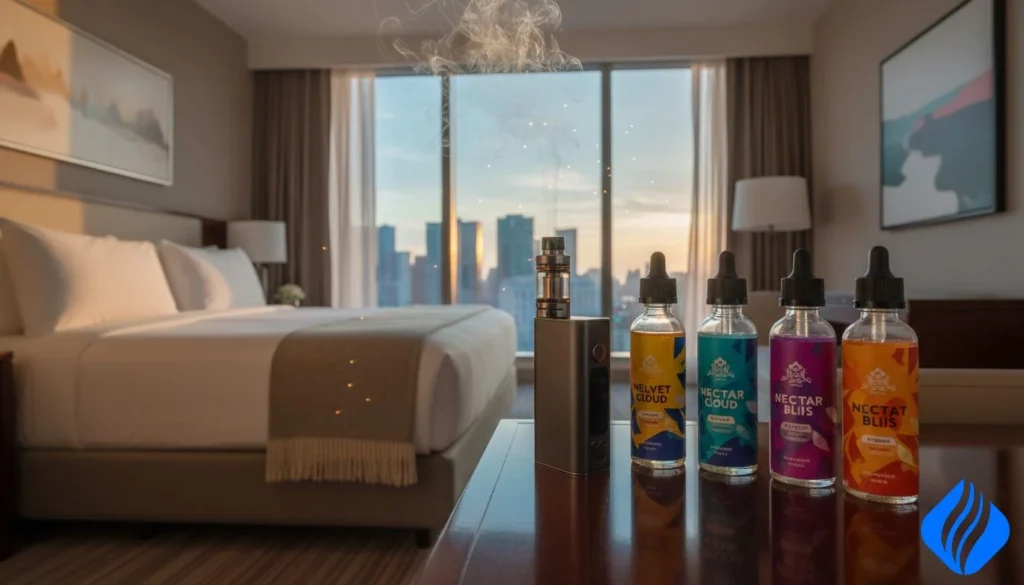
We use hands-on testing to set realistic expectations about visibility, smell, and lingering residue during room turnover. Our tests cover throat hit, vapor output, and flavor after 5,000 puffs for disposable devices.
Later sections compare disposables on Puffs per Dollar and Flavor Consistency. Core specs include mAh, ml, 2%/5% nic salt, mesh or dual mesh coils, and USB‑C charging. We will note brands like Geek Bar, Lost Mary, and Raz.
This is a compliance-first guide. We explain how human signs (odor, haze, residue) work alongside vape detection tech and air quality monitoring. We also preview a buyer-safety checklist (QR authentication) and USB‑C charging tips. Internal links planned: Disposable Vapes and Hot Sale collections for reference.
Key Takeaways
- Most modern hotels treat vaping like smoking; detection often succeeds.
- Vapor is an aerosol that can leave odor and residue used during room checks.
- Hands-on tests reveal real-world puff counts, battery efficiency, and flavor drift.
- We compare devices on Puffs per Dollar, core specs, and charging safety.
- Follow the buyer-safety checklist and respect property rules to avoid fees.
Why Hotels Treat Vaping Like Smoking in the United States
Major U.S. chains often group vaping with smoking. Marriott, Hilton, and Hyatt commonly ban both indoors because aerosols leave residue and odors that affect room readiness and guest satisfaction.

What “smoke-free” typically covers in major chains
Most property policies prohibit smoking and vaping in guest rooms, indoor common areas, and sometimes on balconies linked to non-smoking rooms. Management keeps language broad to avoid confusion.
Why residue and odors matter for guest satisfaction and room turnover
NIH-linked studies note after-effects from vaping can cut guest satisfaction. Residue settles on textiles and surfaces. Odors may linger for hours and prompt complaints.
- Operational impact: Lingering aerosol slows room turnover and raises cleaning costs.
- Health and air quality: CDC evidence on fine-particle pollution supports stricter smoke-free rules for duty of care.
- Guest experience: Flavored aerosol may read as cigarette smoke to non-users, affecting reviews.
| Issue | How it affects rooms | Why management enforces |
|---|---|---|
| Residue | Builds on linens, curtains, vents | Increases deep-clean cycles and costs |
| Odors | Can linger despite ventilation | Leads to guest complaints and lower ratings |
| Staff exposure | Repeated entry increases contact with particles | Workplace safety and liability concerns |
Hotel Vaping Policies You Need to Check Before You Take a Puff
Policy language varies by property. We recommend confirming rules at booking and again at check-in to avoid fees or removal. Many hotels ban vaping inside rooms and in indoor common areas.
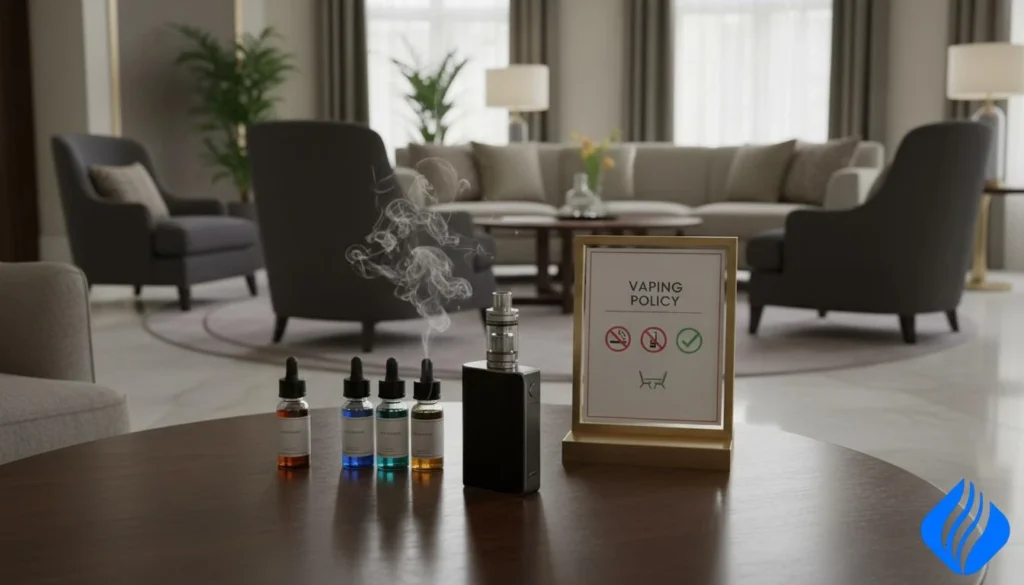
Non-smoking rooms vs. designated smoking areas
Non-smoking room means no indoor aerosol use, even with a window open. A truly smoking-permitted room will be listed explicitly. Saying “I’ll be careful” does not change policy.
Balconies, patios, bathrooms, and other gray areas
Common gray areas that still trigger violations:
- Balcony attached to a non-smoking room
- Bathroom with exhaust fan
- Hallway outside your door
- Stairwells and covered patios
What to ask at check-in
Script we suggest: “Where are permitted outdoor smoking or vaping areas? Are balconies included? What is the fee schedule for violations?”
Compliance checklist for booking and arrival:
- Confirm permitted areas and signage.
- Ask about fees and cleaning charges.
- Store devices and e-liquid sealed in luggage.
- Respect staff workload and other guests; complaints prompt inspections.
For legal outdoor options, consult categories like Disposable Vapes after confirming rules. Browse Hot Sale only once local policies are clear.
Can a hotel tell if you vape? The Real-World Signs Hotels Look For
Hotel staff often spot vaping by its sensory signature: sweet or minty odors, a brief haze, and sticky films. We break human detection into four clear buckets so readers see what triggers inspections and fees.
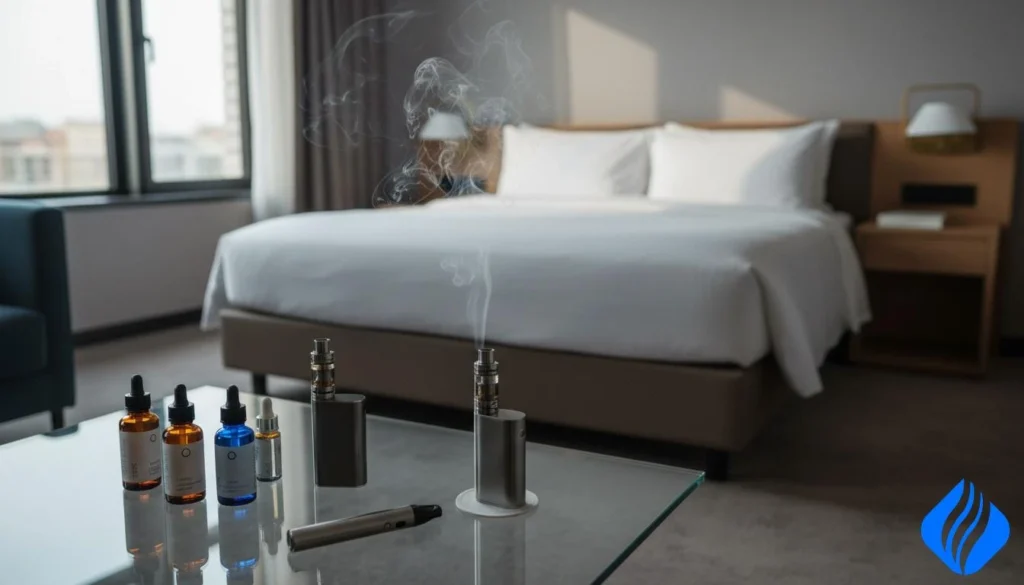
Smell
Flavored vapor leaves a noticeable scent on textiles. Our hands-on testing shows so-called low odor devices still emit fruity and mint notes in enclosed rooms. Soft surfaces trap those scents and make them easy for staff to detect.
Visibility
Higher-output devices create a short-lived haze. In still air that haze can linger under vanity or bathroom lighting. Staff often spot it during cleaning or quick room checks.
Surface film
Aerosols contain VG/PG and flavorants that settle as a faint film. Mirrors and windows show streaks; glossy tables feel tacky. Bedding and curtains absorb odor more than tile or glass, so textiles are examined closely.
Housekeeping pattern recognition
Experienced staff link sweet or mint smells to recent aerosol use. Repeated short sessions raise particulate load and increase detection risk. Cannabis or THC odors are distinct and typically prompt immediate escalation.
- Smell — fruity or mint traces on fabrics.
- Visibility — transient haze in still rooms.
- Surface film — faint residue on reflective surfaces.
- Staff recognition — pattern-based flags during turnover.
How Hotel Vape Detectors Work Compared to Smoke Detectors
Dedicated vape detectors focus on small aerosol particles rather than larger smoke particulates. We explain the difference so readers understand why detection rates differ.
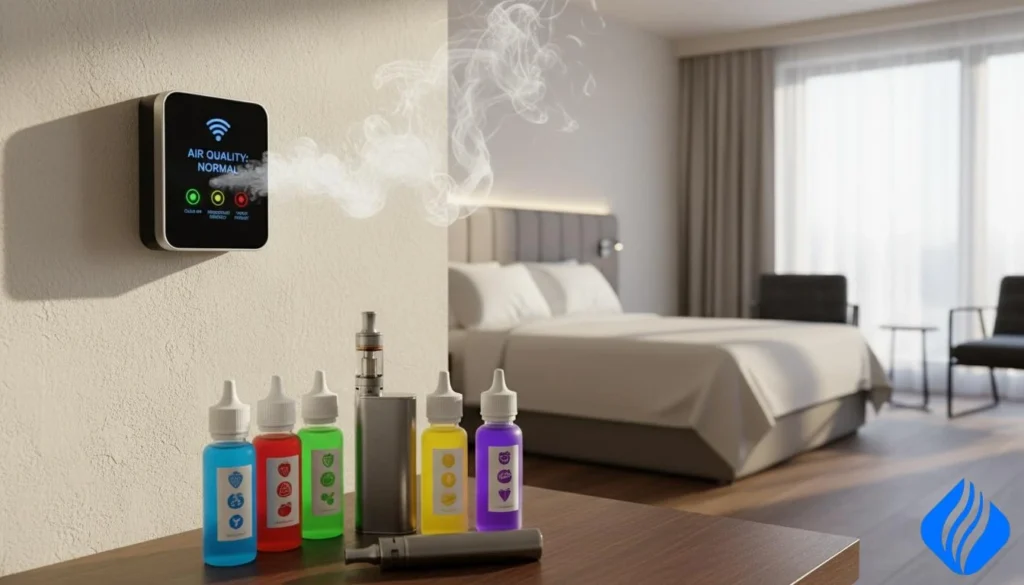
What they detect
Vape detectors use laser or optical particle sensing to measure fine particles and aerosols. When light scatters off suspended droplets, sensors register a signature and trigger alarms.
Where systems are placed
Common install points include ceilings in guest rooms, near bathrooms, and in hallways. Typical coverage per unit is 200–300 sq ft. Units link to Wi‑Fi so incidents send real-time alerts to staff.
Monitoring, alerts, and workflows
Modern monitoring systems log events and forward notifications to phones or property computers. That lets management review timestamps, room IDs, and follow enforcement workflows.
False positives and differentiation
Steam, hair spray, and deodorant can create spikes. Advanced technology analyzes particle size and pattern to reduce nuisance alarms and flag masking attempts.
| Feature | Detected signature | Typical placement | Notes |
|---|---|---|---|
| Smoke detectors | Coarse smoke particulates | Ceilings, corridors | Designed for fire; less sensitive to fine aerosols |
| Vape detectors | Fine aerosols / submicron particles | Rooms, bathrooms, hallways | Optical sensing; alerts for policy enforcement |
| Air-quality systems | Particle counts, VOCs | Central HVAC points, common areas | Continuous monitoring and trend logs |
| Advanced sensors | Pattern recognition, masking detection | Integrated with Wi‑Fi/management | Lower false positives; operational investment required |
Cost reality check: Units typically range from $500–$1,000 plus installation and upkeep. Properties that adopt these systems enforce rules more consistently.
For practical tips on minimizing detection risk and room readiness, see our guide on hide vapor traces.
What Happens When You Vape in a Hotel Room: Fees, Fines, and Eviction Risk
Vaping inside a guest room often triggers immediate operational steps and possible financial penalties. Management treats incidents as policy violations that stack costs and consume staff time.
Cleaning fees and deep-cleaning scope
Common charges include an instant policy fine of $100–$250 plus cleaning costs. Typical cleaning fees run $150–$300.
Deep cleaning usually means laundering or replacing soft goods, ozone or air treatment, wiping hard surfaces, and extra labor time. These tasks add time and costs rather than replace the fine.
HVAC impacts and ventilation limits
Aerosol travels through returns and can settle in vents. Ventilation may dilute smell but rarely removes all residue.
HVAC cleaning or maintenance to address deposits commonly costs $200–$500.
Fire alarm, sprinkler risks, and enforcement
Alarms may trigger from dense aerosol near sensors. Sprinkler incidents are rare but can exceed $1,000 due to water damage and emergency response.
Policy violation outcomes and detector tampering
Enforcement ranges from written warnings to immediate charges on the card on file and possible removal without refund. Management discretion varies.
Do not tamper with detectors. Covering, disabling, or removing units can be illegal in many places; in 28 U.S. states this action may be a felony with penalties that can top $1,000.
| Charge type | Typical range | Why it applies |
|---|---|---|
| Policy fine | $100–$250 | Rule enforcement |
| Cleaning fee | $150–$300 | Textile laundering, ozone, extra labor |
| HVAC service | $200–$500 | Vent cleaning and maintenance |
For practical avoidance and room-readiness tips, see our guide on hide vapor traces and related policy details at hotel vaping detection.
How Long Vape Odor and Residue Can Linger in Hotel Rooms
Airborne droplets from disposable devices settle quickly, then cling to glass, paint, and fabrics. We measured visible haze drop within minutes, but traces stayed on surfaces for much longer.
Why particles settle over time
Vapor disperses, then deposits where airflow slows. Cold glass and mirrors show streaks first. Textiles trap oils and flavorants, creating persistent residue.
Why opening windows and fans often fail
Ventilation reduces immediate smell, yet it does not reverse adsorption into fabric. In our tests, sweeter flavors re-emerged when the room warmed. Steam from showers made condensation hold aerosol on surfaces longer.
- Settling timeline: airborne droplets → brief haze → surface deposition over minutes to hours.
- Room variables: humidity, soft-surface load, and HVAC patterns change persistence.
- Operational impact: lingering odors delay turnover and affect air quality logs.
“Residue often resurfaces after warming; visible cleanness doesn’t equal odor-free,”
For property teams, repeated vaping raises particulate loads and increases cleaning cycles. We note this is a primary reason hotels enforce bans and track air quality during turnover.
How to Vape Without Violating Hotel Rules
Prioritize compliance: verify designated outdoor areas and get written permission before planning use of personal devices. We advise a rules-first approach so incidents do not become costly or disruptive.
Follow posted signage and designated outdoor areas
Most properties list outdoor areas for smoking and vaping. Use those zones and keep distance from entrances. Respecting signs limits complaints and reduces enforcement risk.
Book smoking-permitted rooms only with written confirmation
True smoking-permitted rooms are rare. Confirm in writing at booking and again at check-in. Verbal assumptions do not replace documented policy.
Avoid masking attempts that monitoring systems flag
Advanced air quality systems detect odd particle patterns. Heavy sprays or strong colognes can raise alerts. Masking often creates larger problems than the original aerosol.
Responsible travel device note: choose low-cloud, adult-focused devices for outdoor use. Keep clouds small near other guests and staff. Store gear sealed in luggage when not in use.
| Checklist | Action | Why it matters |
|---|---|---|
| Confirm policy | Ask at booking and check-in; get written note | Prevents retroactive fines and eviction risk |
| Locate designated areas | Use posted outdoor zones only | Reduces complaints and exposure to detectors |
| Respect distance | Stay away from doors, windows, vents | Limits odor transfer and guest impact |
| Avoid masking | Do not use heavy sprays or aerosols | Prevents monitoring alerts and stronger flags |
Resources: Browse portable options at Disposable Vapes, check seasonal deals under Hot Sale, or explore adult lines like RandM and Bang for legal outdoor use where permitted.
Health, Liability, and Air-Quality Reasons Hotels Enforce Vape Bans
Hotels balance guest comfort, staff safety, and legal risk when setting indoor vaping rules. This balance rests on measurable concerns about fine particles in indoor air and operational duty of care.
Secondhand exposure and fine-particle pollution
Public health guidance highlights that aerosols produce fine particles. These particles affect indoor air and air quality, even with ventilation active.
Monitoring shows particle counts rise after short sessions. That rise can change perceived quality for other guests and staff.
Duty of care, compliance, and reputation management
Management must deliver rooms that meet advertised smoke-free expectations. Repeated exposure creates work hazards for housekeeping and adds cleaning cycles.
One odor complaint can trigger refunds, negative reviews, and lost bookings. Brands protect room quality and ratings through consistent policies and monitoring systems.
Market pressure, local rules, and systems adoption
The global vape market is growing rapidly. Greater prevalence prompts many properties to invest in detection technology and stricter enforcement.
Local law, state rules, and insurance requirements change how strict property rules become. Device specs do not alter permission to use indoors; operational and legal factors do.
“Air-quality management and guest expectations drive enforcement more than device performance alone.”
| Concern | Effect on rooms | Management response |
|---|---|---|
| Fine particles | Raise particle counts; linger on fabrics | Install monitoring systems; increase cleaning |
| Staff exposure | Repeated contact during turnover | Policy enforcement; PPE and training |
| Guest complaints | Negative reviews; refunds | Fines, room remediation, stricter signage |
Takeaway: Air and particle metrics, legal duty, and reputation risk explain why many properties enforce bans. Device performance specifications remain separate from permission to use indoors.
Conclusion
We close with clear guidance on detection risk, tested device performance, and safe handling while traveling.
Product comparison (quick):
Geek Bar Pulse — 650 mAh, 6 ml, 5% nic salt, mesh coil, USB‑C. Puffs per Dollar: high. Flavor Consistency: strong through first 3,000 puffs.
Lost Mary — 700 mAh, 8 ml, 5% nic salt, dual mesh, USB‑C. Puffs per Dollar: very high. Flavor Consistency: steadier, slight mute near 5,000.
Raz — 600 mAh, 7 ml, 2%/5% options, mesh, USB‑C. Puffs per Dollar: moderate. Flavor Consistency: brighter early, flattens by 5,000.
Hands-on notes: Throat hit ranged smooth to firm. Vapor production low–high by model. After ~5,000 puffs most flavors muted or flattened.
User FAQ
How to know it’s empty? Draws thin, flavor drops, LED behavior, and visible e-liquid window indicate low or empty.
How to recharge safely? Use proper USB‑C cable, avoid overnight charging, stop if device gets hot.
Is it authentic? Scan QR on packaging and verify via https://www.google.com/url?sa=E&source=gmail&q=sokvape.com; check seals and print quality.
This product contains nicotine. Nicotine is an addictive chemical.
Takeaway: Staff observation plus vape detectors and air‑quality systems make indoor vaping risky. Use designated outdoor areas or permitted rooms only and never tamper with detectors.
Resources: Disposable Vapes, Hot Sale, RandM, Bang.
 English
  German
  Dutch
Dutch  Danish
  Czech
Czech  Italian
  Slovenian
  French
  Hungarian
  Spanish
  Polish