

You’ve come to learn how are vapes made and what compliance means for selling in the United States. This guide pairs manufacturing basics with the regulatory reality that shapes what you can stock, ship, and sell.
Modern electronic devices are engineered systems that combine electrical, fluid, and airflow design. Production quality affects leakage, aerosol consistency, and battery risk. We focus on safety and clear standards.
At a high level, the product build path covers design, materials, assembly, and testing. The e-liquid workflow includes ingredient selection, mixing, filling, and packaging, with contamination control and labeling requirements.
We also preview business essentials: authenticity checks, documentation, an LLC/EIN/Sales Tax Permit checklist, FDA and PACT Act realities, and sourcing best practices such as verified suppliers like Sokvape.com.

Urgent note for recycling: battery and lithium waste pose serious environmental harm. Later sections show responsible recycling steps and why this matters to your brand and community.
Retailers: before leasing or opening a lounge, verify city and county zoning, distance-to-school buffers, signage rules, and local tobacco retailer permits to avoid costly mistakes.
Key Takeaways
- This guide explains the production and compliance context you need to sell safely in the U.S.
- Device performance ties directly to design, materials, and assembly quality.
- E-liquid safety rests on ingredient controls, proper mixing, and accurate labels.
- Expect a practical business checklist covering LLC, EIN, sales tax, and FDA/Pact constraints.
- Responsible recycling of lithium batteries is essential for environmental and brand safety.
What a Vape Is and What “Vapor” Really Means
Think of a vape as a compact heater that turns e-liquid into tiny particles you can inhale. It uses a battery and a heating element to form an aerosol — not smoke from combustion.
People call the output “vapor,” but the correct term is aerosol: fine droplets and suspended particles in air. That distinction matters for ventilation, indoor-use rules, and customer conversations at the counter.
Unlike cigarettes, vaping does not burn tobacco. That means the chemical profile of what someone inhales is different, but it does not imply zero risk. Product design, device settings, and ingredients change exposure levels.
- Definition: battery-powered device that heats e-liquid to create an inhalable aerosol.
- Language: “vapor” is common speech; technically, it is an aerosol.
- Risk note: many products contain nicotine; verify labels before sale.
Safety reminder: these products are intended for adults. Treat nicotine inventory as controlled merchandise with age checks and secure storage.
| Feature | Vaping (aerosol) | Smoking (combustion) |
|---|---|---|
| Source | Heated e-liquid | Burning tobacco |
| Output | Aerosol (droplets) | Smoke (gases and particulates) |
| Typical additives | PG/VG, flavorings, nicotine | Tobacco, additives, combustion byproducts |
| Retail impact | Indoor policies, signage, age-gating | Smoking bans, different ventilation requirements |
Core Parts Inside Modern Vape Devices
Inside a modern unit, a handful of engineered parts work together to turn stored liquid into a consistent aerosol. You’ll learn the role of each piece so you can evaluate products and spot defects before you stock them.
Mouthpiece, tank, and airflow
The mouthpiece guides the draw and affects comfort. A good seal between mouthpiece and cartridge reduces leakage and keeps flavor consistent.
Airflow pathways control resistance and aerosol density. Poor tolerances in channels and seals often cause harsh hits or drips.
Atomizer basics
The atomizer combines a resistance coil and a wick that draws liquid to the heating element. That interaction determines flavor, throat feel, and coil life.
Electronics and activation
Modern devices use a microprocessor and sensors to regulate output, detect airflow or button presses, and enforce safety cutoffs. These controls improve consistency and protect users.
Power and materials
Lithium-ion batteries dominate for energy density and rechargeability, but battery quality and protection circuitry matter for safety.
Construction uses metals, plastics, and sometimes glass—materials choice affects durability and chemical compatibility when sourcing inventory.
- Map of internal architecture: mouthpiece, tank/cartridge, airflow, atomizer, control electronics, battery.
- Watch seals and channels to reduce leakage risk.
How Are Vapes Made: A Step-by-Step Look at Production Today
From sketch to shelf, the production flow ties design choices to repeatable manufacturing steps. You’ll see where quality problems start and what to check before you buy inventory.
Design and prototyping for performance and user experience
Design teams build prototypes to validate draw resistance, mouthfeel, and consistent aerosol output. Early tests reveal whether coil placement and airflow geometry deliver the intended flavor and performance.
Component sourcing and material selection
Devices often use lightweight metals such as aluminum or stainless steel. They may also include glass tanks and plastic seals. Material choice affects durability, chemical resistance, and leakage risk.
Assembly workflows: tanks, coils, seals, mouthpieces
Assembly usually attaches the atomizer to the battery, fits coils and O-rings, then installs the mouthpiece and tank. Torque control and seal integrity matter to prevent leaks and ensure product reliability.
Functional testing before pack-out
Quality checks include airflow consistency, leak tests, actuation and charging behavior, and aerosol consistency across expected settings. Standardized parts can still vary in machining tolerance and coil life, so test each batch.
- Production flow: concept → prototype → sourcing → assembly → test → pack-out.
- Pay attention to material specs and machining tolerances when vetting suppliers.
How Vape Juice Is Made From Base Ingredients to Finished E-Liquid
A reliable juice recipe balances base liquids, concentrated flavors, and precise nicotine levels. That balance drives throat hit, taste clarity, and visible vapor output.
Core composition
Most e-liquid blends use propylene glycol (PG) and vegetable glycerin (VG) as the base. Flavorings add taste, and nicotine is optional but must be handled with care and labeled clearly.
Choosing PG/VG ratios
Higher PG gives a stronger throat hit and carries flavor forward. Higher VG produces thicker liquid and larger clouds. A 50/50 ratio is thinner and often more flavor-forward.
Mixing practice and consistency
Simple shaking works for small batches. Measured stirring with syringes or scales yields repeatable results for retail batches.
Documented recipes and accurate measurement reduce variability, limit returns, and lower regulatory risk.
Filling and packaging
Fill in clean conditions to avoid contamination. Use bottles with child-resistant caps and clear strength labels. On receipt, verify nicotine strength and seal integrity before you accept inventory.
Quick tip: keep batch records and sample tests for traceability and quality complaints.
How Heating, Temperature, and Settings Shape Vapor and Taste
Control of heating profiles determines the balance between taste clarity and vapor production. E-liquid typically reaches about 100–250°C inside the chamber, and that range is critical for forming a stable aerosol.
Voltage, wattage, and energy delivery
Voltage and wattage set the energy that the coil receives. Small changes in settings can raise output levels and shift feel, warmth, and flavor.
Airflow and aerosol behavior
Airflow acts as a cooling and dilution control. More flow cools the atomizer and thins aerosol, while restricted flow increases warmth and intensity but may stress wicking and reduce performance.
Coil resistance and battery safety
Lower resistance coils boost vapor but demand more from the battery. Mismatched cells or damaged wraps can fail under load, so advise customers to stay within manufacturer ranges.
Retailer guardrails: recommend matched coils, genuine cells, and prompt replacement of worn parts. For troubleshooting, uneven taste over time usually signals wick saturation, coil age, or wrong power levels for the e-liquid viscosity.
Device Types and Systems You’ll See in the US Market
Retailers will see three broad device families on shelves, each tuned to a distinct user routine. Choose stock to match your customers’ needs: simplicity, control, or refillability.
Disposable vs. closed rechargeable vs. open tank
Disposable devices are single-use; toss them when the battery or liquid is spent. They suit casual users who want no maintenance.
Closed systems use pre-filled pods and recharge. They offer consistent flavor and ease of use for on-the-go customers.
Open tank options let a user refill liquid and change coils. They demand more skill but reduce waste and allow customization.
Generations: cigalikes to pod mods
Products evolved from cigalikes to tank systems, then to high-power mods and compact pod mods. Key changes were increased battery capacity, finer power control, and new nicotine formats.
- Retail note: disposables simplify sales but increase waste; open tanks need counter education.
- Buyer lens: match device to user to lower leaks, burnt hits, and battery issues.
Always treat nicotine products as adult-only inventory and train staff to explain strengths and safe use.
Quality and Authenticity Checks Before You Sell or Stock Products
Begin with a short intake protocol that focuses on seals, labeling, and compatibility. This simple step saves time and prevents customer complaints.
Red flags include inconsistent labels, missing batch IDs, broken seals, and packaging that differs from prior shipments. Flag any shipment that shows those signs and quarantine it for verification.
Common physical issues to watch for
Leaking tanks do more than make a mess. Leaks point to poor seal tolerances and can expose staff to nicotine-containing liquid during handling.
Mismatched parts—wrong coils, pods, or off-spec chargers—reduce device performance and can stress batteries. Check that parts match brand specs before you sell.
Why standardized parts still vary
Interchangeable components often differ in machining tolerance, coil material, and QC practices. Standard sizes don’t guarantee consistent performance across production runs.
- Quick spot-tests: airflow draw check and O-ring visual inspection.
- Verify serials or QR codes with the brand when present.
- Accept only product with intact batch records and consistent packaging.
Sell authentic stock: counterfeit or grey-market items raise complaint levels, increase safety risk, and can create regulatory exposure if labeling is wrong.
Vape Business Checklist for the United States
A simple business foundation—legal entity, EIN, and sales registration—keeps your inventory flow compliant and defensible.
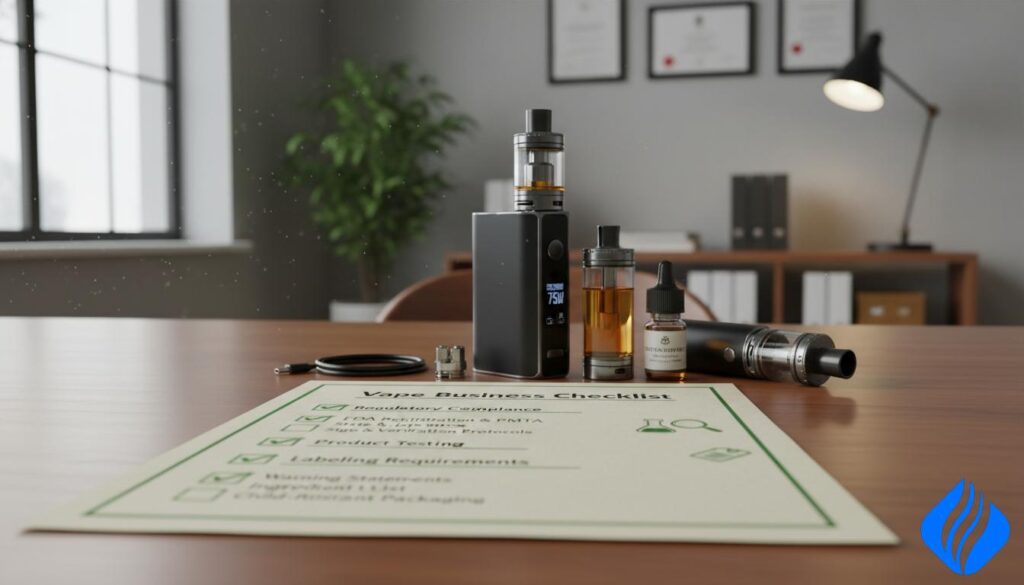
Entity setup essentials
Form an LLC or the appropriate entity for liability protection. Obtain an EIN to open bank accounts and hire staff. Secure a Sales Tax Permit so you can buy wholesale and collect state tax correctly.
FDA compliance and manufacturing expectations
In the U.S., many nicotine products fall under tobacco rules. Labels and manufacturing practices are not optional if you want to sell defensibly. Maintain written procedures, batch traceability, and controlled handling for e-liquid and nicotine strengths.
Document sourcing, keep ingredient records, and match labels to lab or supplier statements to lower enforcement risk.
TPD and cross-border product notes
If you import EU-aligned e-liquids, verify that packaging, limits on nicotine levels, and warnings meet the destination rules. Match the product version you sell to local law to avoid returns or seizures.
Local storefront and local SEO
Check city zoning, distance-to-school rules, tobacco retailer permits, fire-code occupancy, and signage limits before committing to buildout. For local search, list your address consistently and confirm permit status in listings.
Need licensing details? See what license do I need to open a vape for a practical starting point.
Licenses and Shipping Rules That Affect Vape Retailers
Shipping rules and local licensing shape what you can legally sell and how you fulfill orders. You must balance carrier limits, recordkeeping, and shop permits to keep operations running smoothly.
PACT Act overview and practical effects
The PACT Act changed shipping for vaping products by adding delivery verification and heavier recordkeeping duties. Carriers now require adult-signature confirmation and stricter package controls for product shipments.
This increases fulfillment costs and limits some carrier options. Keep clear files for each sale to meet audit requests and avoid penalties.
State and local licenses, renewals, and inspections
Many states and municipalities require tobacco retail licenses or specific vape registrations. Create a renewal calendar for fees and paperwork so your license never lapses.
- Confirm carrier acceptance and signature protocols.
- Update customer messages about delivery verification and pickup options.
- Train staff on age-verification systems to pass inspections.
“Verify licensing and zoning at the same time — a permit does not replace local location rules.”
Plan periodic compliance reviews. Check zoning and permit rules in your city because a valid license won’t override local site restrictions.
Supply Chain and Sourcing: Getting Authentic Devices and E-Liquids
Reliable supply starts with documented proof that a supplier handles brand inventory on legitimate terms. Ask for invoices with clear SKU mapping and consistent lot or batch identifiers. Those documents show traceability through production and shipping.
Vetting wholesalers and spotting counterfeit risk
Check for brand-authorized distribution signals such as written agreements, consistent packaging, and prior customer references. Counterfeit risk often shows as high failure rates, mismatched packaging, or odd performance variance.
Practical receiving and traceability habits
Photograph cartons on arrival and record lot identifiers before you accept stock. Quarantine any questionable shipment until verification completes.
Storage, handling, and battery integrity
Store e-liquid and vape juice in cool, stable temperatures with limited light exposure to protect nicotine and flavors. Control access to nicotine stock and keep batch records for recalls.
Battery safety: avoid heat, never sell damaged or swollen cells, and match chargers to the device options you stock. These simple steps lower risk and preserve product life.
Tip: many shops source from established wholesalers such as Sokvape.com; start due diligence with a lookup at https://www.google.com/search?q=Sokvape.com to verify reputation and distribution channels.
Recycling Disposable Vapes and Batteries the Right Way
A clear disposal routine reduces risk and preserves recoverable lithium from single-use units. Follow a simple, safety-first process for customers and staff to avoid fires and improve material recovery.
Step 1: Tape battery terminals before transport to reduce short-circuit risk. Use non-conductive tape and cover both positive and negative ends.
Step 2: Remove the battery if possible and safe to do so. Do not encourage disassembly when devices are glued or swollen; unsafe attempts create puncture and fire hazards.
Step 3: Use a dedicated lithium-ion drop-off point or an approved household hazardous waste facility instead of curbside recycling. This ensures proper handling and recovery of energy-bearing materials.
Environmental impact: UK-based Material Focus estimates over 40 tonnes of lithium are discarded each year from thrown-away vapes—enough lithium for about 1,200 electric vehicle batteries—illustrating why proper disposal programs matter.
Disposable products mix plastics, metals, electronics, and a battery, which makes recovery harder when units go to general trash. For a lower-waste option, stock and recommend refillable and rechargeable systems. They keep the core device and battery in service while replacing just pods or coils, cutting material and energy losses from production and end-of-life processing.
For practical user guidance, offer a short disposal handout at point of sale or link to detailed instructions such as disposable device use and disposal.
Conclusion
A practical conclusion pairs technical insight with clear compliance steps you can use today.
You should evaluate device design, materials, assembly, and testing to judge build quality. Check the atomizer, coil, mouthpiece, and basic settings before you accept stock.
For vape juice, confirm base mixing, nicotine handling, and sealed packaging. Match labels to batch records to reduce returns and regulatory risk.
Business essentials: form an LLC, get an EIN and Sales Tax Permit, follow FDA expectations, and note TPD differences for imports. Expect tighter shipping rules under the PACT Act and keep state/local licenses current.
Buy through vetted suppliers (for example, Sokvape.com). For recycling: tape terminals, remove the battery if safe, and take cells to a dedicated lithium-ion drop-off. Favor refillable options to cut waste. Finally, confirm city zoning and permits before you expand a brick-and-mortar location.
 English
  German
  Dutch
Dutch  Danish
  Czech
Czech  Italian
  Slovenian
  French
  Hungarian
  Spanish
  Polish