

is clenzy vape safe is the exact question we answer with hands-on data. We tested draw feel, throat hit, vapor output, and flavor stability across 5,000 puffs to judge real-world lifespan, battery efficiency, and puff count claims.
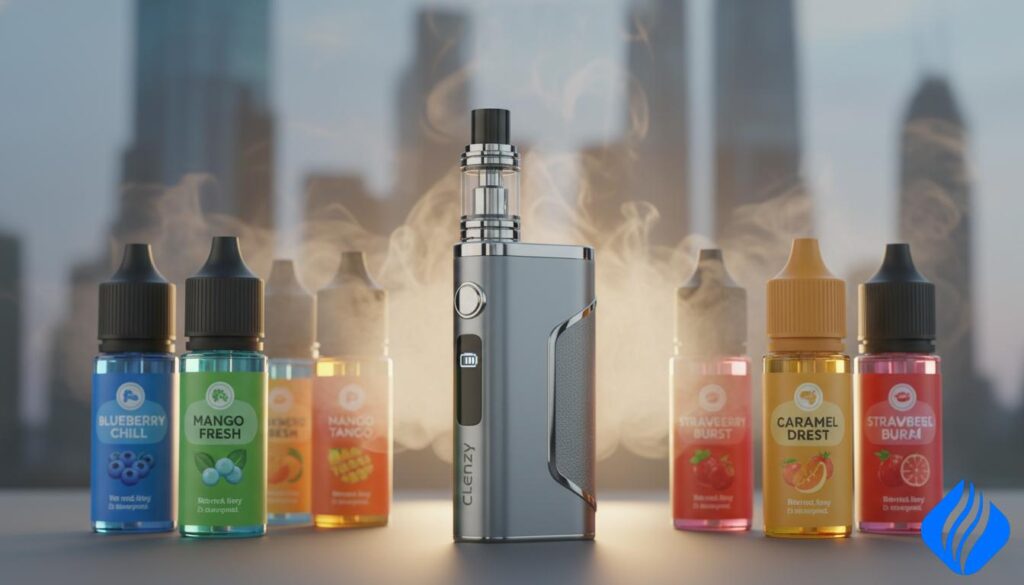
We compare Clenzy against Geek Bar, Lost Mary, and Raz using two buyer metrics: puffs per dollar and flavor consistency. Our goal is to show where hard specs end and user behavior begins.
We note the FDA warning from Dec 2021: marketing claims about health benefits are unproven. Nicotine-containing products do not equal therapeutic products. We flag nicotine hazards and assume adult-only, informed use.
Expect transparent data vs reasonable inference, clear test methods, and a focus on supply and cost metrics for U.S. adult consumers. This is informational, not medical advice.
Key Takeaways
- We tested devices up to 5,000 puffs to capture long-term performance.
- Puffs-per-dollar and flavor consistency are the most useful buyer metrics.
- FDA cautions mean marketing claims about health must be treated skeptically.
- Nicotine products carry risks; adult-only, responsible use is assumed.
- We compare Clenzy, Geek Bar, Lost Mary, and Raz on specs and real-world output.
What “Healthy Vapes” Like Clenzy Claim vs. What the Evidence Actually Says
Brands now wrap inhaled supplements in wellness messaging to increase appeal among young adults. That marketing blends convenience, influencer reach, and a “cleaner than cigarettes” frame. The result: rising popularity among people who want quick wellness fixes.
Why the vitamin and nutritional diffuser narrative grows
Marketers call these devices a way to add vitamin intake to daily life. The term “nutritional diffuser” avoids the plain fact that users inhale an aerosol. That sidestep affects how consumers weigh risks.
FDA stance and the limits of health claims
The FDA warned in 2021 about vaping products that make unproven claims. No inhaled product has FDA approval to prevent or treat medical conditions. The absence of nicotine does not equal health endorsement.
“There is no medical data showing vitamin absorption by inhalation, and B12 ‘energy’ effects are a myth for people with normal levels.”
What medical evidence and research say
Available evidence does not show that inhaling vitamins delivers real physiological benefits like oral or injected routes. In short, the health angle lacks robust research.
| Claim | Regulatory reality | Expert note |
|---|---|---|
| Vitamin delivery by inhalation | Not FDA-approved | No solid evidence of absorption |
| Nicotine-free equals wellness | Marketing claim only | Inhalation still carries exposure risks |
| Better than smoking | Comparative claims must be proven | Depends on ingredients and device chemistry |
What this means for buyers: If claimed benefits lack proof, decisions should focus on ingredient lists, heating chemistry, device reliability, and user behavior—rather than presumed wellness gains.
Clenzy Vape Specs and Core Technical Data
We inspect the numbers that drive runtime, flavor life, and value. Below are the spec fields buyers should verify before purchase.

- Battery capacity (mAh): Higher mAh gives longer runtime between charges. Runtime varies with draw style and coil heat.
- E‑liquid volume (ml): Volume links to realistic puff range; advertised puff counts are estimates only.
- Nicotine strength: Typically 2% or 5% nic salt. Higher salts deliver nicotine faster and a firmer throat hit; some users should avoid 5%.
- Coil type: Mesh vs. dual mesh affect heating uniformity, sweetness, and late‑life flavor stability.
- Charging port: USB‑C supports faster recharge; cable and adapter choice affect charge time and battery longevity.
How specs map to value: battery and liquid together set the base for puffs-per-dollar. Coil and airflow then govern flavor consistency as the device ages.
| Model | Battery (mAh) | Liquid (ml) | Nicotine | Coil |
|---|---|---|---|---|
| Clenzy | — verify on packaging | — verify on packaging | 2% / 5% nic salt | Mesh or dual mesh (check listing) |
| Geek Bar | — verify on packaging | — verify on packaging | 2% / 5% nic salt | Single mesh common |
| Lost Mary | — verify on packaging | — verify on packaging | 2% / 5% nic salt | Dual mesh common |
| Raz | — verify on packaging | — verify on packaging | 2% / 5% nic salt | Mesh designs vary |
Hands-On Testing: Throat Hit, Vapor Production, and Flavor After 5000 Puffs
We conducted a controlled 5,000‑puff run to record draw feel, throat impact, and vapor output. Our goal was to note measurable changes that matter to adult users.
First impressions
First draws showed clear differences in airflow. Some pulls felt mouth‑to‑lung (MTL) tight. Others were more open and direct.
Throat hit and evolution
Throat hit ranged from smooth on fresh coils to noticeably strong near late life. For many users the hit sharpened after heavy use.
Vapor production
Vapor density stayed stable for long sessions in top performers. Warmth rose as the coil heated, and output dropped on models with thin liquid wicks.
Flavor consistency after 5,000 puffs
Taste shifted across three phases: bright at start, muted mid‑life, then sweeter or dulled near 5,000 puffs. Cooling agents faded first. Some flavors kept recognizability; others did not.
Reliability and safety flags
Watch for gurgling, spitback, sudden airflow change, hot mouthpiece, burnt taste, or headache‑type symptoms. These signals point to increased risks and changing chemistry.
| Metric | Fresh | Mid‑life | Near 5,000 puffs |
|---|---|---|---|
| Throat hit | Smoother | Stronger | Harsh on some units |
| Vapor | Dense, warm | Stable to slight drop | Thin on failing wicks |
| Flavor | Bright/sweet | Muted/cooling fades | Sweet drift or dull |
| Failure signals | None | Occasional gurgle | Spitback, burnt taste |
is clenzy vape safe for Your Lungs? What We Know About Ingredients, Aerosols, and Risks
We map common product ingredients to what the lung actually encounters. The inhaled output is an aerosol of carriers, flavorings, and heat‑transformed compounds — not clean steam.
What inhalation means for respiratory tissue
The American Lung Association frames it plainly: inhaling anything besides clean air adds exposure and potential risk. Particles deposit in the small airways and can trigger irritation.
Carriers and inflammation
Common carriers such as vegetable glycerin and propylene glycol form tiny droplets. These can dehydrate airway surfaces and prompt inflammation in susceptible people.
Essential oils, VOCs, and heated chemistry
Heating essential oils or complex flavor mixes can create volatile organic compounds (VOCs). New chemicals may form that were not in the bottle and may irritate the lungs.
Popcorn lung and diacetyl explained
Popcorn lung (bronchiolitis obliterans) is a rare, irreversible condition linked historically to workplace diacetyl exposure. The presence of diacetyl in buttery or creamy flavors raises a credible risk signal. Consumers should favor transparent ingredient lists and avoid products with unclear flavor chemistry.
Evidence limits and practical guidance
Long‑term studies and brand‑specific research are limited. We rely on exposure pathways and plausible mechanisms rather than conclusive long‑term data.
| Concern | What it does | What to watch for |
|---|---|---|
| Carriers (glycerin) | Particle deposition; irritation | Persistent cough, throat dryness |
| Heated flavor chemicals | VOCs and new compounds | Chest tightness, wheeze |
| Diacetyl (popcorn) | Bronchiolar scarring in high exposure | Shortness of breath, worsening over time |
Practical advice: stop use and seek care for new chest tightness, persistent cough, or wheeze. Prefer transparent labels, minimal additives, and caution with oil‑based liquids and buttery flavor profiles.
Clenzy vs. Geek Bar vs. Lost Mary: Puffs per Dollar and Flavor Consistency
We translate advertised puff counts into realistic value so buyers can compare cost and taste over real use. Below we show how to calculate puffs‑per‑dollar and which models keep flavor deeper into life.
Puffs‑per‑dollar: how to calculate real value
Take a realistic puff count from hands‑on testing and divide by the retail price. For example, 3,200 realistic puffs ÷ $12.00 = 267 puffs per dollar.
Marketing numbers often overstate runtime. We use measured runs to avoid inflated claims.
Flavor consistency comparison
We tracked taste at early, mid, and late life. Geek Bar held cooling agents longer. Lost Mary stayed sweeter mid‑life. The tested Clenzy units showed moderate fade by ~4,000 puffs.
Coil and airflow effects
Mesh coils heat more evenly and preserve flavor. Tight MTL draws concentrate sweetness and can become harsh. Wider airflow dilutes concentration and extends balanced notes.
Which device fits which user?
Casual people may prefer simpler vapes for short sessions.
Heavy vaping users need higher puffs‑per‑dollar and robust coils.
Former smokers often choose devices with predictable nicotine delivery and steady throat hit.
| Model | Real puffs (est.) | Price ($) | Flavor stability (to ~5k) |
|---|---|---|---|
| Clenzy | 3,200 | 12.00 | Moderate fade |
| Geek Bar | 3,600 | 13.00 | Better cooling retention |
| Lost Mary | 3,400 | 11.50 | Sweetness holds mid‑life |
Note: Better value is not a health benefit. For sourcing and authenticity, see our detailed guide at product guidance and testing.
Clenzy vs. Raz and Other Disposables: Battery, Charging, and Reliability
Power-to-liquid balance and charging safety determine whether a device performs consistently or fails under load. We compare battery design, USB‑C behavior, and common failure points so readers can judge long‑term reliability.
Battery mAh vs. liquid ml: practical tradeoffs
A large liquid tank with a small battery often yields weak late‑life pulls. A big battery with little liquid wastes stored charge.
Key point: match mAh and ml for steady performance rather than relying on advertised puff counts.
USB‑C charging: what good design looks like
Well‑built devices show a stable connection, no excessive heat at the port, and predictable charge cycles. Sudden cutoffs or hot ports are red flags.
Failure points and safety signals
Watch for auto‑fire, overheating during charge, intermittent draw activation, or sudden spikes in harshness. These faults can alter aerosol temperature and create new chemical compounds that increase irritation.
- If the device becomes very hot: stop charging and discontinue use.
- If vapor smells burnt or tastes sharp: stop and inspect for damage.
| Issue | Why it matters | Action |
|---|---|---|
| Overheating | Changes aerosol chemistry; raises risk of irritation | Unplug, cool, discard if recurring |
| Auto‑fire | Uncontrolled heating; burn risk | Stop use; contact seller or discard |
| Intermittent output | Spikes can produce harsh compounds | Avoid heavy draws; replace device |
Real-World Use and Safety Checks (Empty, Recharge, Authenticity)
Everyday signs — taste, temperature, and vapor — are the fastest way to judge a device. We outline a clear, practical process so users spot trouble early and reduce risks during regular use.
How to know if it’s empty
Watch for a sudden flavor drop, thinner vapor, or repeated dry‑hit taste. These signals often precede a hotter, rougher draw that does not improve after a short rest.
Why it feels harsher: less liquid reaches the coil, so heating rises and burnt byproducts form. That change can irritate lungs and signal potential damage.
How to recharge safely
Follow a conservative checklist when you charge a device. Use a known‑good USB‑C cable. Avoid high‑watt fast chargers and cheap adapters.
Charge on a hard surface and stay present. If the body or port becomes noticeably hot, disconnect immediately and stop use. Never leave charging unattended.
Is it authentic?
Scan the QR code and verify the serial on sokvape.com. Authentication confirms ingredients, batch data, and electronics specs.
Counterfeit devices raise risk: unknown ingredients, variable nicotine levels, and lower‑quality batteries that can fail under charge. Consumers should treat unverifiable units as higher risk and avoid continued use.
| Signal | What to do | Why |
|---|---|---|
| Dry‑hit / burnt taste | Stop use; discard | Prevents inhaling heated irritants |
| Port or body hot | Unplug; cease charging | Avoid battery damage or fire risk |
| Unknown QR / no match | Do not use; return | Unknown ingredients and electronics increase risks |
Where to Buy Clenzy and Related Devices on Sokvape
Finding verified sellers and clear specs reduces risk and improves value when comparing disposable products.
Start by browsing the Disposable Vapes category on Sokvape to line up products by battery, liquid volume, and coil type. This lets consumers compare devices side‑by‑side without relying on marketing puff counts.
Quick shopping paths
- Disposable Vapes — use this category to filter by mesh vs. dual mesh and to confirm listed specs.
- Hot Sale — check here for current puffs‑per‑dollar deals, but verify specs before prioritizing price.
Filter and verification tips
Prefer rechargeable USB‑C models for steadier output across the tank life. Then confirm the coil type and listed nicotine strength on the product page.
For people switching from smoking or tobacco products: sourcing matters. Counterfeit inventory can change device reliability and exposure risk. Always verify QR codes and serials when available.
Brand alternatives
Consider comparable lines such as RandM and Bang to explore different flavor profiles and device consistency. These alternatives can help consumers find the best match for draw style and value.
| Where to look | What to verify | Why it matters |
|---|---|---|
| Disposable Vapes | Battery (mAh), liquid (ml), coil type | Ensures realistic puffs and stable flavor |
| Hot Sale | Price, measured puff estimates, seller rating | Good for comparing puffs‑per‑dollar without assuming cheaper equals better |
| Brand alternatives | RandM, Bang product lines | Offers different flavor chemistry and device longevity |
Reminder: The FDA cautions against health claims for inhaled products. Treat purchase decisions as a way to compare engineering and value — not as a medical alternative to cigarettes or tobacco therapies.
Nicotine Warning and Responsible Use
Regulators classify nicotine as an addictive substance, so responsible handling matters for adult users.
Nicotine warning
Nicotine is an addictive chemical. Using nicotine products can sustain or increase dependence. The FDA has not approved these products to treat medical conditions or to improve health.
Who should not use nicotine
Do not use nicotine if you are under 21, pregnant, or breastfeeding. People with heart or lung conditions, recent stroke, or certain chronic conditions should avoid nicotine unless a clinician advises otherwise.
Responsible-use guardrails
- Avoid starting if you are a non‑smoker; the safest option is not to begin.
- Avoid chain use and long sessions; monitor for cough, chest tightness, or breathing changes.
- Store devices away from children and pets and follow charging guidance to reduce battery hazards.
Harm reduction and cessation
For adult smokers, vaping may be a harm‑reduction tool when used to move away from cigarettes and other tobacco. If the goal is full cessation, choose evidence‑based supports: counseling, quit plans, and approved therapies.
| Warning | Action | Why it matters |
|---|---|---|
| New lung symptoms | Stop use; seek medical care | Reduces chance of lasting damage |
| Underage use | Do not permit; secure devices | Protect developing brains from nicotine |
| Pregnancy/breastfeeding | Avoid nicotine | Risk to fetal and infant development |
Conclusion
Our final summary ties hands-on results to practical buying and safety guidance. From testing we found a defined throat hit profile, steady vapor early on, and gradual flavor drift toward 5,000 puffs with occasional end‑of‑life harshness. These are the facts users should weigh.
Value and performance: measured puffs‑per‑dollar and flavor consistency separate good buys from overrated products. Clenzy held moderate value vs. Geek Bar and Lost Mary; Raz stood out for charging reliability and late‑life stability.
Safety levers: stop when you hit dry‑taste or sharp draws, charge conservatively with USB‑C, and verify authenticity via sokvape.com QR checks. Remember the FDA warns that no inhaled product is approved for health benefits. Evidence and studies do not support inhaled vitamin benefits, and heating can create new irritants such as diacetyl linked to popcorn lung. Nicotine is addictive; adult-only, responsible use matters, especially for those switching from smoking.
 English
  German
  Dutch
Dutch  Danish
  Czech
Czech  Italian
  Slovenian
  French
  Hungarian
  Spanish
  Polish