What is atomizer in vape technology matters now more than ever: modern mesh coils and smart screens shape flavor and efficiency.
We write as industry analysts and technicians. Our goal is a data-driven, practical guide that helps readers pick and evaluate systems. We define components, compare rebuildable setups to clearomizers, and explain coil, wick, and tank roles.
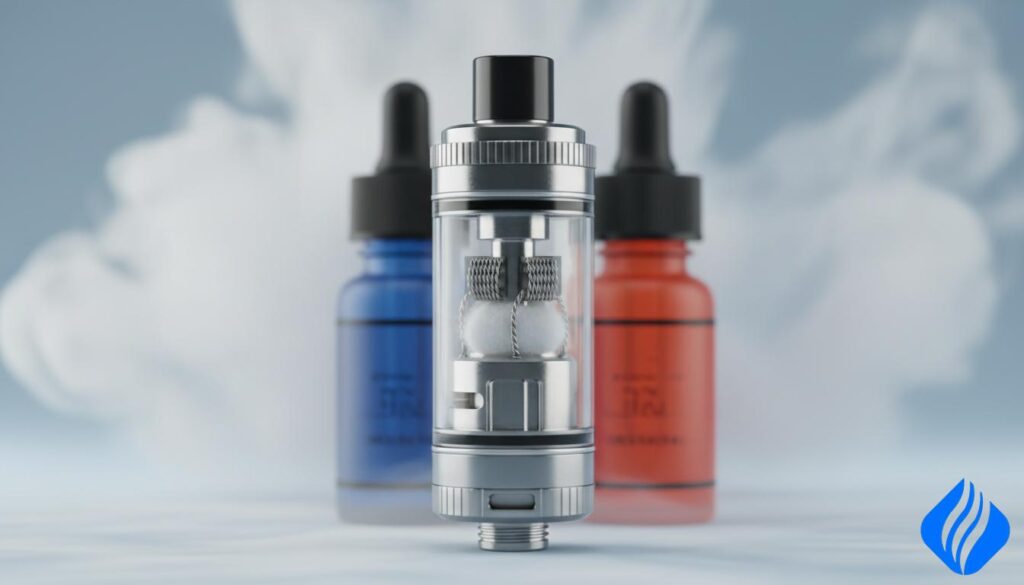
A standard tank atomizer setup. The glass reservoir holds the e-liquid, feeding it into the central chimney where the atomization coil resides, distinct from disposable or dripper systems.
We set clear evaluation standards up front — Flavor Consistency, throat hit, vapor production, and a Puffs per Dollar metric. Later sections include hands-on tests, 5,000-puff flavor checks, competitor comparisons, and maintenance tips.
We flag safety and age guidance for adults 21+. For background reading and a broader primer, see our linked beginner resource at the ultimate guide for beginners. Expect objective data, clear testing methods, and actionable buying criteria.
We define device components and terminology plainly.
Evaluation uses measurable standards for fair comparison.
Hands-on tests include Puff-per-Dollar and flavor after 5,000 cycles.
Maintenance, airflow, and wicking often cause burnt taste.
Content targets adult readers and includes a nicotine safety warning.
what is atomizer in vape and why it matters for flavor and vapor production
We treat the atomizing element as the performance core of modern vaping devices. An atomizer is the part of a system that converts e-liquid into inhalable vapor by heating at the coil and wick interface.
Atomization quality drives three practical outcomes: flavor clarity, vapor density, and throat hit intensity. A well-designed unit gives cleaner flavor and steadier vapor production at lower power.
Airflow path and chamber shape change how strong or smooth a hit feels. Two devices with the same nicotine level can feel different because one controls flow and saturation better.
How atomizing systems differ across devices
Disposables, pod setups, and tanks all contain an atomizing system. The difference is control. Rebuildable options let users tune coil build, wick, and airflow. Integrated systems favor ease: less setup, less tuning.
Integrated systems: low effort, limited tuning.
Rebuildable units: high control, tailored results.
How a vape atomizer works inside your device
We trace the full cycle of liquid, heat, and airflow to show how each part affects flavor and longevity. The process is simple when broken into steps. Each step links to a common fault and an easy fix.
E-liquid absorption and wicking
The wick (usually cotton) draws e-liquid from the reservoir or tank. It keeps the coil fed as liquid vaporizes. Poor wicking causes taste to change before leaks or visible problems appear.
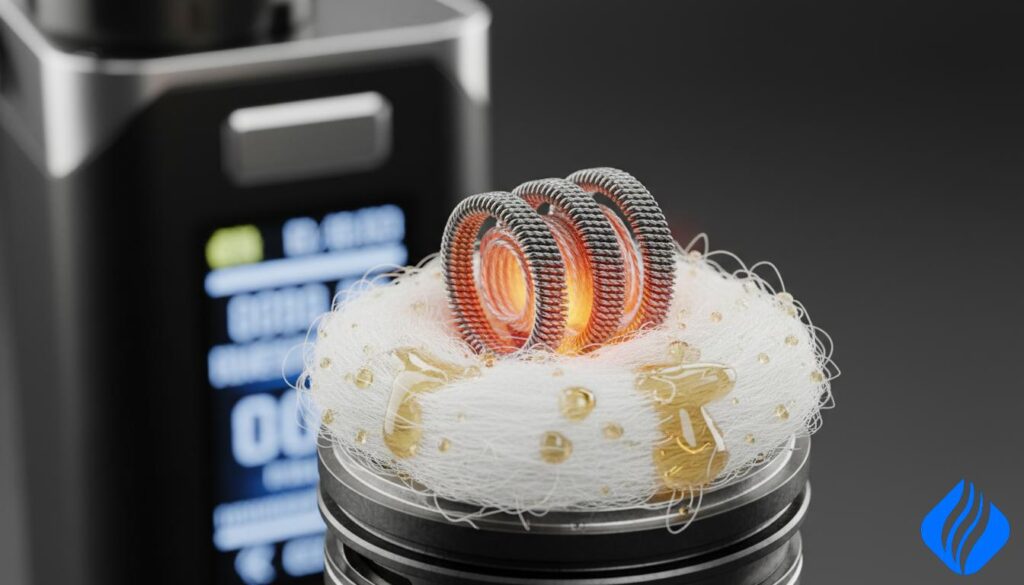
The heart of the atomizer: A macro view showing how the resistance coil generates heat to vaporize e-liquid absorbed by the cotton wick. This creates the flavor and throat hit.
Heating, resistance, and power
Electric energy from the battery passes through the coil. The coil’s resistance converts power into heating. Lower resistance draws more current and raises heat demand on the wick.
Airflow, chimney, and mouthpiece
Air moves over the hot coil, picks up vapor, and follows the chimney to the mouthpiece. Tighter airflow gives warmer, denser flavor. Open airflow cools the vapor and raises cloud volume.
Preventing dry hits and coil damage
Dry hits happen when the wick can’t supply liquid fast enough. Causes include low saturation, chain puffs, or power that exceeds wicking speed. To prevent this:
Prime new coils and let cotton soak before use.
Start at conservative power and increase slowly after flavor stabilizes.
Watch for flavor drop or harsher pulls—replace coils or refill tanks promptly.
These same physics apply to disposables and tanks. Even sealed units suffer when liquid runs low. Understanding the cycle helps you maintain performance and avoid burnt taste.
Key components of a vape atomizer you should understand before buying
We break components down so buyers judge parts, not marketing. Focus on elements that affect flavor, leaks, and coil life.
Coils and coil builds
Resistance coil refers to the electrical resistance that controls heat. Lower resistance heats faster and gives warmer hits. Higher resistance runs cooler and saves e-liquid.
Single vs multi-coil matters: singles heat more slowly but use less power. Dual or mesh builds increase vapor and speed up ramp-up.
Tanks and reservoirs
Choose a clear tank or visible reservoir so you can watch liquid level. A visible tank reduces accidental dry firing and extends coil life.
Capacity matters for convenience. Larger tanks mean fewer refills and steadier saturation during long sessions.
Seals and O-rings
Inspect O-rings at the base, top cap, and coil junction. Worn seals show seepage, loose fit, or leaking at joints.
“Small leaks usually point to a seal fault—not bad liquid.”
Replacing seals is cheap. Good seals deliver clear benefits: fewer leaks, steadier flavor, and longer coil lifespan—helping buyers make a confident choice.
Buyer’s tip: prefer clear tanks and replaceable O-rings for easier upkeep.
Types of atomizers and systems: disposable vapes, clearomizers, RTAs, and RDAs
We outline the main system categories so readers can match a setup to their daily routine.
Quick guide: systems split into sealed, serviceable, and rebuildable options. Each category changes hands-on time, flavor control, and ongoing cost.
Disposable integrated systems
Convenience-first: prefilled, no coil swaps, and minimal maintenance. Ideal for users who want consistent use with zero setup.
Drawback: limited tuning and fixed lifespan. We will test disposables in Section 6 for value and consistency.
Clearomizers (replaceable coil heads)
Everyday balance: visible tank, swappable coil heads, and straightforward upkeep. Good for users who want moderate control without building.
Rebuildable tank atomizers (RTAs)
Customization and savings: users build coils and wick cotton to tune flavor and airflow. Higher skill needed, but lower long-term consumable cost.
Rebuildable dripping atomizers (RDAs)
Performance-first: direct dripping delivers intense flavor and dense vapor. Requires frequent refills and hands-on skill.
Cartomizers
Cartridge + atomizer: often use filler material to hold liquid. Delivery differs because filler affects saturation and maintenance. Dry-burning filler can ruin it.
Selection heuristic: pick convenience for low effort, serviceable tanks for balance, or rebuildables for control and long-term savings.
Key tradeoffs: convenience vs control vs cost over time.
Practical tip: start with clearomizers if unsure; move to RTAs or RDAs as skill grows.
Next: Section 6 will run hands-on tests, comparing disposable systems across brands for puffs per dollar and flavor consistency.
Hands-on testing and real-world comparison: puffs per dollar and flavor consistency
Our lab-style protocol measures real-world puffs per dollar and flavor drift under steady use. We test a disposable product with an integrated mesh coil, USB-C charging, and nicotine salts options to represent current market designs.
Main test rig and key spec fields
We record these fields for every unit:
battery mAh
e-liquid ml
nicotine strength (2% vs 5%)
coil type (mesh vs dual mesh)
charging port (USB-C)
Estimating Puffs per Dollar
Advertised puff counts mislead. We divide price by usable puffs before flavor collapse. Then we adjust for battery capacity and recharge cycles. That gives a practical Puffs per Dollar metric readers can use to compare products.
Flavor, throat hit, and vapor notes at ~5000 puffs
After extended use top notes fade first. Sweetness flattens and harshness can appear when wicking lags. Mesh designs usually retain denser flavor longer. Dual-mesh may boost vapor but speed flavor fatigue.
Competitor matchups
Geek Bar vs our main product: Geek Bar often wins on initial cloud output. Our product holds flavor longer when mAh and ml are balanced, so Puffs per Dollar can favor either brand depending on price and recharge behavior.
Lost Mary / Raz vs our main product: these rivals typically show steadier long-run profiles. They sometimes keep flavor recognizable deeper into device life, especially with visible e-liquid levels that reduce dry-hit risk.
Test note: Our fair-use cadence, realistic recharges, and flavor checkpoints produce usable comparisons rather than idealized puff counts.
How to use, maintain, and troubleshoot an atomizer without ruining coils
We present concise care steps and a quick troubleshooting flow so users keep flavor and avoid wasted parts. Short checks prevent most failures and keep devices safe.
Quick troubleshooting flow
Burnt taste, weak vapor, gurgling, or tight draw point to common faults. Check these in order:
Wick saturation — refill tanks or top a reservoir.
Airflow — clear blockages at the mouthpiece or vents.
Coil age — replace when flavor stays muted.
Seals — worn O-rings cause leaks and gurgle.
FAQs: empty, recharging, authenticity
How to know it’s empty? Look for a flavor drop, harsher pull, a higher-pitched airflow sound, reduced cloud, or a low visible reservoir.
How to recharge safely? Use a trusted USB-C charger, avoid soft surfaces, stop if the device heats unusually, and don’t leave charging unattended.
Is it authentic? Verify the unit by scanning the QR code and checking on sokvape.com. For repair tips and common issues see our common fixes.
Cleaning and selection tips
Rinse rebuildable parts in warm water after removing cotton and dry fully before re-wicking. Change a resistance coil when burnt taste persists after correct priming or when residue darkens.
Choose tight airflow for MTL cigarette-style inhalation. Pick wider flow for direct lung draws and bigger clouds.
Note: These products are not risk-free; nicotine dependence is real. Adults switching from a cigarette should match strength and draw to avoid overuse.
Conclusion
Performance comes down to the piece that converts e-liquid into throat feel and vapor.
Choose a device type based on control, upkeep, and inhale style: disposables for ease, clearomizers for balance, and rebuildables for customization and long-term savings.
Compare by two practical metrics:Puffs per Dollar for value, and Flavor Consistency for real-world performance after extended use.
Coil design, wick quality, and airflow tuning remain the primary levers that change the user experience. Match power and pacing to saturation to avoid dry hits and premature coil failure.
For further research see our vetted categories: Disposable Vapes, Hot Sale, RandM, and Bang for spec comparisons and shopping checks.
Nicotine warning: This article is for adults 21+ (United States). Many products contain nicotine, an addictive chemical. Keep away from children and pets and consult a healthcare professional if pregnant, nursing, or with heart or respiratory conditions.
FAQ
Q: Learn About What is Atomizer in Vape Technology
A: We explain the component that converts e-liquid into vapor, its role in flavor and throat hit, and why understanding coil types, wick materials, and airflow matters for performance.
Q: what is atomizer in vape and why it matters for flavor and vapor production
A: The atomizer is the system that turns liquid into inhalable vapor. It directly affects throat hit, vapor density, and flavor clarity through coil resistance, wick saturation, and airflow design.
Q: Atomizer definition in vaping: the system that turns e-liquid into inhalable vapor
A: The atomizer combines a heating element (coil), wick, and chamber. When the battery supplies power, the coil heats the wick-soaked e-liquid and produces aerosol for inhalation.
Q: Why your atomizer impacts throat hit, vapor density, and flavor clarity
A: Coil resistance, surface area (mesh vs round wire), and wick material control how fast liquid vaporizes. Airflow and chimney length tune vapor temperature, so small design changes change perceived strength and taste.
Q: Atomizer vs “the whole vape”: how disposables, pods, and tanks all rely on atomization
A: Disposables, pods, and tank systems differ in integration and serviceability but all use a coil-and-wick arrangement or mesh insert to atomize liquid. Choice affects cost, maintenance, and customization.
Q: How a vape atomizer works inside your device
A: E-liquid moves from the reservoir to the wick, the coil heats the wick, and vapor travels through the chimney and mouthpiece. Proper wicking, adequate power, and consistent airflow keep performance stable.
Q: E-liquid absorption: wick materials like cotton moving liquid to the coil
A: Organic cotton and alternative fibers draw liquid via capillary action. Good wicking prevents dry hits; poor wick choice or packing speed limits saturation and causes burnt taste.
Q: Heating and resistance: how the coil converts battery power into heat
A: The coil’s resistance (ohms) determines current draw at a given wattage. Lower resistance and larger surface area give faster, warmer vapor; higher resistance suits mouth-to-lung draws and lower battery drain.
Q: Airflow, chimney, and mouthpiece: how vapor travels from chamber to inhale
A: Adjustable airflow changes draw tightness and cooling. The chimney guides vapor and influences throat hit. Mouthpiece shape alters delivery and condensation behavior.
Q: Preventing dry hits: wicking balance, saturation, and power settings
A: Maintain correct coil-wick contact, use appropriate wattage ranges, and keep reservoir filled. Let new coils prime before use and avoid excessive power that outpaces wicking.
Q: Key components of a vape atomizer you should understand before buying
A: Learn coil types, tank capacity and visibility, seals, and how those parts affect leakage, lifespan, and flavor. These determine maintenance needs and compatibility with your device.
Q: Coils and coil builds: resistance coil basics and common configurations
A: Coils come as single, dual, mesh, and Clapton styles. Mesh offers large surface area and consistent heating. Builders choose resistance and wrap type to tune vape temperature and ramp-up time.
Q: Tanks and reservoirs: capacity, visibility, and why clear designs reduce burnt hits
A: Transparent tanks let you monitor liquid level to avoid dry hits. Larger capacity reduces refill frequency; smaller tanks increase the chance of running low and stressing the wick.
Q: Seals and O-rings: leak prevention and maintenance checkpoints
A: Proper seals prevent leaks and pressure loss. Inspect O-rings for wear during refills and replace them if torn to maintain performance and avoid e-liquid loss.
Q: Types of atomizers and systems: disposable vapes, clearomizers, RTAs, and RDAs
A: Systems range from integrated disposable units to rebuildable setups. Each offers trade-offs between convenience, cost, flavor fidelity, and customization.
Q: Disposable vape “integrated atomizer” systems: convenience with prefilled e-liquid
A: Integrated units come prefilled with e-liquid and a built-in coil. They require no maintenance and provide predictable performance but lack rebuild options and may cost more long term.
Q: Clearomizers: swappable coil heads, visible tank, and everyday ease
A: Clearomizers use replaceable coil heads and a visible tank. They balance convenience and cost, letting users swap coils without rebuilding while monitoring liquid level.
Q: Rebuildable tank atomizers: customization, savings, and hobby appeal
A: RTAs let experienced users build coils and wick manually. They offer tailored flavor and cost savings over time but require skill and regular maintenance.
Q: Rebuildable dripping atomizers: direct dripping for intense flavor and vapor
A: RDAs discard tanks and require manual dripping of e-liquid onto the coil. They deliver peak flavor and cloud performance but need frequent refilling and handling.
Q: Cartomizers explained: cartridge + atomizer design and how delivery differs
A: Cartomizers combine a liquid-holding cartridge with an atomizer. They provide a hybrid between cartridges and tanks and vary in draw and leakage risk.
Q: Hands-on testing and real-world comparison: puffs per dollar and flavor consistency
A: Evaluate devices by battery capacity (mAh), e-liquid ml, nicotine strength, coil type (mesh vs dual mesh), and charging (USB-C). These metrics predict cost efficiency and longevity.
Q: Main product test rig: disposable vape with integrated mesh coil, USB-C charging, and nic salt options
A: Test rigs should include devices with mesh coils for even heating, USB-C for rapid charging, and nic salt formulations to represent typical user experience across strengths.
Q: Core technical data to compare across devices: mAh, e-liquid ml, 2% vs 5% nic salt, mesh vs dual mesh, USB-C
A: Compare battery capacity, reservoir volume, nicotine concentration, coil architecture, and charging standard. These values drive puffs-per-dollar and consistency metrics.
Q: Puffs per Dollar: how to estimate value from capacity, battery, and advertised puff count
A: Divide estimated usable puffs by retail price. Adjust for real-world variables like flavor decline and battery degradation to get practical value comparisons.
Q: Flavor Consistency after 5000 puffs: what changes first and how coil style affects it
A: Taste tends to dull as coils accumulate residue. Mesh coils usually preserve flavor longer; round-wire builds may clog sooner and need replacement.
Q: Throat hit and vapor production notes: smooth vs strong hit and cloud output across styles
A: MTL setups and higher-resistance coils give tighter draws and stronger throat hit. DTL and low-resistance mesh yield larger clouds and smoother inhale.
Q: Competitor matchup: Geek Bar vs the main product on consistency and cost efficiency
A: Compare puff count, coil style, battery specs, and price. Geek Bar and similar brands vary by mesh implementation and nic salt formulation, affecting long-term consistency and cost.
Q: Competitor matchup: Lost Mary or Raz vs the main product for long-run flavor stability
A: Evaluate coil architecture and e-liquid formulation. Some brands use advanced mesh or higher-quality wick materials that sustain flavor longer under heavy use.
Q: Where to shop internally: link to Disposable Vapes, Hot Sale, RandM, and Bang
A: We list retail categories for quick navigation: Disposable Vapes, Hot Sale, RandM, and Bang. Check product pages for technical specs before purchase.
Q: How to use, maintain, and troubleshoot an atomizer without ruining coils
A: Prime new coils, use recommended wattage ranges, keep tanks topped, and clean or replace wicks regularly. Monitor flavor and airflow to catch issues early.
Q: How to know if it’s empty: signs from flavor drop, airflow sound, and visible reservoir level
A: A sudden flavor drop, airy or muted draw, and low visible liquid indicate the reservoir needs refilling or the coil is drying out.
Q: How to recharge safely: USB-C basics, charge timing, and avoiding overheating
A: Use the supplied cable and a compatible charger. Avoid charging unattended, and stop if the device becomes hot. Follow manufacturer charging recommendations.
Q: Is it authentic: verifying via QR code check on sokvape.com
A: Check device authenticity by scanning the QR code and verifying serial numbers on the manufacturer portal. Authentic products list batch and safety data.
Q: Cleaning and upkeep: rinsing, replacing cotton, and when to change the resistance coil
A: Rinse tanks with warm water, replace cotton when flavor degrades, and change coils when taste becomes burnt or vapor output falls. Regular maintenance extends device life.
Q: Choosing the right atomizer for your inhale style: MTL vs direct lung and airflow setup
A: Match atomizer type to your inhale preference: MTL and higher-resistance coils for cigarette-like draws; DTL and low-resistance mesh for larger clouds. Adjust airflow to fine-tune draw tightness.



 English
  German
  Dutch
Dutch  Danish
  Czech
Czech  Italian
  Slovenian
  French
  Hungarian
  Spanish
  Polish