who owns logic vapes is a common search for adults checking product trust. We start with a clear answer and verifiable context. The brand was founded in 2010 and later became part of the JT Group after an acquisition announced by Japan Tobacco Inc.
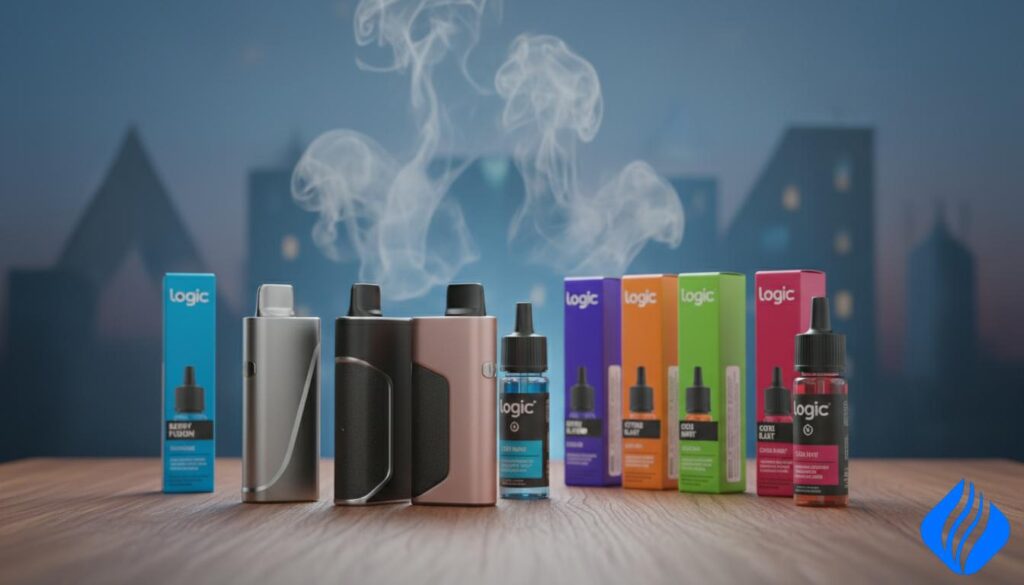
The Logic Vapes product family. In this guide, we answer “who owns Logic Vapes” (Japan Tobacco Inc.) and benchmark these devices against competitors like Geek Bar and Lost Mary.
We will present a core technical data checklist up front: battery mAh, e-liquid ml, nicotine strengths (2%/5% nic salt), coil type (mesh vs dual mesh), and USB‑C charging. Next, we benchmark against Geek Bar, Lost Mary, and Raz using Puffs per Dollar and Flavor Consistency.
Our review previews hands-on testing on throat hit, vapor output, and draw feel. We explain changes after 5,000 puffs, ways to reduce flavor drop-off, and give practical information readers need today. A User FAQ and a US-only nicotine warning + 21+ age note follow.
We answer the ownership question plainly and back it with corporate records and regulatory context.
Expect a technical checklist for device specs and performance benchmarks.
We compare Puffs per Dollar and Flavor Consistency versus mainstream competitors.
Hands-on notes cover throat hit, vapor output, and longevity after 5,000 puffs.
Practical guidance includes USB‑C charging safety, QR authenticity checks, and the 21+ nicotine warning for US readers.
Who owns Logic Vapes today? The ownership story behind Logic Technology Development
This passage outlines the timeline and business terms behind the 2015 acquisition by Japan Tobacco.
Origins in Florida and early company details
Logic Technology Development LLC was founded in 2010 and was headquartered in Pompano Beach, Florida. The operating company built a U.S. retail and online presence selling e‑cigarette products. Co‑founders Eli Alelov (CEO) and Howard Panes were listed as company representatives during its formative year.
2015 acquisition agreement and timelines
On April 30, 2015, Japan Tobacco announced it had entered into an agreement to acquire technology development llc known as Logic Technology Development LLC. The deal was expected to close in Q3 FY2015 after regulatory clearance. JT said the purchase would be funded from existing cash and loan facilities and would have a minor effect on FY2015 performance.
Placement inside the JT Group and JTI role
Japan Tobacco International (JTI) framed the acquisition as a way to gain a sizeable share of the U.S. e‑cigarette market. Masamichi Terabatake noted the brand delivered strategic participation for the broader tobacco international group. In practice, the operating entity stayed as the consumer‑facing company under the JT umbrella.
Leadership continuity and consumer impact
“Logic’s executive management team would remain with the JT Group post-acquisition.”
That continuity signaled stability for distribution, compliance, and product stewardship in the U.S. The preserved management team brought category experience and helped ensure the transition focused on regulatory alignment rather than abrupt product changes.
Operating entity: Logic Technology Development LLC.
Acquisition announced: April 30, 2015; expected close Q3 FY2015.
Parent group: Japan Tobacco / Japan Tobacco International.
Consumer outcome: continuity in U.S. sales and compliance posture.
Why the acquisition mattered in the U.S. vape market and regulatory landscape
We view the acquisition as a turning point for product availability and compliance in the U.S. e‑cigarette market. Japan Tobacco brought capital and structured compliance systems. That combination can change which products survive scrutiny and keep retail shelf space.
How JT positioned the brand in a fast-growing category
JT and JTI framed the purchase as a route to gain market share in a fast-growing segment. The parent company operates across many countries, which can supply compliance resources and long-horizon strategy for product rollouts.
FDA authorization: what consumers need to know
The FDA cleared several tobacco-flavored ENDS under the Logic Vapeleaf, Logic Power, and Logic Pro families. Approval focused on the potential for adult smokers to reduce use of cigarettes, provided strict postmarketing steps limit youth exposure.
Authorized products: specific tobacco-flavored devices and related products.
Denied products: multiple SKUs received marketing denial orders and must be removed.
Consumer impact: authorization is product-specific, not a blanket brand approval.
Category
Authorized
Denied
Key controls
Brands
Logic Vapeleaf / Power / Pro
Other ENDS SKUs
Postmarketing reporting; youth access limits
Rationale
Likely adult benefit vs youth risk
Insufficient evidence of benefit or risk mitigation
Restricted marketing and retail checks
Availability
Can be sold with conditions
Must be removed from market
Enforcement by FDA and retailers
For ongoing regulatory updates and regional briefing information, we reference regulatory summaries and reporting such as the regulatory briefings. This helps retailers and adult consumers understand what is legally available today.
Logic devices and performance context vs. competitors (Geek Bar, Lost Mary, Raz)
Practical device specs matter most when you choose between tank, rechargeable, or single-use formats. We define shopper-facing categories, then give a compact technical checklist you can use on any product listing.
Core technical data checklist
Battery capacity (mAh)
E-liquid volume (ml)
Nicotine strength — 2% or 5% nic salt
Coil type — Mesh coil vs Dual mesh
Charging port — USB‑C vs older ports
Formats and where Pro fits
Logic historically offered disposables, rechargeables, and a tank-style system called Logic Pro. The Pro model targets users wanting refillable control and replaceable coils.
Performance, hands-on testing, and flavor life
We rate throat hit as smooth for 2% nic salt and stronger for 5%. Vapor output labels: low, medium, high. Draw feel maps to MTL (tight) or looser pulls.
After ~5000 puffs, sweet top notes and cooling often fade first. To reduce drop-off: avoid chain vaping, pause between draws, and allow the wick to re-saturate.
Puffs per dollar and coil airflow notes
Use advertised puff count ÷ retail price for a simple Puffs per Dollar metric. Against Geek Bar and Lost Mary, many rechargeable and pro-style offerings show better long-term value when coils are replaceable.
Mesh coils heat evenly and preserve flavor ramp-up. Dual mesh boosts vapor density but increases e-liquid use and may shorten flavor life.
User FAQ
How to tell it’s empty: flavor fade, marked vapor reduction, or device LEDs/blink patterns.
Safe USB‑C charging: use a low-power adapter, charge on a non-flammable surface, stop if the device heats excessively.
Verify authenticity: check packaging QR codes and buy from trusted retailers; verify codes using the label or QR portal and source pages such as Disposable Vapes.
Compare formats and prices via these navigation links: Hot Sale, RandM, Bang.
These are nicotine products intended for adults 21+ in the United States. Store securely and keep out of reach of youth.
Conclusion
Japan Tobacco completed the purchase of Logic Technology Development LLC, placing the brand inside the JT Group. ,
For consumers this means a recognizable parent company, but a product-by-product regulatory reality: certain tobacco-flavored Logic ENDS received FDA authorization while other products did not. Verify the exact product before purchase.
Before you buy: confirm listing details for battery mAh, e-liquid ml, nicotine strength (2% or 5%), coil type (mesh vs dual mesh), and USB‑C charging. Compare expected Puffs per Dollar and flavor stability versus Geek Bar, Lost Mary, or Raz.
Buy from trusted retailers. Check packaging and QR codes for authenticity. Use safe charging practices to reduce overheating risk.
This product contains nicotine. Nicotine is an addictive chemical. For adults 21+ only. Keep out of reach of children and pets.
FAQ
Q: Who owns Logic Vapes? Insights into the brand’s ownership
A: Logic Technology Development LLC originated in Florida and operated as the U.S. developer for the Logic brand. In a later transaction, Japan Tobacco Inc. (JTI) acquired the business interests tied to the Logic product line, integrating the brand into the Japan Tobacco Group. Today, JTI and Japan Tobacco International manage global strategy while the original U.S. operations continue to support product availability and regulatory compliance.
Q: Logic Technology Development LLC origins, founding year, and Florida roots
A: Logic Technology Development LLC began as a Florida-based company focused on electronic nicotine delivery systems. The firm built early product design, distribution relationships, and U.S. market presence prior to the acquisition. Exact founding dates and registration details are available through state business records and regulatory filings for those seeking formal verification.
Q: What did the Japan Tobacco Inc. acquisition agreement mean for the Logic brand?
A: The acquisition transferred brand stewardship and global commercialization to Japan Tobacco while retaining local teams and supply chains where practical. For consumers, the change meant expanded distribution, greater regulatory resources, and access to JTI’s manufacturing and quality-control frameworks.
Q: What role does Japan Tobacco International play and how does Logic fit into the JT Group?
A: Japan Tobacco International oversees international tobacco and nicotine product portfolios. Logic fits into JTI’s harm-reduction and NEXT product strategies as a consumer-focused ENDS brand, aligned with their broader portfolio management, regulatory submissions, and cross-border distribution capabilities.
Q: What stayed the same after the deal: leadership and brand continuity in the U.S.?
A: Post-transaction, product line names, packaging conventions, and many customer support functions remained recognizable. Operational teams in the U.S. sustained continuity for retail and distribution. Strategic oversight migrated to JTI, while local staff often continued day-to-day brand support.
Q: Why did this acquisition matter in the U.S. vape market and regulatory landscape?
A: The deal mattered because it placed Logic under a company with extensive regulatory experience and resources. That improved the brand’s ability to engage with the FDA, manage compliance for ENDS products, and support product authorizations and market continuity in a turbulent policy environment.
Q: How did JTI position Logic in the fast-growing U.S. e-cigarette category?
A: JTI positioned the brand as a mainstream, convenience-channel product with emphasis on consistent performance, retail availability, and responsible marketing. Strategy focused on nicotine-salt formulations, disposable and rechargeable formats, and meeting adult consumer preferences for throat hit and simplicity.
Q: Which Logic tobacco-flavored ENDS products received FDA authorization and why does that matter?
A: Specific tobacco-flavored ENDS products were submitted under Premarket Tobacco Product Applications (PMTAs) and received FDA marketing orders based on demonstrated population-level benefits relative to risks. FDA authorization signals regulatory review of ingredients, manufacturing controls, and potential public-health impacts. For current authorization status, consult the FDA’s public PMTA database.
Q: What core technical data do consumers shop for in Logic products?
A: Shoppers typically compare: battery capacity (mAh), e-liquid volume (mL), nicotine strength (mg/mL or %), coil type (mesh/dual mesh), airflow design (MTL/DTL), device format (disposable/rechargeable/tank), and charging port (USB‑C vs micro‑USB). These specs determine runtime, throat hit, vapor production, and refillability.
Q: How do disposable, rechargeable, and tank-style systems differ and where does Logic Pro fit?
A: Disposables are single-use and prefilled. Rechargeable devices reuse batteries with replaceable pods or cartridges. Tank systems offer refilling and coil swaps for advanced users. Logic Pro targets users who want rechargeable convenience with replaceable pods—bridging disposables’ ease and tanks’ longevity.
Q: What battery capacity, e-liquid volume, nicotine strength, coil type, and charging port should I expect by format?
A: Expect disposables to range 300–700 mAh with 2–20 mL prefilled fluid; rechargeables often 500–2000 mAh with 2–8 mL pods; tanks vary widely. Nicotine salts commonly range 20–50 mg/mL (2–5%). Mesh coils dominate for even heating; dual mesh increases surface area and consistency. USB‑C is now the preferred charging port for faster, safer charging.
Q: What did hands-on testing reveal about throat hit, vapor output, and draw feel across nicotine strengths?
A: Higher nicotine salts (30–50 mg/mL) deliver stronger throat hit with low-power setups, suitable for mouth-to-lung draws. Lower strengths provide smoother draws and larger clouds on direct-lung hardware. Mesh coils produce consistent vapor and flavor; airflow tuning alters throat sensation and draw resistance.
Q: How does flavor consistency change after 5,000 puffs and how can I reduce flavor drop-off?
A: Flavor fade typically begins as coil deposits accumulate and wick condition declines. After extended use, sweet or complex notes decline first. Reduce fade by using appropriate nicotine strength, avoiding chain puffing, keeping pods sufficiently filled, and replacing coils or pods per manufacturer guidance.
Q: How do puffs-per-dollar benchmarks compare between Logic, Geek Bar, Lost Mary, and Raz?
A: Puffs-per-dollar depends on device capacity and retail price. Generally, high-capacity disposables offer better puffs per dollar, while premium rechargeable systems reduce long-term cost per puff through refillable pods. Compare e-liquid volume and listed puff estimates against current retail pricing for accurate benchmarks.
Q: How do coil and airflow choices impact consistency: mesh coil vs. dual mesh?
A: Mesh coils heat evenly for steady flavor and durable performance. Dual mesh increases contact area, improving vapor production and longevity at similar wattages. Airflow design modulates draw restrictiveness: tighter airflow favors MTL consistency; wider airflow supports DTL vapor volume.
Q: How can I know if a device is empty without guessing?
A: Indicators include sudden flavor mutedness, reduced vapor, or a burning taste. Some devices show LED or pod-transparent windows to inspect remaining e-liquid. Track puff counts or refill/replace pods at manufacturer‑recommended intervals to avoid dry hits.
Q: How do I recharge USB-C devices safely, and what are recommended charging times and power sources?
A: Use the supplied cable or a certified USB‑C cable and a reputable charger (5V, 1–2A typical). Avoid high-output fast chargers unless device specs allow. Charging times vary by battery capacity—small pods may recharge in 30–60 minutes; larger batteries up to 2 hours. Stop charging if device becomes hot and store at moderate temperatures.
Q: How do I verify a device is authentic?
A: Check QR or security codes on packaging and verify through the brand’s official authentication portal. Purchase from authorized retailers or manufacturer webstores. Inspect packaging quality, serial numbers, and batch codes; counterfeit products often show mismatched fonts, poor seals, or missing regulatory labeling.
Q: Where can I shop for related alternatives and product categories?
A: Look for reputable retailers and category pages such as Disposable Vapes, Hot Sale, RandM, and Sokvape merchants. Confirm seller authorization and review return policies. For brand-specific availability, consult official Japan Tobacco International distribution information.
Q: Is there a nicotine warning and age restriction note for U.S. readers?
A: Yes. Products contain nicotine, a highly addictive chemical. Sale and use are restricted to adults 21+ in the United States. Follow all local laws, and keep products away from children, pregnant people, and non‑smokers. For cessation help, consult healthcare professionals.



 English
  German
  Dutch
Dutch  Danish
  Czech
Czech  Italian
  Slovenian
  French
  Hungarian
  Spanish
  Polish