

how many vape hits is a cigarette frames the exact question we answer with data, testing, and industry context.
We set expectations up front: we will translate puff counts into useful measures and compare nicotine delivery. Our baseline: 10–15 puffs per cigarette and about 1–2 mg nicotine absorbed per cigarette. These anchors guide our analysis.
We explain two comparison frames we use throughout: puff-count equivalence and nicotine-delivery equivalence. Both matter because device design, coil type, and nicotine salt strength change the real-world experience.
Our audience is U.S. adults (21+) seeking practical advice to manage cravings and avoid accidental overuse. We preview hands-on testing on throat hit, vapor output, and flavor stability over long use.
Later sections include device specs (mAh, ml, nic salt %, mesh vs dual mesh, USB‑C), brand comparisons (Geek Bar, Lost Mary, Raz), and value metrics like Puffs per Dollar.
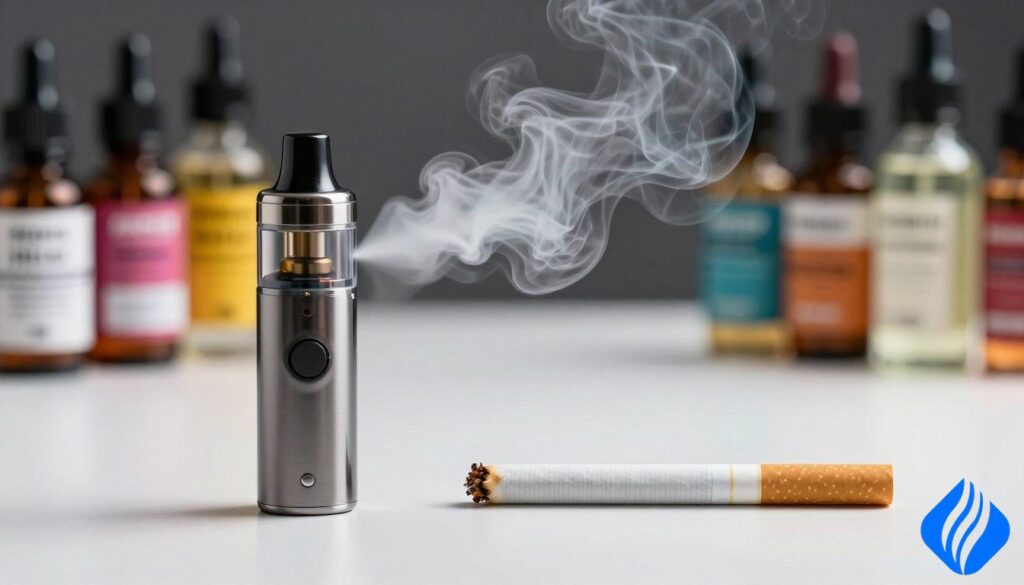
Understanding the difference between a single cigarette and vape hits starts with comparing how nicotine is delivered and absorbed.Key Takeaways
- We use 10–15 puffs and 1–2 mg nicotine as baseline comparison points.
- Two frames guide analysis: puff-count and nicotine-delivery equivalence.
- Device efficiency, coil type, and nicotine strength change perceived strength.
- Target readers are U.S. adults (21+) seeking data-driven guidance.
- Hands-on tests and brand comparisons will follow with transparent ranges and calculators.
Why “Vape Hits vs. a Cigarette” Isn’t a Perfect One-to-One Comparison
Direct numeric comparisons between smoking and inhaled e-liquid often miss key biological and mechanical differences.
10–15 puffs per cigarette is a behavioral average. It describes how many draws many smokers take during one cigarette, not the chemical delivery to the body.
Average puff counts: what 10–15 puffs represents
The number varies by cigarette length, filter ventilation, burn time between draws, and whether the smoker takes short drags or long pulls.
Simple puff tallies do not account for inhalation depth or pause between puffs. Those change dose and perception.
Nicotine absorption basics
Differentiate nicotine content (what’s in the product) from nicotine absorbed (what reaches the bloodstream). The latter predicts cravings and effects.
“Most smokers absorb about 1–2 mg of nicotine per cigarette, despite higher raw nicotine content.”
Absorption differs between smoke and aerosol because of chemistry, particle size, and inhalation pattern. Two users can take the same number of puffs yet absorb different nicotine amounts depending on device power and e-liquid formulation.
Next, we give equivalence ranges by nicotine strength and show how puff duration changes the math.
| Metric | Typical Range | Why it matters |
|---|---|---|
| Behavioral puffs per one cigarette | 10–15 puffs | General user pattern; not chemical dose |
| Nicotine content (per product) | Varies widely | Raw amount present before delivery losses |
| Nicotine absorbed per one cigarette | ~1–2 mg | Best benchmark for cravings and effect |
how many vape hits is a cigarette Based on Nicotine Strength and Puff Style
Matching ritual and chemical dose requires two different rules of thumb. We separate behavioral replacement from true nicotine delivery so readers can choose the right approach.
Quick equivalence rule
(A) Match puff count (start with 10–15 draws) to replace the ritual. (B) Match nicotine delivery to control cravings — this depends on mg/ml, nic salts, and device output.
Nicotine-equivalence estimates (ranges)
| Strength (mg/ml) | Estimated puffs per cigarette-equivalent | Notes |
|---|---|---|
| 3 | ~60+ | Low-output devices need many draws |
| 6 | ~40–60 | Light satisfaction unless pull is long |
| 12 | ~25–40 | Common middle ground |
| 18 | ~15–25 | Closer to one-cigarette dose |
| 20 (2%) | ~12–20 | Often smoother with nic salt |
| 50 (5%) | ~10–15 | Most cigarette-like nicotine hit |
Nic salts vs freebase & pull duration
Nicotine salts let manufacturers offer higher concentrations with less throat bite. That leads to faster perceived nicotine delivery and often fewer draws to match cravings.
Longer pulls increase aerosol per draw. A 4–6 second pull can deliver much more nicotine than a brief 2–3 second drag, so adjust counts accordingly.
“Vapes can deliver ~0.5–7.5 mg over 10–15 puffs depending on strength and device.”
Practical takeaway: choose MTL devices and higher mg/ml (often nic salts) to mimic smoking. Monitor for overconsumption and step down if needed.
How to Estimate Your Daily Nicotine Intake When Switching From Smoking to Vaping
Start by converting your daily cigarette count into a practical puff range you can track. Multiply your usual cigarettes per day by 10–15 to get a behavioral puff range. For example, 10/day ≈ 100–150 puffs per day as a ritual baseline.
Two practical methods
Behavioral: cigarettes per day × 10–15 = puff range to match ritual.
Chemical: estimate absorbed nicotine (cigarettes per day × ~1–2 mg) and choose a setup that delivers similar daily intake without chain-puffing.
Heavy vs. light smokers
- Light (1–5/day): start lower (3–6 mg/ml freebase or low nic salt).
- Moderate: commonly 6–12 mg/ml or ~2% nic salt in tight-draw devices.
- Heavy (pack/day+): may need 18–20 mg/ml or 5% nic salt early, then step down.
Signs you need to adjust
Too high: nausea, headache, racing heart, strong lightheadedness, or harsh throat irritation.
Too low: persistent cravings, irritability, constant top-offs, or compulsive puffing.
“Change one variable at a time — nicotine strength, airflow, or puff duration — to find the right intake without overshooting.”
For step-by-step tools and calculators, see our daily conversion guide. We cover device specs and testing later to refine these estimates.
How Much Vape Juice Equals a Pack of Cigarettes?
Estimating how much e-liquid equals twenty cigarettes requires two benchmarks: a behavioral puff-count and an absorbed-nicotine benchmark.
Define the pack: We mean 20 cigarettes per pack. We compare both puffs and absorbed nicotine rather than product label content alone. That gives a realistic match for ritual and chemical dose.
Puff-count benchmark
1 ml ≈ 200–300 puffs on many disposables and refill cartridges. That means 1 ml can roughly equal a pack’s worth of draws for many users, depending on pull length and device type.
Nicotine-content benchmark
Smokers absorb about 22–36 mg nicotine per pack. A 5% (50 mg/ml) e-liquid contains 50 mg per ml. With ~50–60% vaporization efficiency, one ml can deliver roughly 25–30 mg inhaled—close to pack absorption.
ml needed per pack (common strengths)
- 6 mg/ml: 4–6 ml
- 12 mg/ml: 2–3 ml
- 18 mg/ml: 1.5–2 ml
- 20 mg/ml: 1–2 ml
- 50 mg/ml (5%): 0.5–1 ml
| Benchmark | Typical value | Why it matters |
|---|---|---|
| Puffs per 1 ml | ~200–300 | Behavioral ritual estimate |
| Pack nicotine absorbed | ~22–36 mg | Chemical dose to match cravings |
| 1 ml at 50 mg/ml inhaled | ~25–30 mg | Close to pack absorption |
“Device efficiency, puff duration, and MTL vs DTL style drive the ranges above.”
Why ranges swing: coil efficiency, airflow, and user pull length change both puffs and amount nicotine delivered. Monitor ml/day, not just puff count, when using high-strength nic salts to avoid unintentional overconsumption.
Next: With this ml-to-pack math in hand, converting high-puff disposables into pack equivalents becomes straightforward and practical.
High-Puff Disposable Vapes: Converting 500, 1000, 2000, and 4000+ Puffs Into Cigarette Equivalents
When a device promises 2,000–4,000+ draws, users need a fast way to estimate real-world parity.
Use a simple calculator method. Estimate cigarette equivalents ≈ total puffs ÷ (10–15). This gives a practical range and keeps expectations realistic.
Quick notes before converting
- Label limits: “max puffs” assumes short, gentle draws. Longer pulls lower the total count.
- Nicotine effect: nic salt 2% or 5% in an MTL device will match perceived strength more closely.
- Check ml used: track e-liquid consumed to avoid unintended excess.
Pack and cigarette equivalents (estimate)
| Puffs | Cigarette range | Pack range |
|---|---|---|
| 500 | ~30–50 | ~1.5–2.5 packs |
| 1000 | ~50–100 | ~2.5–5 packs |
| 2000 | ~100–200 | ~5–10 packs |
| 4000+ | ~300–400 | ~15–20 packs |
“Divide total puffs by 10–15 for a fast, conservative estimate; adjust for device style and nicotine strength.”
These are estimates. Device power, coil design, and puff length change actual nicotine delivery. For a detailed calculator and tools, see our conversion guide on puff-to-cigarette conversion.
Hands-On Testing: Device Specs That Change Throat Hit, Vapor Production, and Flavor Consistency
To predict real-world performance, we isolated five technical variables and measured their effects across controlled runs. We focus on clear, repeatable metrics so readers can compare devices objectively.
Core spec checklist we use for every unit:
- Battery capacity (mAh)
- E-liquid volume (ml)
- Nicotine strength (2% or 5% nic salts)
- Coil type (mesh vs dual mesh)
- Charging port (USB‑C)
Each spec matters operationally. mAh drives voltage stability under load. ml predicts run time. Higher nicotine sets the delivery ceiling. Mesh and dual mesh alter heat spread and flavor. USB‑C affects charge time and safety.
Method and short findings
We measure draw consistency, ramp time, throat hit sharpness, vapor temperature, leakage, and flavor decay over 5,000 puffs.
Throat hit: 2% nic salts felt smoother and suited all-day use. 5% gave faster satisfaction but could feel harsh with tight airflow or chain draws.
Vapor: dual mesh and open airflow raised cloud volume and made nicotine feel stronger. Tight MTL draws kept the profile cigarette-like even with less vapor.
Flavor after ~5,000 puffs: units with steady power and quality mesh held mint and ice notes longer. Sweet fruit profiles tended to mute first due to coil residue.
| Spec | Typical value | Operational effect |
|---|---|---|
| Battery (mAh) | 500–1500 | Voltage stability; affects flavor and output |
| E-liquid (ml) | 2–15 | Run time; correlates with puffs before decay |
| Nicotine strength | 2% / 5% | Delivery ceiling; satisfaction speed |
| Coil | Mesh / Dual mesh | Heat distribution; flavor and vapor volume |
| Port | USB‑C | Recharge speed and safety |
Because these specs change perceived nicotine and value, we will compare top brands on puffs per dollar and flavor consistency next.
Value and Performance Comparison: Puffs per Dollar and Flavor Consistency vs. Geek Bar, Lost Mary, and Raz
A simple cost-per-1000-puffs calculation cuts through marketing noise.
Our frame: we rate units on puffs per dollar and deep flavor consistency. These two metrics show real user value better than “max puff” claims.
Cost per 1000 puffs = price ÷ (realistic puffs ÷ 1000). Manufacturers often assume short draws. That inflates advertised counts.
Puffs per dollar and build differences
- Geek Bar: steady throat hit, 2%/5% nicotine options, mid-range cost per 1000 puffs.
- Lost Mary: usually mesh coil, stronger flavor retention, slightly higher upfront price but lower cost per 1000 puffs in tests.
- Raz: tight MTL draw, best for cigarette-like feel; flavor may fade sooner under heavy use.
| Brand | Nicotine | Recharge |
|---|---|---|
| Geek Bar | 2% / 5% | Sometimes USB‑C |
| Lost Mary | 2% / 5% | Often USB‑C |
| Raz | 2% / 5% | Varies |
Decision guide: pick tight draw and nic salts for closest-to-cigarette feel. Pick mesh/dual mesh for longest-lasting flavor and stable vape juice output over the day.
Shop practical options on our best disposable vape page or browse Disposable Vapes and Hot Sale for price-led picks. For quick brand filters, see RandM and Bang selections on the site.
Safe Use, Authenticity Checks, and Knowing When Your Vape Is Empty
We provide clear, practical guidance so users can spot emptiness, charge safely, and verify authenticity. Follow these checks to avoid dry hits, overheating, and counterfeit products.
Empty checklist
- No vapor production during normal draws.
- Sudden flavor drop-off or a muted taste compared with earlier use.
- Burnt or harsh taste indicating coil residue or dry wick.
- Reduced throat hit despite normal airflow.
- Blinking indicators or error lights signaling low reservoir or fault.
Some units may still power LEDs while delivering little or no aerosol. Stop use when you notice a dry or burnt note to avoid damage and discomfort.
USB‑C charging best practices
Use reputable chargers and cables. Charge on a hard, nonflammable surface and avoid overnight or unsupervised charging.
If the device becomes hot to the touch, disconnect immediately. Repeated low-battery cycles can weaken performance and mimic emptiness even with remaining vape juice.
Authenticity verification
Scan the QR code on the package or unit. Verify the redirected URL against the official link: https://www.google.com/url?sa=E&source=gmail&q=sokvape.com.
If the code fails, points to a different domain, or packaging looks inconsistent, stop and verify before use.
FAQ — quick answers
- Signs it’s empty? See the checklist above: no vapor, flavor loss, burnt taste, blinking lights.
- Safe to recharge? Yes, with USB‑C using trusted chargers and monitoring for heat.
- How to confirm authentic? Scan QR and match the link to the official site.
Nicotine warning: This product contains nicotine. Nicotine is an addictive chemical.
Responsible use: store at room temperature, keep away from children and pets, and watch daily nicotine levels when switching from smoking to avoid unintended escalation.
Conclusion
We close with clear, actionable anchors to guide daily choices and device selection.
Use the practical baseline: 10–15 puffs ≈ one cigarette’s puff count, and expect ~1–2 mg of nicotine absorbed per cigarette. Decide whether you want ritual match (puff-count) or chemical match (nicotine delivered).
Adjust by nicotine strength and pull length. Remember ~200–300 puffs ≈ 1 ml, and pack absorption sits near 22–36 mg. Mesh, dual mesh, and stable power change throat feel and perceived strength even at the same mg.
Compare units by cost per 1000 puffs and flavor consistency, not advertised max counts. For conversion tools and extra context, see our puff-to-cigarette conversion.
Responsible use: monitor signals of too high or too low nicotine, pace intake when switching, and remember nicotine is addictive.
 English
  German
  Dutch
Dutch  Danish
  Czech
Czech  Italian
  Slovenian
  French
  Hungarian
  Spanish
  Polish